Kelowna Townhomes: Why Time in the Market Beats Timing It
Quick Answer: Across 27 years of Kelowna townhome sales, the same units resold for about 34% more on average — but holding period decided everything. Long-term owners won big. Of buyers who bought near the 2021–2022 peak, 270 of 355 resold above purchase price before costs, yet roughly 1 in 4 sold for a loss, and many of the rest netted little after fees.
The Stat That Made Me Stop
Most market reports lean on one number: the average sale price. The problem is nobody owns the average. You own one specific home, bought at one specific price, on one specific day — and that's the number that actually matters to you.
So I ran the data differently. Instead of tracking monthly averages, I tracked the same townhomes selling more than once over the last 10,000 days. That's closer to real life.
Here's what jumped out: of the Kelowna townhomes bought near the 2021–2022 peak and resold since, about 1 in 4 sold for less than the owner paid. Not comparable homes. Not the average. The exact same units, sold a second time.
Why Same-Unit Resales Tell the Truth
A median price compares different homes every year, and that's its weakness. One year the sales mix skews toward newer luxury townhomes; the next it skews older and smaller. The "market" can look stronger or weaker than it really is — purely because of what happened to sell.
Same-unit resale analysis removes that noise. It tracks one property from one sale to the next, so you're measuring the actual change in that home's value. Across 27 years of local sales, 4,920 Kelowna townhomes sold two or more times, and pairing those sales is how you see real performance.
This is the same logic behind the Case-Shiller Home Price Index, which economists use to track price changes by following repeat sales rather than averages.
What 27 Years of Repeat Sales Show
Sort those resales by when the owner bought, and the pattern is impossible to miss.
| Bought | Same-unit performance |
|---|---|
| Before 2016 | Up ~107% |
| 2016–2019 | Up ~48% |
| 2020 | Up ~37% |
| 2021 | Up ~11% |
| 2022 or later | Down ~2% (nearly half sold for less than paid) |
The longer someone held, the better the outcome — full stop. The shorter the timeline, especially for peak buyers, the more risk they carried into the sale.
2021 Buyers Had a Cushion. 2022 Buyers Didn't.
The 2021 market was expensive, but most buyers still had room because prices kept climbing into 2022. The squeeze hit hardest for people who bought near the very top and then had to sell within a year or two.
That's where the market turned unforgiving. Buy at a peak price, add closing costs, then sell on a short timeline — and there's almost no margin for error. The purchase wasn't "bad." The timeline was just too short to absorb a soft patch.
Did Peak Buyers Actually Lose Money?
This is the question I get most, and the honest answer is: both things are true at once. Over the long term, townhomes performed very well. At the same time, some peak buyers who sold quickly genuinely lost money.
The numbers: of the unique peak-bought units that resold, 270 of 355 still sold for more than they paid before costs. Most came out ahead on paper. But roughly 1 in 4 sold below purchase price — and as you'll see next, "ahead on paper" and "ahead in your pocket" are not the same thing.
The market didn't punish every peak buyer. It punished the ones with the least room for error.
The Part Most Sellers Miss: Before Costs vs. After Costs
Here's the distinction that changes everything. When a home "made money before costs," it means the resale price beat the purchase price. It does not mean the owner pocketed a profit.
Selling carries real expenses:
- Realtor fees
- Legal fees
- Mortgage penalty (if breaking a term early)
- Property transfer tax on the next purchase
- Moving costs, repairs, and staging
- GST exposure on some newer properties
- Opportunity cost on the down payment
The math that matters: A townhome can sell for $20,000 above what you paid and still leave you near break-even once 4–5% in selling costs and a mortgage penalty come off the top. Headline price is not net proceeds — and net proceeds are the only number you carry to your next purchase.
That's why I never let a seller make a decision off the sale price alone.
[Image Placeholder: Simple infographic showing sale price minus selling costs equals net proceeds — alt text: "Net proceeds breakdown for selling a Kelowna townhome after costs"]
Why Peak Buyers Were More Exposed
Three forces stacked against them:
- They paid more. Low inventory and high demand in 2021–2022 meant strong prices, often in competing-offer situations.
- Rates rose. Higher borrowing costs cut what the next buyer could pay, putting downward pressure on resale values.
- Their timeline was too short. This was the real culprit. Hold a peak purchase for ten years and the story likely turns out fine. Sell after one or two, and the market simply hasn't had time to recover.
The Long-Term Story Is Still Excellent
Don't lose this in the caution: Kelowna townhomes have performed very well over time. The typical same-unit resale came in about 34% above its previous sale price, and owners who bought in the late 1990s and held are up more than fourfold.
So the lesson isn't "townhomes are risky." It's sharper than that: townhomes reward time and punish short timelines bought at peak prices. Different message entirely.
The takeaway in one line: Real estate is about time in the market, not timing the market.
Why Timing the Market Is the Wrong Goal
People ask me constantly whether they should wait for the perfect moment to buy. The honest answer: you only ever spot the top or the bottom in the rear-view mirror. By the time it's obvious, it's gone.
So the better question isn't "Can I time this perfectly?" It's "Can I hold long enough if the market moves against me?"
That's where people actually get hurt — not because real estate stops appreciating, but because life doesn't wait. Jobs transfer. Relationships change. Families grow. Rates move. Some owners simply have to sell earlier than they planned, and a short holding period is what does the damage.
What This Means If You're Buying
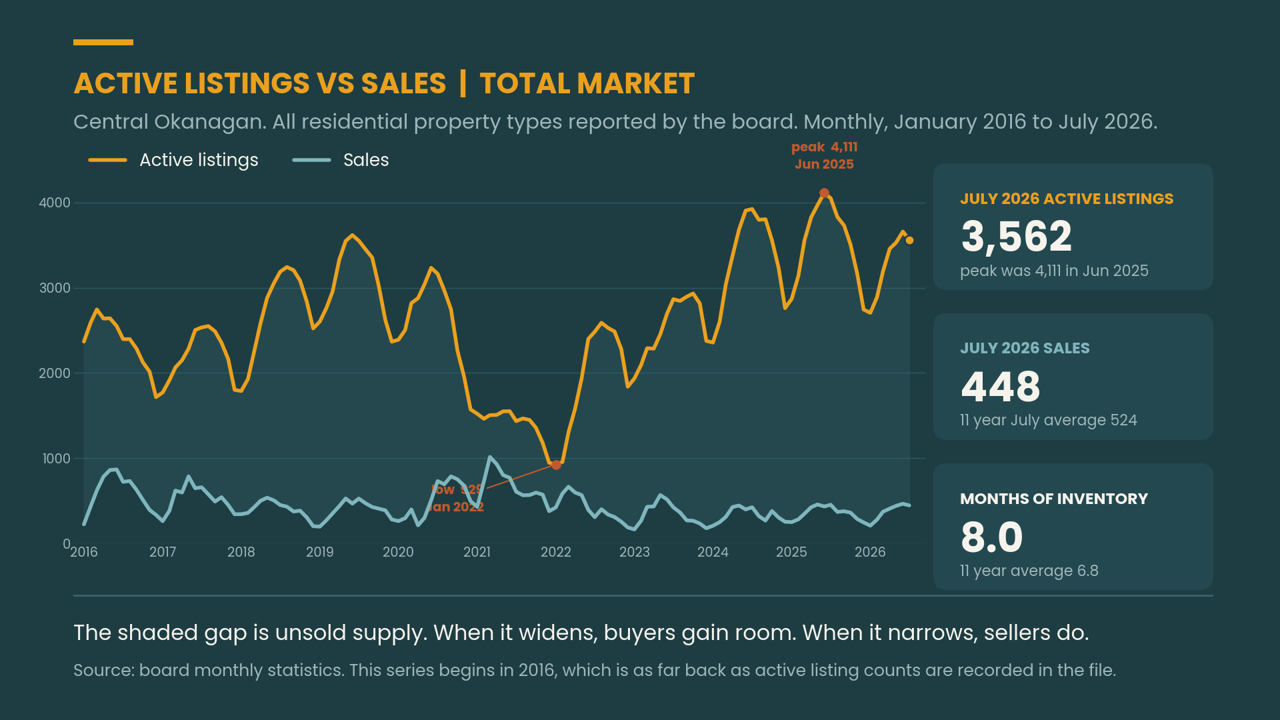
Today's market gives buyers more breathing room than the peak did — more inventory in many segments, longer days on market, and sellers more open to negotiating. That's a genuine advantage. But three things still matter most, in order:
- Buy the right product. Newer townhomes appeal — modern layouts, lower maintenance, better efficiency. But newer doesn't automatically mean better returns; sometimes the real value is lower monthly costs, not fast appreciation. (More on that in my breakdown of whether new construction is still worth the premium.)
- Buy at the right price. Overpaying at a peak is exactly what exposed recent buyers. A good property is a poor buy if the entry price is too high.
- Buy with the right timeline. A five-to-seven-year horizon gives you room to ride out a soft market. A one-to-two-year horizon — especially after a run-up — is where the risk lives.
A good purchase should work even if the market stays flat for a couple of years. For provincial context on where prices and rates are heading, the BC Real Estate Association's market forecasts are a solid reference.
What This Means If You're Selling
Your equity position depends heavily on when you bought. Bought before 2020? There's a good chance you're sitting on strong equity. Bought near the 2021–2022 peak? Your position is likely tighter — but that doesn't mean you can't sell. It means you need your real numbers first, not a guess.
Before listing, know your:
- Realistic sale price today
- Remaining mortgage balance
- Selling costs and mortgage penalty
- Next move and its cost
- Whether renting or holding longer beats selling now
Real equity isn't sale price minus purchase price. It's what you actually walk away with after the full move.
🏠 Want to know exactly where you stand? Get a free home valuation backed by 27 years of local data — I'll show you net proceeds, not just a headline price. Straight numbers, no pressure.
👉 See the latest homes for sale in Kelowna here
The Bottom Line
Kelowna townhomes have been a strong long-term asset, and the same-unit data proves it. Even among peak buyers, 270 of 355 unique units sold above purchase price before costs. The real risk was never the product or even the price — it was being forced to sell too soon, then watching costs eat a thin gain.
A strong market hides that risk; a softer market exposes it. You don't need to perfectly time the market. You need enough time to survive it.
Frequently Asked Questions
Are Kelowna townhomes still a good investment in 2026? Over the long term, yes — the typical same-unit resale was up about 34%, and long-held units multiplied several times over. The risk shows up on short timelines, especially for buyers who paid peak 2021–2022 prices and need to sell within a year or two.
Did most Kelowna peak buyers lose money? No. Of the unique peak-bought townhomes that resold, 270 of 355 sold for more than the owner paid before costs. But about 1 in 4 sold for less, and after selling costs more were closer to break-even than the headline price suggests.
What's the difference between "before costs" and "after costs"? Before costs compares resale price to purchase price. After costs subtracts realtor and legal fees, mortgage penalties, and moving expenses. A home can sell above purchase price and still leave the owner near break-even.
Should I wait to buy until prices drop? Timing the bottom is nearly impossible — you only see it after it's passed. The better question is whether you can hold for five-plus years if the market softens. If yes, entry timing matters far less.
I bought near the peak — should I sell now or hold? It depends on your net proceeds and your next move. If selling leaves you near break-even and you don't need to move, holding longer often improves the outcome. Run the real numbers first.
How do I find out how much equity I actually have? Send me your address and I'll prepare an equity report: likely sale price today, estimated selling costs, and real net proceeds — so you can decide whether selling, holding, or renting makes the most sense.
About the Author
Mark Coons PREC* is a REALTOR® with eXp Realty and founder of the Selling Okanagan Group. Mark tracks 27 years of Central Okanagan sales data and publishes regular market updates at sellingkelownarealestate.com. Based in Kelowna, Mark serves buyers, sellers, and investors across the Central Okanagan including Kelowna, West Kelowna, Lake Country, and Peachland.
Ready to Find Out Where You Stand?
The Okanagan is an equity market. If you own a Kelowna townhome and want to know your real position, send me your address and I'll build you a simple equity report — what you'd likely sell for today, your selling costs, and what you'd actually net.
📞 Call or text me directly at 778-946-6454 📧 [email protected] 🌐 sellingokanagangroup.com 📅 Book a call: https://calendly.com/sellingkelownarealestate
Mark Coons PREC*, BBA, CE Team Lead, Selling Okanagan Group | eXp Realty Kelowna
Footnotes
- Same-unit and peak-buyer analysis based on Kelowna townhome resales from internal sales data.
- "Made money before costs" refers to resale price compared with original purchase price, before selling expenses.
- Transaction costs may materially reduce or eliminate apparent resale gains.
- Holding-period analysis is historical and not a guarantee of future returns.
- Buyers and sellers should review property-specific data before making decisions.