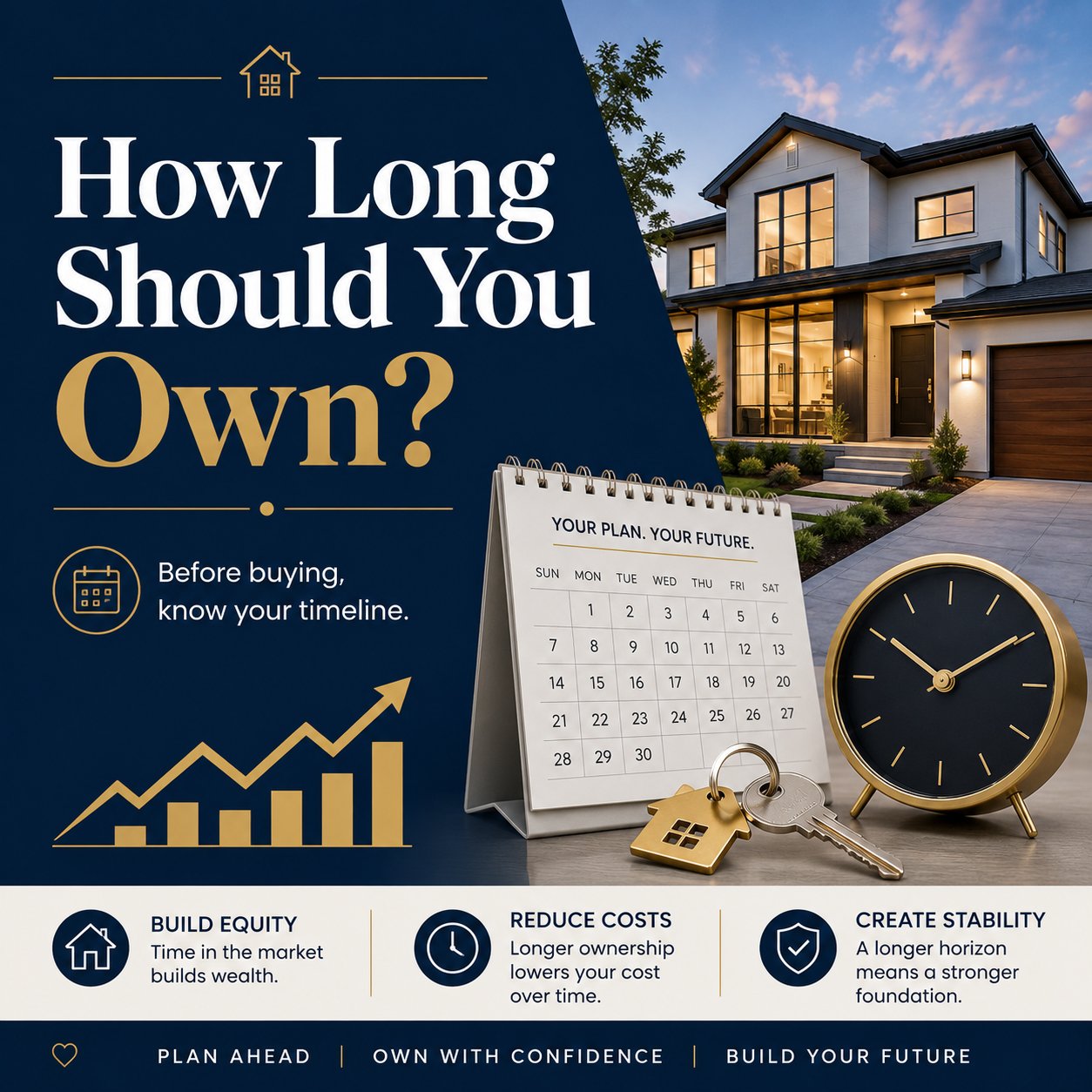
How Long Do You Need to Own a Home in Kelowna for Buying to Make Sense?
A common piece of real estate advice says you should plan to own a home for at least five years.
It sounds simple.
But it is not a rule.
Someone who buys a well-priced home, enjoys strong market growth and sells four years later may do very well.
Someone else could own for seven years, overpay, face major repairs and sell during a slow market.
The real question is not:
“How many years do I have to own?”
It is:
“How long do I need to own before the benefits of ownership have enough time to overcome the costs of buying and selling?”
That is why buying for two years is very different from buying for 10 years.
The shorter your ownership period, the more your result depends on what the market does immediately after you buy.
The longer you own, the more time you have to pay down your mortgage, move through different market conditions and spread your transaction costs across more years.
Why Your Holding Period Matters
When people compare their purchase price with their future selling price, they often miss many of the costs in between.
Buying a home can involve:
- Property transfer tax
- Legal or notary fees
- Inspection costs
- Appraisal fees
- Moving expenses
- Mortgage setup costs
- Immediate repairs or renovations
Selling can involve:
- Real estate commission
- GST on professional services
- Legal or notary fees
- Mortgage discharge costs
- Possible mortgage penalties
- Moving expenses
- Repairs or preparation before listing
This means your home may rise in value without you earning a true net profit.
A home bought for $700,000 and sold for $735,000 increased in value by $35,000.
But that does not mean the owner walked away $35,000 richer.
In B.C., the general property transfer tax on a $700,000 purchase would be $12,000 unless the buyer qualified for an exemption. The owner would then still need to account for legal costs, selling expenses and any money spent on the property.
The shorter the ownership period, the harder it can be for price growth and mortgage paydown to overcome those costs.
Owning for One to Three Years
Buying for one to three years carries the most short-term risk.
You may buy during a strong spring market and need to sell during a slower winter.
Interest rates may rise.
More competing homes may come onto the market.
A major employer could leave the area.
Your building could face an insurance issue or special assessment.
None of these things automatically make the home a bad long-term purchase.
But they can become a serious problem when you do not have time to wait.
Why a Two-Year Purchase Is So Different
Imagine purchasing a home for $700,000.
You pay $12,000 in general property transfer tax unless an exemption applies. You also pay legal fees, inspection costs, moving expenses and possibly mortgage-related fees.
Two years later, your life changes and you need to sell.
Even if you receive the same $700,000, you are not breaking even.
You still have selling costs.
Real estate commission is negotiated between the seller and the brokerage. B.C. does not have one mandatory or standard commission rate.
There could also be a mortgage penalty if you need to end or move your mortgage before the term expires.
To truly break even, the property usually needs to sell for enough to cover both the original buying costs and the new selling costs.
That is a much higher bar than simply selling for what you paid.
Short-Term Tax Rules May Also Matter
Selling quickly can create additional tax questions.
The B.C. home flipping tax applies to taxable profits from properties sold within 730 days. The rate is 20% during the first 365 days and gradually declines during the second year before reaching zero after 729 days. Exemptions may apply for certain life events and other circumstances.
The federal residential property flipping rule can also treat profits from a residential property held for fewer than 365 consecutive days as business income rather than a capital gain, unless an exception applies.
These rules do not mean you cannot sell.
Life changes.
People relocate, separate, have children, lose family members or face financial pressure.
But they are another reason a planned one- or two-year purchase should be considered carefully.
When Buying for One to Three Years Could Still Make Sense
A shorter purchase may still work when:
- You are buying well below market value
- You are adding meaningful value through renovations
- You could keep the home as a rental after moving
- Your downside risk is manageable
- The property is difficult to replace
- You understand that you may lose money if forced to sell
However, buying because you are tired of renting is not enough on its own.
When your future is uncertain, renting may be the smarter financial decision.
You are not just paying for a place to live.
You are buying flexibility.
Owning for Three to Five Years
Three to five years gives the owner more breathing room, but the outcome can still depend heavily on timing.
You have more time to:
- Pay down part of the mortgage
- Complete useful improvements
- Recover from a slower market
- Spread buying and selling costs over more years
- Avoid selling during a temporary slowdown
However, three to five years is not automatically long enough to guarantee a good result.
Suppose prices rise for the first two years, fall during the third year and stay flat during the fourth.
An owner who needs to sell in year four may still struggle to cover all costs.
Another owner who bought during a slow market may have a very different result over the same holding period.
This is why “five years” should not be treated as a promise.
It is better viewed as a planning checkpoint.
Questions to Ask Before Buying for Three to Five Years
Before purchasing, consider:
- Will the home still fit if my family changes?
- Could my work require me to move?
- Is there enough space for the next stage of my life?
- Would I be comfortable becoming a landlord instead of selling?
- Can I afford repairs without relying on the home rising in value?
- Am I buying a home buyers will still want in five years?
A three-to-five-year purchase should provide more than a temporary solution.
It should have enough flexibility to survive at least one unexpected life change.
Owning for Five to Ten Years
This is where the odds often begin to improve.
Five to 10 years gives an owner time to move through more than one market condition.
During that period, the market may experience:
- Rising prices
- Falling prices
- Higher interest rates
- Lower interest rates
- Tight inventory
- A wave of new listings
- Strong buyer demand
- Slower sales
The owner is less dependent on what happens during one specific year.
That does not guarantee a profit.
Location, property condition, purchase price and local demand still matter.
But time gives the decision more room to work.
What Our Okanagan Apartment Research Found
We reviewed 11,827 apartment resales across the Central Okanagan, covering approximately 27 years.
The shorter holding periods produced the least predictable results.
As the holding period increased, owners were more likely to resell for more than their recorded purchase price.
By roughly the 10-year mark, owners had resold for more than they originally paid about 99% of the time.
That does not mean they earned a 99% investment return.
It also does not account for mortgage interest, strata fees, property taxes, inflation, repairs, commissions or other ownership expenses.
What it shows is that longer-term owners became far less dependent on buying during the perfect month or year.
Why Five to Ten Years Can Be More Forgiving
A longer holding period can give you time to:
- Recover from buying near a market peak
- Reduce your mortgage balance
- Complete improvements gradually
- Wait out a slow market
- Build savings for your next purchase
- Choose when to sell instead of being forced to sell
The ability to choose your selling date is valuable.
A homeowner who must sell within 30 days has less control than one who can wait six months or another year.
Time creates options.
Owning for 10 Years or Longer
Ten years is not a magic number.
But it changes the nature of the decision.
Over a decade, a home becomes less of a short-term trade and more of a long-term housing plan.
The owner has had more time to:
- Pay down mortgage principal
- Spread transaction costs across many years
- Experience multiple market cycles
- Make improvements
- Build roots in a community
- Benefit from the stability of owning their home
Our apartment research found that owners who reached approximately 10 years were extremely likely to have sold for more than their original recorded purchase price.
That does not mean every owner became wealthy.
A property could rise in value while producing a modest return after inflation and expenses.
An owner could also spend heavily on renovations, strata fees, repairs or interest.
However, the longer holding period reduced the chance that one poorly timed market cycle controlled the entire result.
Buying Near a Peak Does Not Automatically Create a Loss
People often assume that anyone who buys near a market peak is making a mistake.
That is too simple.
Buying near a peak can hurt someone who needs to sell shortly afterward.
It can matter much less to someone who owns for 10, 15 or 20 years.
The biggest problem is often not buying before prices decline.
It is being forced to sell before you have time to recover.
That is why life planning may matter more than predicting the market.
How Property Transfer Tax Affects the Result
Property transfer tax is generally paid when a buyer acquires a property in B.C., unless an exemption applies.
The general rates are:
- 1% on the first $200,000
- 2% on the portion from $200,000 to $2,000,000
- 3% on the portion above $2,000,000
- A further 2% may apply to the residential portion above $3,000,000
Using the general rates:
Purchase price | General property transfer tax |
|---|---|
$500,000 | $8,000 |
$600,000 | $10,000 |
$700,000 | $12,000 |
$800,000 | $14,000 |
$1,000,000 | $18,000 |
These amounts may be reduced or eliminated when a buyer qualifies for an exemption.
However, when the tax applies, it is an immediate cost that does not increase the value of the home.
An $800,000 buyer starts with a $14,000 transaction cost before considering legal fees, inspections, moving or future selling expenses.
Over two years, that is a significant cost.
Over 15 years, it becomes a much smaller annual part of the ownership decision.
How Real Estate Commission Affects the Result
Real estate commission is normally paid when the property sells.
There is no single government-set commission rate in B.C. The amount is negotiated between the seller, the real estate professional and the brokerage.
Because the commission is connected to the selling price, it can be one of the largest transaction expenses.
This is especially important for short-term owners.
A small increase in value may look positive until the cost of selling is included.
For example, an owner might purchase for $700,000 and sell for $735,000.
The public sale history shows a $35,000 increase.
But the owner must still deduct:
- The original property transfer tax
- Buying and selling legal costs
- The negotiated selling commission
- GST on professional fees
- Mortgage penalties, when applicable
- Repairs, preparation and moving costs
A higher sale price does not always equal a net profit.
How Legal and Notary Costs Affect the Result
Legal or notary costs are usually paid when buying and again when selling.
They may include work related to:
- Reviewing and preparing documents
- Title searches
- Registering the transfer
- Registering a mortgage
- Adjusting property taxes and utilities
- Paying out and discharging an existing mortgage
- Handling sale proceeds
- Other searches and disbursements
Costs vary based on the provider and complexity of the transaction.
A simple purchase with no mortgage may cost less than a transaction involving multiple mortgages, title issues, a strata property or unusual conditions.
Legal costs alone are unlikely to determine whether buying makes sense.
But when added to property transfer tax, commission, inspections and moving costs, they become part of the larger break-even calculation.
Do You Need Your Home to Increase in Value?
Not every benefit of homeownership appears in the sale price.
A home also provides:
- A place to live
- Housing stability
- Greater control over the space
- Protection from certain rental disruptions
- The ability to renovate
- Forced mortgage principal payments
- A possible long-term asset
Renting provides benefits too:
- Greater flexibility
- Fewer repair responsibilities
- Lower transaction costs
- Easier relocation
- Less exposure to property-specific risks
This is why a home should not be judged only as an investment.
You still need somewhere to live.
The better comparison is the complete cost and benefit of owning versus the complete cost and benefit of renting during the same period.
So, How Long Should You Plan to Own?
There is no single answer for every buyer.
But the shorter your planned ownership period, the stronger the purchase needs to be.
One to three years
Buying carries substantial risk because transaction costs and short-term market changes can control the outcome.
Three to five years
The decision has more room to work, but the result can still depend heavily on the market when you sell.
Five to 10 years
You have more time to reduce your mortgage, recover from a slowdown and spread transaction costs across several years.
Ten years or longer
Short-term market timing becomes less important, although property quality, maintenance and purchase price still matter.
For many buyers, planning to own for at least five to 10 years creates a healthier margin for error.
That is not a guarantee.
It is a planning range.
The Better Question to Ask Before Buying
Instead of asking:
“Will this home go up in value?”
Ask:
“Could I comfortably keep this home if the market did not cooperate for several years?”
Would it still fit your family?
Could you afford the payments?
Could you handle repairs?
Would the location continue to work?
Could you rent it out if your plans changed?
Could you wait to sell?
The best protection against a slow market is often not predicting it.
It is buying a home you are not forced to leave.
Don’t Time the Market—Time Your Life
The difference between owning for two years and owning for 10 years is not simply eight more years of price growth.
It is eight more years to:
- Reduce your mortgage
- Spread out transaction costs
- Move through different markets
- Adapt the property to your needs
- Choose when to sell
- Recover when your timing is imperfect
Buying makes more sense when the property fits both your finances and the life you are building.
You do not need to predict the perfect year.
You need enough time for the decision to work.
Don’t time the market. Time your life.
Are You Deciding Whether to Buy or Keep Renting in Kelowna?
To discuss what fits your current stage of life, reply to our weekly email or contact us directly.
Mark & Maddie Coons
Selling Okanagan Group | eXp Realty Kelowna
Office: 778-946-6454
Cell: 250-801-0361
[email protected]
Important Note
This article provides general information, not tax, legal, mortgage or financial advice. Tax rules and available exemptions depend on the owner, property and reason for selling. Buyers and sellers should confirm their specific situation with an accountant, lawyer, notary and mortgage professional.