Is New Construction Making Older Kelowna Townhomes Harder to Sell?
New townhouse and infill construction is giving some Kelowna buyers more choices. That can make selling an existing townhouse more challenging, especially when a similar new home is available nearby. But the data doesn't show that every resale townhouse is losing value because of new development.
In fact, the construction numbers tell a more complicated story.
Kelowna still has thousands of homes being built, but new housing starts are down sharply in 2026.
At the same time, resale townhomes are taking longer to sell, and many sellers have had to adjust their asking prices.
So how much of that is connected to new construction?
That's what I wanted to look at.
Kelowna is building homes, but fewer new projects are starting
One of the more interesting housing statistics this year comes from the Canada Mortgage and Housing Corporation (CMHC).
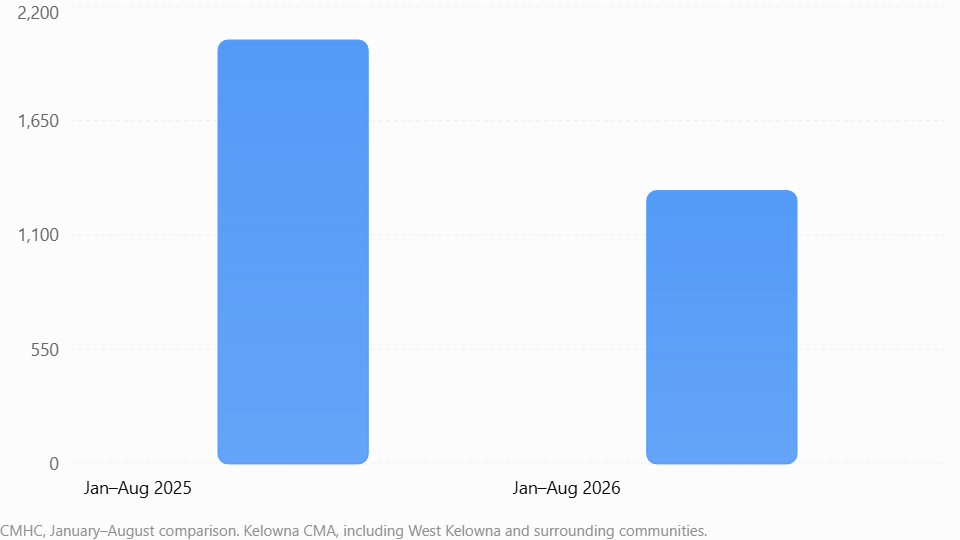
From January through August 2026, the Kelowna census metropolitan area recorded 1,313 housing starts.
Over the same period in 2025, there were 2,037.
That's a decline of approximately 36%.
But at the end of August 2026, there were still 4,034 homes under construction.
Kelowna-area construction | Reported figure |
|---|---|
Housing starts, Jan–Aug 2025 | 2,037 |
Housing starts, Jan–Aug 2026 | 1,313 |
Change | −35.5% |
Homes under construction, August 2026 | 4,034 |
Those numbers aren't contradictory.
A housing start measures when construction begins. Homes under construction include projects that started months or even years earlier.
And the homes being built today will not necessarily reach the market at the same time.
This creates two different supply questions.
How much competition will existing sellers face as current projects finish?
And:
What happens to future competition if developers continue starting fewer projects?
Both matter. But they operate on different timelines.
It's also important to note that these numbers cover the broader Kelowna metropolitan area, not just the City of Kelowna.
Not all new housing competes with your townhouse
This is a distinction I think gets overlooked.
People hear that thousands of new homes are under construction and assume all of them compete with existing resale properties.
They don't.
An apartment building with small rental units is not necessarily competing directly with a three-bedroom townhouse with a double garage.
A downtown condominium is a different product from a family-sized townhome in Glenmore.
And a new fourplex with compact layouts may appeal to different buyers than an older, larger townhouse with outdoor space.
Some of those buyers overlap. Others don't.
The more similar a new property is to an existing resale home, the more relevant that additional supply becomes.
For a resale seller, I would ask:
If a buyer toured your townhouse this weekend, what new homes would they also be considering?
That's a much more useful question than simply counting every unit being built across Kelowna.
There are completed new homes still waiting for buyers
Another part of CMHC's construction data deserves attention.
In August 2026, published CMHC inventory figures showed 728 completed but unabsorbed homes in the Kelowna metropolitan area.
Of those, 126 were row homes, the category that includes townhouses.
Another 497 were apartments.
These are completed new homes that had not yet been absorbed under CMHC's reporting definitions.
They are not all available MLS listings, and they should not be added directly to resale inventory figures. Some may be marketed through different channels.
But they tell us that not every newly completed home immediately finds a buyer.
That matters because an existing townhouse seller may be competing against a builder that has already finished construction.
A builder with several units to sell might use incentives, flexible terms or price changes to attract buyers.
A private seller typically has only one property to sell and a different financial situation.
Neither side is guaranteed to have more flexibility.
But the competing options deserve a closer look.
What is actually happening in the resale townhouse market?
This is where the MLS resale research becomes useful.
In September 2026, the Central Okanagan recorded 46 townhouse sales.
There were roughly 10 months of townhouse inventory, and the median selling time reached 72 days.
Those numbers suggest buyers had a substantial amount of choice relative to the pace of sales.
I also looked at 631 townhouse sales from August 2025 through July 2026.
Of those, 187 sold more than 5% below their original asking price.
That's 29.6%.
In September 2026, nearly half of the townhomes sold finished more than 5% below their original asking price.
That's a noticeable difference.
But it does not establish that new construction caused those price adjustments.
Mortgage costs, buyer confidence, asking prices, property condition and competition from other existing homes all affect sales.
The better interpretation is that resale sellers are operating in a market where buyers have more options and many properties need time or price adjustments to attract offers.
I explain the listing-price evidence in more detail in Townhome Buyers Have More Leverage.
Could a new fourplex affect the value of an older townhouse?
It could. But the effect isn't automatic.
Kelowna has been changing its approach to infill housing.
The City of Kelowna's Infill Fast-Track program includes pre-approved designs with two to six dwelling units per property, and more than 1,800 MF1-zoned lots in the Core Area are eligible for the program.
That creates the opportunity for more housing in established neighborhoods.
But eligibility is not the same as a completed home.
A property being zoned for multiple units doesn't mean somebody will build them immediately.
Developers still need projects that work financially.
And a newly built fourplex doesn't necessarily reduce the value of an older property next door.
There are several possible outcomes.
A new home with a similar size, layout and price could attract buyers who would otherwise have considered an existing townhouse.
A new unit with a much higher price might make the resale option look better by comparison.
And additional neighborhood housing could support amenities, services and demand over time.
The effect depends on the actual competing homes, their pricing and what buyers value.
More homes nearby is not enough evidence, by itself, to conclude that an existing property's value has fallen.
Why the price difference between new and resale homes matters
Imagine two townhouses that appeal to the same buyer.
One is five years old. It has three bedrooms, a functional garage and an established strata.
The other is newly built, with similar square footage and a modern interior.
If the new home costs $100,000 more, the resale property might offer strong value, even if the buyer needs to make some updates.
If the two homes are similarly priced, the buyer will likely compare condition, layout, warranty coverage, storage, outdoor space, strata arrangements and expected maintenance.
The new home may have an advantage in some areas.
The existing home may have advantages in others.
And if a builder adjusts its price or offers incentives, that comparison can change quickly.
This is why I would not value a resale townhouse using only older resale sales.
I would also want to know what competing new construction is offering.
The seller mistake I would watch for
Suppose you bought a townhouse in 2021 or 2022.
You've maintained it well and made a few upgrades.
Now you're thinking about selling.
You might look at a newly built townhouse advertised for $850,000 and assume yours should be worth something close to that.
But an asking price isn't proof of market value.
That new home could have been sitting for months.
The builder might have several unsold units.
Or its layout and features may be substantially different from yours.
The reverse is also true.
An older sale isn't automatically a good comparable if new construction has changed what buyers can choose from today.
I would compare the full competitive set:
- Recent resale sales of similar properties.
- Current resale listings and their pricing histories.
- New homes that appeal to the same buyer.
- Builder incentives and available inventory.
- Layout, parking, strata costs and property condition.
Then I would look at how long comparable properties have been on the market.
In a separate review of 2,013 Central Okanagan detached-home sales, I found that longer listing periods were associated with larger discounts from asking price.
That study was about detached homes, not townhouses, so I wouldn't apply the exact percentages to a townhouse.
But the broader lesson still matters: time on market can tell you something about how buyers are responding to a listing.
You can read that research in When Negotiating Room Grows.
What does this mean if you're buying a townhouse?
I would compare new and resale options rather than assuming one is the better deal.
A resale townhouse might offer more space, mature landscaping, established common areas or a better location for the price.
A new townhouse might offer modern construction, warranty protection or lower immediate maintenance needs.
But neither advantage should be assumed.
Review the strata documents where applicable, warranty coverage, planned costs and the actual purchase terms.
And if a property has been sitting on the market, look at its full pricing history.
Sometimes the largest adjustment happened before the buyer ever wrote an offer.
What happens when fewer new homes start construction?
Here's the other side of this story.
We know housing starts in the Kelowna area are down sharply in 2026.
That could mean fewer new homes become available in future years.
But it doesn't tell us exactly how many townhouses will be available, or when.
Most of the reported new starts are in housing categories other than single-detached, and those categories include apartments and other types of multi-unit housing.
We would need a more detailed townhouse-specific construction series before predicting the future resale townhouse market.
And even if future supply slows, prices aren't guaranteed to increase.
Demand matters too.
For now, I think the distinction is important.
Existing homeowners may face competition from homes already under construction, even while fewer new projects are entering the pipeline.
Today's inventory and tomorrow's supply are not the same thing.
So, is new construction hurting Kelowna resale townhomes?
In some situations, new construction can make an existing townhouse harder to sell by giving buyers an appealing alternative.
But I wouldn't say that all new infill housing is pushing down resale values.
The evidence supports something narrower and more useful.
We have a substantial amount of housing still under construction.
We have completed new homes that haven't yet been absorbed.
We have a resale townhouse market showing slower sales and meaningful asking-price adjustments.
And we have fewer new housing starts than a year ago.
Those conditions can exist together.
What we do not have from these figures alone is proof that one caused the other.
If I were selling a townhouse today, I would want to understand the actual competing properties rather than rely on a headline about Kelowna construction.
And if I were buying, I'd compare the value of new and resale homes carefully. The best opportunity may not be the newest property or the one with the largest advertised price reduction.
If you own a townhouse in Kelowna or West Kelowna and are wondering how nearby new construction affects its value, send me the address. I'll compare your property against current resale listings, recent sales and the new homes competing for the same buyers.
Mark Coons, BBA, CE
Mark Coons Personal Real Estate Corporation
REALTOR® | eXp Realty Kelowna
Team Lead, Selling Okanagan Group
778-946-6454
[email protected]
Sources and methodology
CMHC: Housing starts and construction data for August 2026. Kelowna census metropolitan area housing starts and under-construction inventory. January–August 2025 and 2026 compared using the same reporting geography.
CMHC housing inventory: August 2026 completed and unabsorbed new-home figures, as reported in a September 2026 Central Okanagan housing construction analysis. Verify the detailed inventory table against CMHC's downloadable data before final publication.
City of Kelowna: Infill Fast-Track. Eligibility and design parameters describe development opportunities, not completed homes.
Selling Okanagan Group MLS research: Townhome Buyers Have More Leverage and When Negotiating Room Grows. These studies describe resale listing and sales behavior. They do not isolate the effect of new housing construction.
Limitations: Construction data covers the Kelowna CMA, while the referenced resale study covers Central Okanagan MLS activity. Their geographic coverage and housing definitions are not identical. The article identifies potential competition between new and existing homes; it does not establish a causal estimate of construction's effect on resale prices.