Are Kelowna Detached Homes and Townhouses Moving Further Apart in Price?
The price gap between detached homes and townhouses in the Central Okanagan is widening, and that could matter for homeowners thinking about downsizing.
In September 2026, the benchmark price of a detached home was $1,057,200, compared with $696,600 for a townhouse.
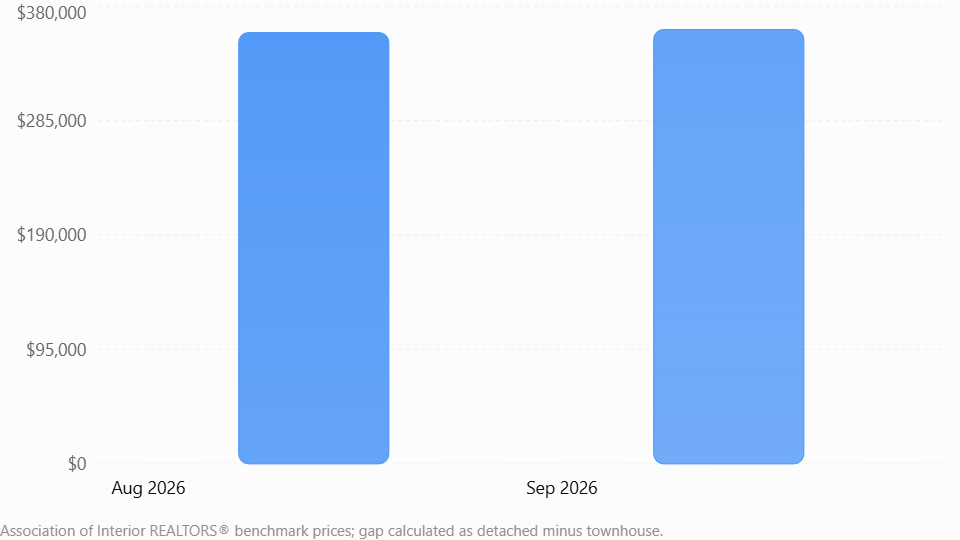
That's a difference of $360,600.
A month earlier, the difference was $358,100.
The gap grew by $2,500 in September, and the year-over-year market data points in the same direction: detached benchmarks increased while townhouse benchmarks declined.
But does a bigger gap mean it's a better time to downsize?
Not necessarily. Here's what the numbers actually tell us.
The detached-versus-townhouse price gap in Kelowna
I often hear from homeowners who would like to move into something smaller but are hesitant to sell.
Maybe they remember what their home could have sold for in 2022.
Or they're wondering whether waiting another year might leave them with more money.
Those are reasonable concerns.
But when you're selling one property and buying another, I would pay close attention to the difference between the two prices.
Here's what happened between August and September 2026.
Central Okanagan benchmark | August 2026 | September 2026 |
|---|---|---|
Detached home | $1,056,700 | $1,057,200 |
Townhouse | $698,600 | $696,600 |
Price difference | $358,100 | $360,600 |
The detached benchmark increased by $500.
The townhouse benchmark decreased by $2,000.
That widened the gap by $2,500 in one month.
It's not a dramatic change on its own. A single month shouldn't be used to predict where prices are going next.
But there is something more interesting happening when we look beyond September.
Detached and townhouse prices are moving in different directions
According to the Association of Interior REALTORS®, Central Okanagan detached-home benchmark prices were higher in September 2026 than a year earlier.
Townhouse benchmark prices were 5.5% lower year over year.
That's an important distinction.
When someone tells me that Kelowna prices are up or down, my first question is usually, "Which type of property?"
The detached market is not behaving exactly like the townhouse market.
And that creates different circumstances depending on whether you're buying, selling or doing both.
If you own a detached home and want to purchase a townhouse, the relative movement of those two markets may be working in your favour.
If you own a townhouse and want to move into a detached home, it may be doing the opposite.
The difference matters more than a general headline about Kelowna home prices.
Why this matters if you're thinking about downsizing
Imagine you own a four-bedroom home in Kelowna.
The kids have moved out. You're using only part of the house, and maintaining the yard is becoming less appealing.
You've been looking at townhouses, but you keep putting off the move because you want your current home to recover more of its previous value.
I would want to compare two things.
First, what could you actually sell your home for today?
Second, what would the townhouse you want cost?
The September benchmarks suggest that the price difference between a typical detached home and a typical townhouse is larger than it was a month earlier.
That could be encouraging.
But the benchmarks are not interchangeable with actual property values.
A newer, larger townhouse in the Lower Mission might be priced considerably above the Central Okanagan townhouse benchmark.
An older detached property needing substantial work might sell below the detached benchmark.
And not every townhouse offers what downsizers want. Main-floor living, minimal stairs, a double garage and storage can make certain properties much more desirable.
The benchmark gap tells us where to investigate. It does not tell us how much equity you will personally release.
Are townhouses giving buyers more negotiating room?
The September market data provides another reason to look closely at townhouses.
Central Okanagan townhouse inventory stood at 445 properties, compared with 1,218 detached homes.
Townhouses also took longer to sell on average:
September 2026 | Detached | Townhouse |
|---|---|---|
Homes sold | 149 | 46 |
Active inventory | 1,218 | 445 |
Average days to sell | 67 | 82 |
Townhouses were taking about 15 days longer to sell on average.
At September's pace, those inventory and sales figures equate to roughly eight months of detached supply and nearly ten months of townhouse supply.
That's worth paying attention to.
More supply relative to the number of buyers can create negotiating opportunities.
But I wouldn't assume every townhouse seller is desperate to sell.
Some homes are appropriately priced from the beginning. Others have already reduced their prices. And desirable properties can attract strong interest even in a slower market.
I would compare recent sales, days on market, pricing histories and competing properties before deciding what to offer.
What if you're moving from a townhouse into a detached home?
Here's the other side of the story.
Suppose you own a townhouse and want to buy a detached home because your family needs more space.
A widening price gap could make that move more expensive.
For example, using the September benchmarks:
- Detached benchmark: $1,057,200
- Townhouse benchmark: $696,600
- Difference: $360,600
That's the difference between two benchmark prices, not the mortgage you would need.
Your actual financing depends on your existing debt, usable equity, transaction costs and the purchase price you negotiate.
But if detached values continue to hold up better than townhouse values, someone moving into a detached home could face a larger gap.
That's why market conditions can be favorable to one type of move and less favorable to another at the same time.
I explore this further in The Cost of Moving Up.
Does a $360,600 gap mean you'll have that much cash left over?
No.
This is one of the most important distinctions.
Suppose your detached home sells for $1.1 million and you buy a townhouse for $750,000.
The price difference is $350,000.
But that isn't automatically the amount you'll keep.
You still need to account for any remaining mortgage, selling expenses, property transfer tax, legal fees, moving costs and any improvements to the replacement property.
You should also compare the ongoing ownership costs.
A townhouse might have lower exterior maintenance costs, but there could be strata fees and future special levies.
A detached home may have higher utilities and yard-care costs, but moving does not necessarily eliminate every one of those expenses.
Downsizing should be assessed using both your remaining equity and the cost of living in the next property.
For a more detailed breakdown, see Should You Wait to Downsize?.
Could the gap narrow again?
Absolutely.
The market does not move in a straight line.
Townhouses could recover faster than detached homes.
Detached prices could fall while townhouses remain stable.
Or both could rise or fall at different rates.
There are also reasons to be cautious when interpreting regional benchmarks.
The Central Okanagan includes different communities, price ranges and property styles.
A townhouse in West Kelowna may not behave like one in North Glenmore.
A walkout rancher on Dilworth may appeal to a different buyer than a large two-storey home in the Upper Mission.
And new townhouse and infill construction could affect some resale properties more than others, depending on how much competing supply actually comes to market.
We would need local comparable sales and construction data to measure those effects.
The September figures show that the gap has widened. They don't tell us how long that will continue.
The comparison I would make before selling
For a homeowner considering downsizing, I would start with three questions.
1. What could your current home sell for?
Not what it was worth in 2022 or what a neighboring property is asking. I would look at recent comparable sales and current competition.
2. What would the replacement actually cost?
We would identify homes that fit your needs, including layout, stairs, parking, location and monthly ownership costs.
3. How much money would remain after the move?
That means calculating your mortgage payout, transaction expenses, available equity and any changes to your monthly spending.
Then I would compare moving today with waiting.
If your preferred replacement becomes more expensive while you wait, a higher future sale price might not help as much as you expect.
But if your current home performs better than the type of property you want to buy, waiting could improve your position.
Both outcomes deserve consideration.
So, are detached homes and townhouses moving further apart in Kelowna?
Yes. September 2026 data shows a $360,600 benchmark price difference in the Central Okanagan, and the gap widened from August.
The broader year-over-year figures also show detached and townhouse prices moving in opposite directions.
That is especially relevant for homeowners selling detached properties to buy townhouses.
It doesn't mean everyone should rush to sell.
And it doesn't mean townhouse buyers are guaranteed a discount.
It means the relationship between what you own and what you want to buy deserves as much attention as the sale price of your current home.
If you're considering downsizing in Kelowna or West Kelowna, I'd be happy to compare recent sales for your property with the townhouses you're considering.
That will tell us far more than the regional benchmark alone.
Mark Coons, BBA, CE
Mark Coons Personal Real Estate Corporation
REALTOR® | eXp Realty Kelowna
Team Lead, Selling Okanagan Group
778-946-6454
[email protected]
Sources and methodology
Association of Interior REALTORS® (AIR)
September 2026 Central Okanagan benchmark prices, sales, inventory and average selling times. August 2026 benchmark prices used for the month-over-month comparison.
Primary sources:
Methodology: The price gap is calculated by subtracting the townhouse MLS® Home Price Index benchmark from the detached-home benchmark for the same month and region. August's gap was $358,100; September's was $360,600. The resulting increase was $2,500.
Months of inventory are approximate calculations using reported active inventory divided by monthly sales.
Benchmarks represent typical properties within each category. They are not the average selling prices, individual property valuations or estimates of proceeds after transaction costs. No causal conclusion about new construction or seller negotiating behavior is drawn from these figures.