Should You Buy a Home in Kelowna Now or Wait Until Spring?
Fall 2026 vs. Spring 2027: The real trade-off for Kelowna homebuyers
Short answer: Buying a home in Kelowna this fall could make sense if you find the right property at a price supported by recent sales. Slower demand can create room to negotiate. Waiting until spring 2027 may give you more homes to choose from, but it could also mean competing with more buyers. The better decision depends on your budget, the type of home you want, your financing and what waiting actually costs you.
I think buyers sometimes spend too much time trying to predict where the market is going and not enough time looking at what they can actually buy.
The question I keep coming back to is this:
Would you rather buy a home when fewer people are shopping, or wait until there are more homes available?
Both have advantages.
And depending on what you are looking for, either could be the right decision.
What the September 2026 Kelowna market tells us
The latest Central Okanagan numbers give buyers something worth considering.
CENTRAL OKANAGAN | SEPTEMBER 2026
320
Residential sales
2,927
Active listings
778
New listings
Central Okanagan figures, including Kelowna and surrounding communities. Source: September 2026 Association of Interior REALTORS® data.
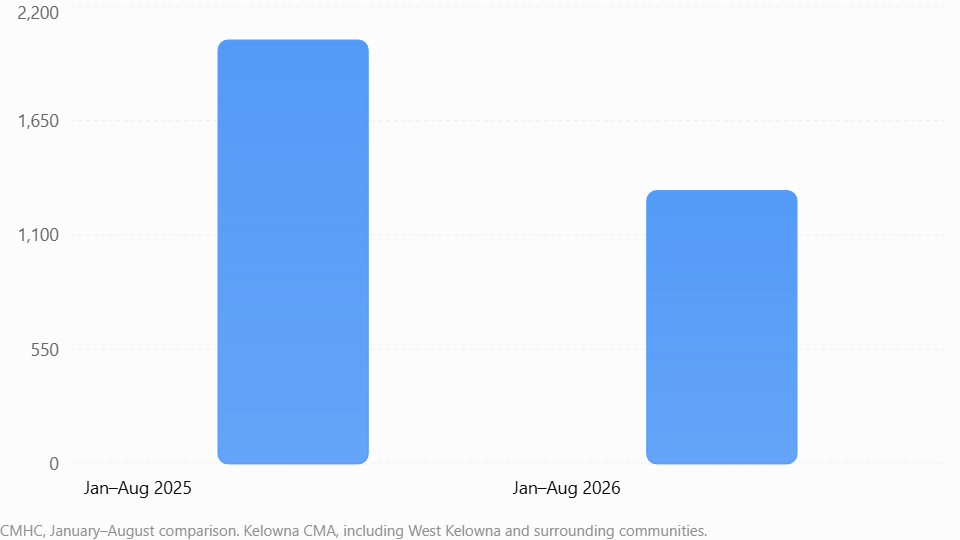
There is a meaningful amount of housing inventory available compared with the number of monthly sales.
But I would be careful about calling every one of those listings a buying opportunity.
Some are overpriced. Some have condition issues. Some have been listed, withdrawn and relisted. Others are perfectly good properties that simply haven't connected with the right buyer.
The difference matters.
A home sitting for 90 days does not automatically mean the seller will accept a low offer. And a home listed yesterday does not automatically mean you will have to compete.
I would want to know how that particular property compares with recent sales, not just how many homes are on the market.
1. Fall may offer better negotiating conditions
This is probably the strongest argument for buying before winter.
As we move through fall, some sellers have already been on the market for several months.
They may have had showings, open houses, price adjustments and plenty of feedback.
And they still haven't sold.
For some, their plans have not changed. They still want to move.
That can create an interesting situation for a buyer who is financially prepared.
You may be able to negotiate on more than the price:
A longer or shorter completion date.
Repairs identified during an inspection.
Included appliances or other agreed items.
Conditions that allow time for proper due diligence.
None of those concessions is guaranteed. The seller's circumstances and the strength of your offer still matter.
But when a seller has fewer competing offers, you may have more room to structure a purchase that works for you.
The important distinction is that a good negotiation is not necessarily a good purchase.
Getting $40,000 off an overpriced home is not the same as buying $40,000 below fair market value.
I would want the comparable sales to support the purchase before calling it a good deal.
2. Spring usually brings more selection, but not necessarily better value
This is where the argument for waiting gets stronger.
If you are looking for something specific, spring may be worth waiting for.
Maybe you want a walkout rancher in Dilworth, a certain lot size in the Lower Mission, or a home with a pool and lake view.
You could have a healthy number of active listings across Kelowna and still find very little that meets your needs.
Spring often brings more properties onto the market as owners prepare for the busier selling season.
That means more floor plans, locations, conditions and features to compare.
But spring can also bring more buyers.
The number I would want to watch is not simply how many new listings arrive. It is how quickly buyers absorb those listings.
If new listings rise 20% but sales rise 40%, for example, buyers may actually face more competition despite having more homes to look at.
That is a hypothetical example, not a forecast.
More listings do not automatically mean more negotiating power.
3. What if Kelowna home prices fall between now and spring?
They could.
And that is a reasonable reason to consider waiting.
But I would be cautious about assuming a lower overall market price means the home you want will be cheaper.
The Kelowna housing market is not one market.
Detached homes, townhomes and apartments can behave differently. So can homes at $650,000 compared with homes above $1.5 million.
If a larger share of lower-priced properties sells in one month, the average sale price may fall even if comparable properties have not lost value.
That is why I prefer looking at recent comparable sales, benchmark trends and property-specific competition together.
Let's say you are considering a $900,000 home.
A 3% price decline would represent $27,000.
That is meaningful.
But what if the property you want is already priced 3% below comparable sales? Or what if waiting means paying more for a similar property because the selection changes?
The market average cannot answer those questions.
And neither can I without looking at the actual homes.
4. Interest rates could change the calculation
One of the biggest reasons buyers consider waiting is the hope that mortgage rates will fall.
As of September 2, 2026, the Bank of Canada held its overnight policy rate at 2.25%. Its next scheduled announcement is October 28.
Bank of Canada's September rate announcement
But the Bank of Canada's policy rate is not the same as your mortgage rate.
Variable mortgages are more directly affected by changes in prime rates, while fixed mortgages are influenced heavily by bond yields and lender pricing.
Waiting for the Bank of Canada to cut rates does not guarantee that the fixed mortgage you want will become cheaper.
Here is an illustration.
Example: $900,000 purchase with 20% down
Mortgage of $720,000, 25-year amortization, illustrative rates only.
Mortgage rate | Monthly payment |
4.00% | $3,800 |
4.50% | $3,985 |
5.00% | $4,188 |
Approximate principal-and-interest payments using Canadian semi-annual mortgage compounding. Excludes property taxes, insurance, maintenance and other ownership costs.
A half-point rate difference can change your payment by roughly $185 to $200 per month on this mortgage.
That matters.
But the purchase price matters too.
A lower mortgage rate on a more expensive home may not save as much as you expect.
I would compare the entire purchase, not just the advertised mortgage rate.
5. The cost of waiting is not always obvious
Consider two buyers looking at a $900,000 home.
One buys this fall.
The other waits six months.
The buyer who waits may benefit if prices fall, rates improve or more suitable homes become available.
But there are costs and risks on both sides.
Illustrative six-month comparison
Assumes the same type and quality of home, a 20% down payment, and a 4.5% mortgage rate in both scenarios.
Scenario | Purchase price | Difference |
Buy this fall | $900,000 | Baseline |
Wait, prices fall 3% | $873,000 | Save $27,000 |
Wait, prices rise 3% | $927,000 | Pay $27,000 more |
Hypothetical price scenarios, not predictions. Financing, transaction costs, carrying costs and property differences can change the result.
Now consider someone currently paying $2,800 per month in rent.
Six more months means $16,800 in rent.
That doesn't automatically mean buying is better. A homeowner also pays mortgage interest, property taxes, insurance, maintenance and other expenses.
Some of the mortgage payment builds equity, while some is an expense.
Rent also provides flexibility, which can be valuable.
For a fair comparison, I would include the rent paid while waiting, the costs avoided by not owning, the interest earned on the down payment, and the difference in future purchase costs.
There is also another cost that is harder to put into a spreadsheet.
What if the right property sells while you are waiting?
Or the opposite: what if you buy a home that is only an okay fit, and a much better one comes onto the market three months later?
Both risks are real.
6. When waiting until spring is actually the better decision
I don't think every buyer should be trying to negotiate a purchase this fall.
There are situations where waiting makes more sense.
Your finances are not quite ready. If another six months gives you a stronger down payment, more stable income or a better emergency fund, that may be worth more than any seasonal negotiating advantage.
You haven't found the right property. Buying something that doesn't meet your needs just because the seller is willing to negotiate can be an expensive mistake.
Your property requirements are narrow. If you need a particular layout, lot size, neighbourhood or feature, a larger spring selection may be valuable.
You are relocating and need to understand the area. Spending more time in Kelowna before committing can help you avoid a location decision you later regret.
You expect to move again soon. Buying and selling costs can be significant. If you may need to sell within a short period, renting or waiting may reduce your exposure.
These are not reasons to stop looking.
They are reasons to be selective.
7. When buying this fall could make more sense
On the other hand, I would seriously consider buying before spring if your financing is ready, you know the area and the right property is available.
Especially if the property has been on the market for a while and comparable sales support a reasonable purchase price.
I would look at its original asking price, full listing history, competing properties, recent sold prices and how many similar homes have actually sold.
If the numbers support the purchase and the home works for your long-term plans, waiting solely because spring is coming may not improve your position.
That does not mean every fall listing is a deal.
It means you have enough information to make a decision without needing to predict the entire market.
8. My approach: Buy when the property and the numbers make sense
Here is how I would think about the next six months.
Factor | Buying this fall | Waiting until spring |
|---|---|---|
Negotiating power | May be stronger with some sellers | Could weaken if buyer demand increases |
Selection | May narrow toward winter | Often improves as listings increase |
Purchase price | Current price can be tested against sales | Future direction is uncertain |
Mortgage rates | Can evaluate available financing now | Could improve or worsen |
Financial readiness | Works if budget is comfortable | More time to save and prepare |
Property fit | Good if the right home is available | Better if current options fall short |
I wouldn't make this decision based on the calendar alone.
I would make it based on the home you want, what similar homes have sold for, what you can comfortably afford, and what you are giving up by waiting.
If the right property is available at a price that makes sense, I wouldn't dismiss it simply because it is October.
If nothing available meets your needs, I wouldn't force a purchase because someone says fall is a better time to negotiate.
The goal isn't to buy at the perfect moment.
It's to buy the right home, on terms you understand, without taking risks you don't need to take.
Want to know what buying now versus waiting could mean for you?
If you are planning to buy in Kelowna, West Kelowna or Lake Country over the next six months, I can put together a personalized comparison.
We can look at your budget, the neighbourhoods and property types you are considering, recent comparable sales, current competition, mortgage payment scenarios and what would need to change by spring to make waiting worthwhile.
You may find buying now makes more sense. You may find waiting is the better move.
Either way, you'll have numbers behind the decision.
Email me at [email protected] with your budget and the type of home you're looking for.
About the author
Mark Coons, BBA, CE Mark Coons Personal Real Estate Corporation REALTOR® | eXp Realty Kelowna Team Lead, Selling Okanagan Group
Mark relocated to Kelowna in 2018 and helps buyers and sellers make informed real estate decisions throughout the Okanagan.
778-946-6454 | [email protected]
Additional supporting sources include the September 2026 AIR market release and Bank of Canada's September rate announcement.