What Are the Closing Costs for Sellers in Kelowna? A Complete 2026 Guide
Selling your home in Kelowna or West Kelowna? Your selling price is not the same as the money you will receive when the sale closes.
Most sellers need to budget for real estate commissions, GST on those commissions, legal fees, mortgage discharge costs, and adjustments for property taxes or strata fees. Some sellers may also face mortgage penalties or taxes on the sale itself.
The important question is not just how much your home will sell for. It is how much money will you actually have left after everything is paid?
Let's break it down.
1. Real Estate Commissions in Kelowna
For many sellers, real estate commission is the largest direct cost of selling a home.
One thing that often surprises homeowners is that there is no single fixed commission rate in British Columbia. Commissions are negotiable and depend on the agreement between the seller and their real estate brokerage.
You may come across a commission structure such as:
- 7% on the first $100,000 of the sale price.
- 3% on the remaining balance.
- Plus 5% GST on the commission.
This is an illustrative commission structure, not a mandatory or universal Kelowna rate.
Example: Selling a Home for $900,000
Using that example commission structure:
Calculation | Amount |
|---|---|
7% on the first $100,000 | $7,000 |
3% on the remaining $800,000 | $24,000 |
Total commission | $31,000 |
5% GST | $1,550 |
Total including GST | $32,550 |
Your actual commission could be higher or lower depending on the agreement.
Before signing a listing agreement, I would recommend understanding what services are included, how the commission is shared between brokerages, and what you are agreeing to pay.
A lower commission does not automatically mean you will walk away with more money.
For example, saving $3,000 in commission may not help if the property ultimately sells for $10,000 less. But paying more commission does not guarantee a higher sale price either.
The goal is to understand the total cost and the value of the service being provided.
2. Legal Fees and Notary Costs
When selling a home in British Columbia, you will generally need a lawyer or notary to complete the transaction.
They handle important steps such as:
- Preparing and reviewing closing documents.
- Arranging the payout and discharge of your mortgage.
- Calculating property tax adjustments.
- Handling sale proceeds and payments.
- Confirming the necessary documents are completed.
For budgeting purposes, you might set aside approximately $1,000 to $2,000 for a straightforward sale, although actual fees and disbursements vary.
A more complicated transaction involving multiple mortgages, title issues, or additional legal work may cost more.
I would recommend getting a written quote before completion.
3. Mortgage Payouts and Early Payment Penalties
This is one of the costs I would want homeowners to investigate before listing their property.
If you still have a mortgage, the outstanding balance will generally need to be paid from the sale proceeds unless an approved arrangement is made with your lender.
But the balance itself is not a selling expense in the same way commission is. It is debt you already owe.
The additional expense to watch for is a mortgage prepayment penalty.
If you sell before the end of a closed mortgage term, your lender may charge a penalty.
Depending on your mortgage agreement, this could be based on three months of interest or an interest rate differential calculation.
Some homeowners may owe little or nothing. Others could face thousands of dollars in penalties.
What I Would Check Before Listing
Contact your lender and request a mortgage payout statement or estimate for your expected completion date.
Ask whether you can transfer your mortgage to another property, whether a penalty applies, and how that penalty would change if you sold at a different time.
A homeowner planning to sell and purchase another property may have options that someone selling without buying does not.
4. Mortgage Discharge Fees
Separate from any early payment penalty, there may be a cost to remove the mortgage from your property's title.
Lenders can charge discharge fees, and there may be related legal or registration expenses.
These charges vary by lender and mortgage agreement.
Make sure the estimated discharge cost is included in your closing statement so it does not come as a surprise.
5. Property Tax Adjustments
Property taxes are another cost that can confuse sellers.
In Kelowna and West Kelowna, property taxes are paid annually. When a property changes hands, the buyer and seller normally divide the year's property tax responsibility based on the completion date.
For example, imagine your annual property taxes are $4,000 and you sell halfway through the year.
Your share would be approximately $2,000, while the buyer would be responsible for the other half.
If you already paid the full year's taxes, you would generally receive an adjustment credit for the buyer's share.
If the taxes have not yet been paid, the amount owed may be adjusted against your sale proceeds.
The exact calculation depends on the completion date, tax payments, and applicable adjustments.
This is also where homeowners should check how their Home Owner Grant has been handled.
6. Strata Fees and Special Levies
If you are selling a condo, townhouse, or strata property in Kelowna, there may be additional costs.
These can include:
- Strata document and certificate fees.
- Adjustments for prepaid monthly strata fees.
- Outstanding strata charges.
- Special levies payable under the contract or applicable law.
- Move-out or administration fees where permitted.
A special levy can be particularly important.
Imagine you are selling a condo for $550,000 and the strata corporation has approved a $15,000 special levy for building repairs.
Who is responsible for that amount may depend on when it became payable, the contract terms, and the applicable strata rules.
That is something I would want clearly addressed before removing subjects or finalizing a sale.
7. Do Kelowna Sellers Pay Property Transfer Tax?
Generally, no.
British Columbia's Property Transfer Tax is normally paid by the buyer when the property transfer is registered.
It is not usually a closing cost for the seller.
However, if you are selling your existing home and buying another property, you may need to budget for Property Transfer Tax on your next purchase unless you qualify for an exemption.
This is an important distinction for homeowners who are downsizing or moving into a larger home.
8. Capital Gains Tax and the BC Home Flipping Tax
Not every seller pays tax on the profit from selling a home.
If the property has been your principal residence throughout the years you owned it and you meet the applicable rules, you may qualify for the federal principal residence exemption.
However, taxes may apply if you are selling:
- An investment or rental property.
- A second home or vacation property.
- A property that was not your principal residence for the entire ownership period.
- A property sold within a short ownership period.
British Columbia also has a Home Flipping Tax that can apply to profits from certain residential property sales within 730 days of acquisition, subject to exemptions and other rules.
There are also separate federal rules that can apply to residential property sold within 365 days.
These taxes are not necessarily deducted as ordinary closing costs by your lawyer or notary, but they can affect how much money you ultimately keep.
If you purchased recently or are selling an investment property, I would recommend speaking with your accountant before listing.
9. Preparing Your Kelowna Home for Sale
Not every selling expense appears on your final closing statement.
Some costs happen before your property even reaches the market.
You may decide to spend money on cleaning, landscaping, painting, repairs, staging, photography, or moving.
The important thing is to avoid assuming every improvement will pay for itself.
For example, spending $15,000 updating a kitchen does not guarantee buyers will pay $15,000 more for the property.
I would compare the home against competing listings and recent sales before deciding which improvements make financial sense.
Sometimes a few smaller improvements can help the property show better. Other times, the better decision may be to sell the home in its current condition and price it accordingly.
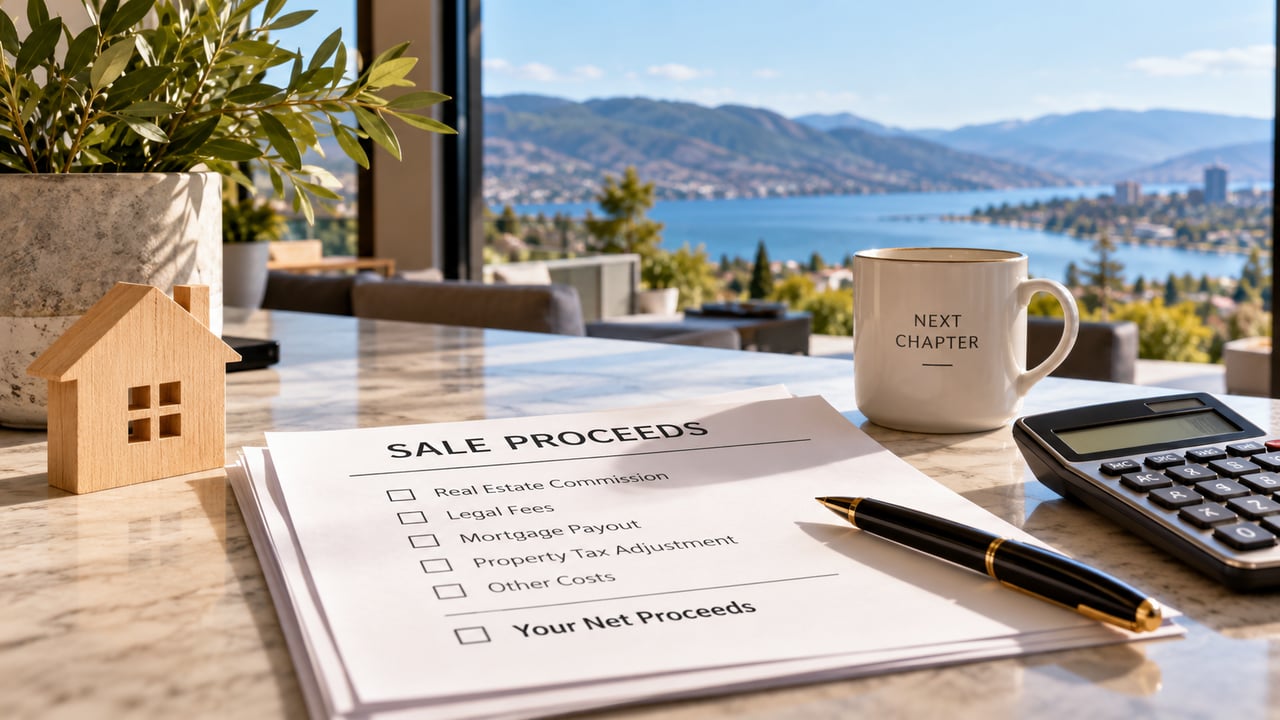
10. Example: How Much Would You Keep Selling a $900,000 Home in Kelowna?
Let's look at a hypothetical homeowner selling a detached home for $900,000.
Assume the homeowner has a $350,000 mortgage balance and is using the illustrative commission structure described earlier.
Item | Amount |
|---|---|
Home sale price | $900,000 |
Real estate commission | -$31,000 |
GST on commission | -$1,550 |
Legal fees and disbursements (assumed) | -$1,500 |
Mortgage discharge cost (assumed) | -$300 |
Property tax adjustment (assumed debit) | -$1,000 |
Mortgage balance payout | -$350,000 |
Estimated money remaining | $514,650 |
This example assumes no mortgage prepayment penalty, no taxable gain, no special levy, and no additional preparation or moving expenses.
The legal, discharge, and tax adjustment amounts are hypothetical budgeting figures, not quotes.
<escape>Estimated net proceeds: $514,650.</escape>
That is quite different from the $900,000 sale price.
It is also important to separate the actual cost of selling from the mortgage payout.
In this example, the seller has $35,350 in estimated transaction costs and adjustments, plus $350,000 in existing mortgage debt to repay.
11. What Closing Costs Should You Budget For?
Here is a practical summary for a typical Kelowna home sale.
Expense | What to budget |
|---|---|
REALTOR® commission | Negotiated amount plus GST |
Legal or notary fees | Often budget $1,000–$2,000 for a straightforward sale |
Mortgage discharge | Depends on lender and legal charges |
Mortgage penalty | $0 to potentially thousands |
Property tax adjustments | Depends on taxes paid and completion date |
Strata fees or levies | If applicable |
Moving and preparation | Depends on your plans |
Capital gains or flipping taxes | Only where applicable |
These are planning figures. Your final amounts should be confirmed with your brokerage, lawyer or notary, lender, and tax advisor.
12. How Can You Reduce Your Selling Costs?
There are ways to manage expenses, but I would be careful about focusing only on the cheapest way to sell.
Start by understanding your mortgage terms. A change in completion date or a mortgage portability option could make a difference.
Next, review the commission agreement and exactly what is included.
Before spending money on renovations, compare your property with what buyers are actually purchasing in your neighbourhood.
Finally, request an estimated statement of net proceeds before listing.
This brings the conversation back to the number that matters.
If you sell your home for a certain price, how much money will you actually have available for your next move?
That is the number I would want to know before making a decision.
Frequently Asked Questions
How much does it cost to sell a $1 million home in Kelowna?
The cost depends on your negotiated commission, legal fees, mortgage terms, and any property-specific expenses.
Using the illustrative 7% on the first $100,000 and 3% on the balance structure, commission on a $1 million sale would be $34,000, plus $1,700 GST, for a total of $35,700.
Other closing costs and mortgage payouts would be additional.
Do sellers pay GST when selling a home in BC?
Most sales of previously occupied residential homes are exempt from GST on the property itself. However, GST generally applies to real estate commission and certain professional services.
Different rules can apply to new homes, substantially renovated properties, and some commercial or investment transactions.
Can I sell my Kelowna home before my mortgage term ends?
Yes, but your lender may charge a mortgage prepayment penalty. Request an estimate before choosing your sale and completion dates.
Do I need a lawyer or notary to sell my home in Kelowna?
A lawyer or notary is normally used to handle the legal closing, mortgage payout, title documents, and distribution of funds.
The Bottom Line
When you sell a home in Kelowna, the sale price is only one part of the financial picture.
Your commission, legal fees, mortgage obligations, tax adjustments, and potential penalties all affect what you walk away with.
For homeowners planning to downsize, relocate, or move into a larger property, I think it makes more sense to work backward from the amount of money you need for your next move.
A higher selling price is helpful, but the money you actually keep is what determines your options.
Want to Know What You Would Walk Away With?
If you are thinking about selling your home in Kelowna or West Kelowna, I can prepare a property-specific estimate showing a realistic selling range, estimated selling costs, and how much equity you may have available afterward.
Send me your property address and I can help you work through the numbers.
Mark Coons, BBA, CE
Mark Coons Personal Real Estate Corporation
REALTOR® | eXp Realty Kelowna
Team Lead, Selling Okanagan Group
778-946-6454
[email protected]
Publishing note: The commission structure and legal-cost budget in the article are illustrative, not verified local quotes. Before publishing, confirm they reflect the examples you want to use. The tax rules have been checked against government guidance, but individual sellers should confirm their own tax treatment.