How Much Negotiating Room Is There on a Kelowna Home After 30, 60 or 90 Days?
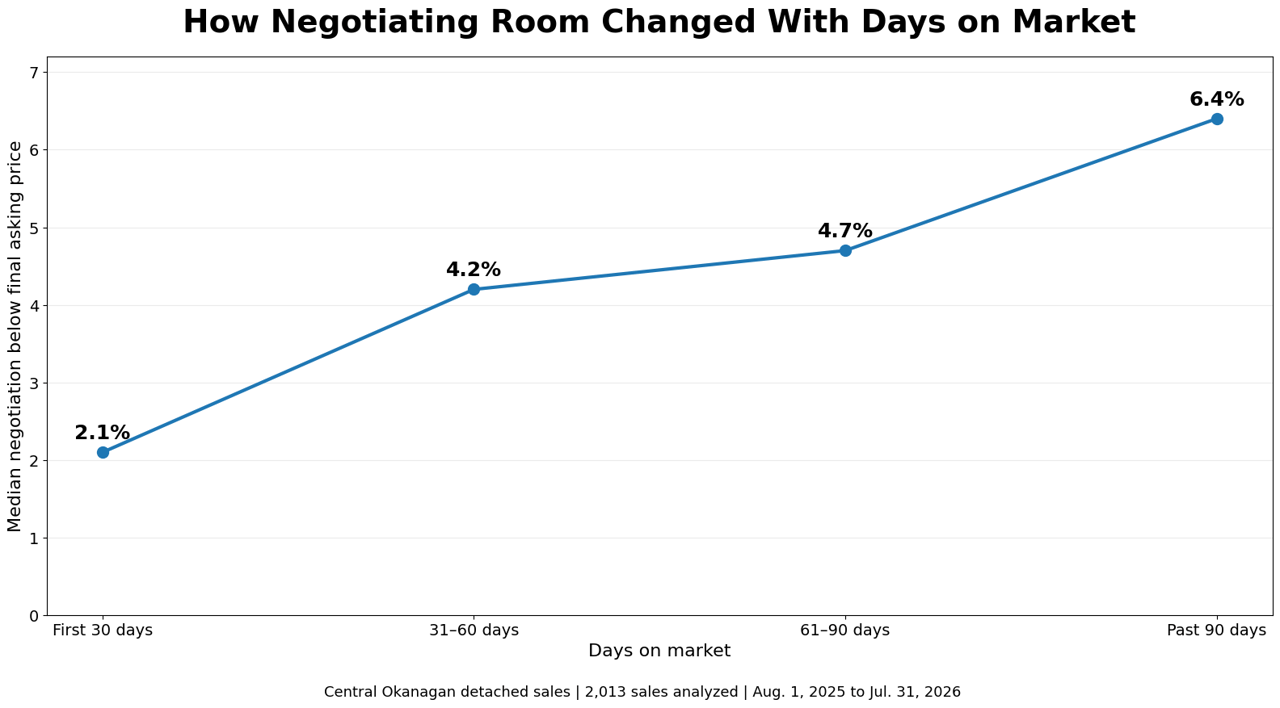
I analyzed 2,013 detached-home sales across the Central Okanagan from August 1, 2025 through July 31, 2026. Homes that sold in their first 30 days gave up a median of 2.1% from the final asking price. After 90 days, that increased to 6.4%.
The interesting part was what did not predict the discount nearly as well.
The age of the house.
I originally started digging through these sales because I wanted to see whether older homes gave buyers more negotiating room.
They really didn't.
Once you take the pre-1970 homes out of the equation, detached homes from the 1970s through the 2020s all landed within a very narrow range.
The clock told a much different story.
How much were buyers negotiating based on days on market?
Here is what happened across the 2,013 detached sales I analyzed:
Time on market | Median negotiation |
|---|---|
First 30 days | 2.1% below asking |
31 to 60 days | 4.2% below asking |
61 to 90 days | 4.7% below asking |
More than 90 days | 6.4% below asking |
The biggest jump happened once a home passed its first month.
The median discount roughly doubled from 2.1% during the first 30 days to 4.2% between days 31 and 60.
It continued climbing from there.
That does not mean you should automatically offer 6.4% below asking on every home that has been listed for 90 days.
It means time is information.
And buyers should probably be paying more attention to it.
The same pattern shows up from the other direction
I also sorted the sales based on how far below asking they eventually sold.
Homes that sold at or above asking took a median of just 18 days.
Homes selling between 0% and 2.5% below asking took 26 days.
Those selling 2.5% to 5% below asking took 45 days.
And homes selling more than 5% below asking took a median of 71 days.
Final result | Median days on market |
|---|---|
At or above asking | 18 days |
0% to 2.5% below | 26 days |
2.5% to 5% below | 45 days |
More than 5% below | 71 days |
Same relationship.
The longer the property had been waiting for a buyer, the larger the eventual negotiation tended to become.
What surprised me was how little the age of the home mattered
I expected an older house to produce a bigger discount.
Outside of the pre-1970 category, that was not really what happened.
Median negotiation by decade ranged from about 3.5% to 4.0%.
That is an extremely tight range.
A 1980s home was not automatically more negotiable than a 2010s home.
A 1990s home was not giving buyers some hidden age-related discount.
The property's time on market was a much stronger signal.
That changes how I would look at a listing as a buyer.
Instead of starting with:
How old is this house?
I would be asking:
How long has the seller been trying to sell it?
Price reductions made the pattern even stronger
This was probably the most interesting part of the study.
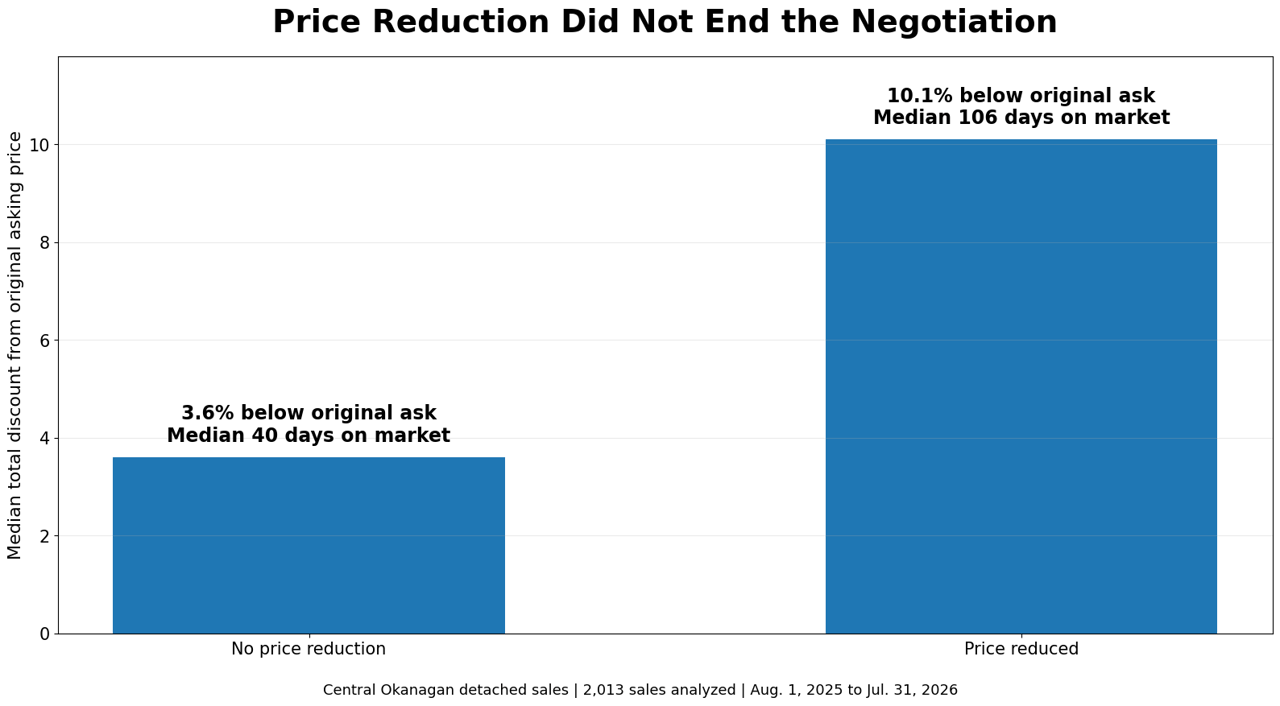
Homes that never had a price reduction:
- sold in a median of 40 days
- sold 3.6% below asking
Homes that had already been reduced:
- took a median of 106 days
- still sold another 6.3% below the reduced asking price
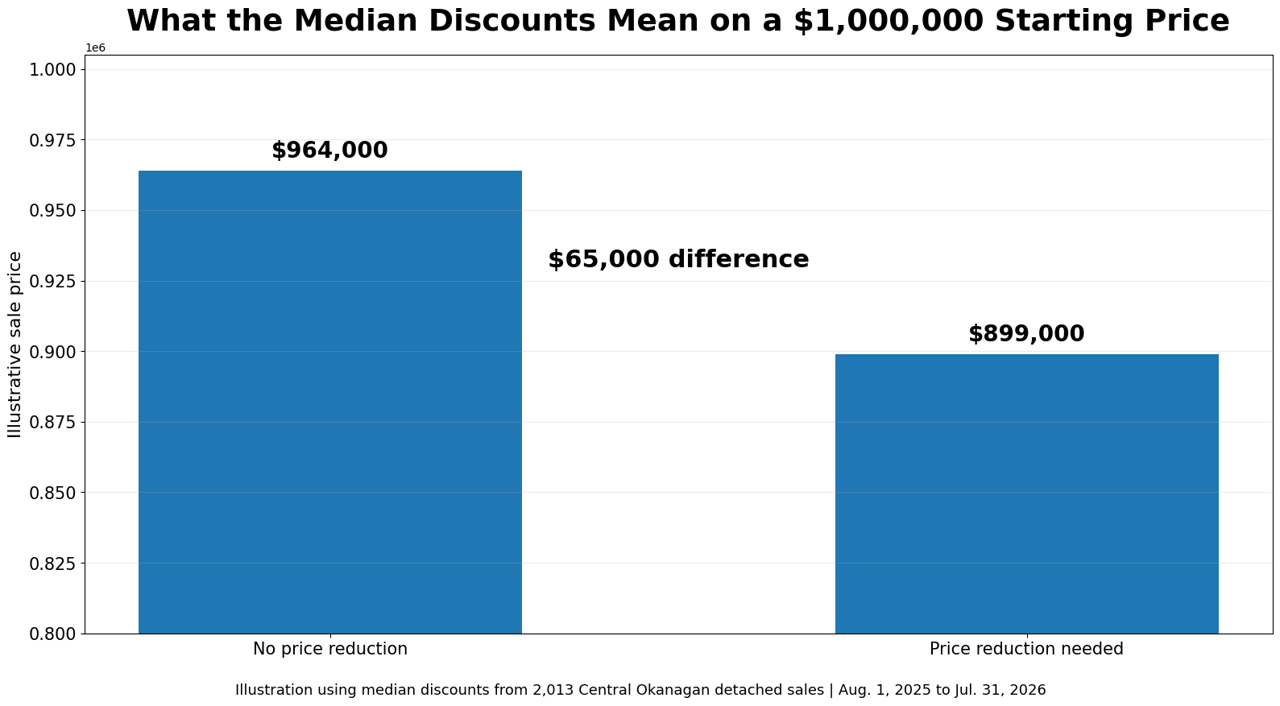
- finished 10.1% below where they originally started
The price reduction did not automatically end the negotiation.
In many cases, it simply changed the starting point for the next conversation.
That is important for buyers.
A seller cutting a price does not necessarily mean the new number is the number buyers ultimately accepted.
But there is an important warning
A long time on market is not automatically a bargain.
There may be a reason the home has been sitting.
It could be:
- condition
- layout
- location
- road noise
- renovation exposure
- an unusual lot
- a price that is still too high
- something else buyers keep rejecting
A home selling 6% below asking is also not automatically 6% below market value.
Those are two completely different things.
If the asking price started 10% too high, negotiating 6% off does not necessarily mean you got a deal.
That is why days on market should be used as a negotiation signal, not as the valuation itself.
Comparable sales still matter.
How I would use this when making an offer
I would think about the listing in four stages.
Under 30 days
The data showed a median negotiation of about 2.1%.
A fresh listing may still have competition, especially if the property is priced well.
This is where I would be careful about assuming a seller needs to make a large move.
31 to 60 days
Median negotiation increased to 4.2%.
Now I would start asking more questions.
Has the seller already adjusted the price?
Have there been previous offers?
How does the current price compare with the most relevant recent sales?
61 to 90 days
The median moved to 4.7%.
The difference from the 31-to-60-day group was not huge, but the listing has now spent two or three months being tested by the market.
That deserves attention.
More than 90 days
Median negotiation reached 6.4%.
This is where I would spend more time digging into the listing history.
But I would also spend more time figuring out why everyone else passed on it.
There can be opportunity here.
There can also be a reason the home is still available.
The number I would not use by itself
I would not simply take the number of days on market, look at this chart and subtract the corresponding percentage from the asking price.
The 6.4% number is a median across many transactions.
It is not a pricing formula.
One property may deserve asking price.
Another may still be expensive after a 10% reduction.
The useful part of this study is not that it tells you exactly what to offer.
It gives you a better place to start asking questions.
What I would check before deciding on the offer
For a specific property, I would want to know:
- How long has it actually been exposed to the market?
- Where did the asking price start?
- How many times has the price changed?
- What are the closest comparable homes actually selling for?
- Is there something about this property that explains the longer market time?
- What competing listings can the buyer choose instead?
That tells you much more than simply saying the market is up, down or balanced.
The bigger takeaway
The strongest predictor of negotiating room in this study was not how old the home was.
It was how long the seller had been waiting.
Across 2,013 Central Okanagan detached sales, median negotiation increased from 2.1% during the first 30 days to 6.4% after 90 days.
That does not tell you what every seller will accept.
But if I were deciding how to structure an offer, it is one of the first numbers I would want to know.
Methodology
This analysis used 2,013 detached-home sales in the Central Okanagan from August 1, 2025 through July 31, 2026.
Sales were grouped by days on market and by the percentage negotiated from the final asking price.
The results describe what happened across the dataset. They do not prove that additional days on market caused the larger discounts, and they should not be treated as a formula for valuing an individual property.
Property condition, location, size, lot, view, renovations, suite potential and other factors can materially affect both sale price and days on market.
Common Questions
Is 90 days on market a red flag?
Not automatically. It is a reason to investigate. The home may be overpriced, unusual or simply competing with better options.
Should I always offer below asking on a home that has been sitting?
No. Start with the property's value based on comparable sales. Then use the listing history and days on market to help decide how aggressively to negotiate.
Does a price reduction mean the seller will accept another discount?
Not always, but the study showed reduced properties still sold a median 6.3% below their reduced asking price.
Is days on market more useful than the age of the home?
For predicting negotiation in this dataset, yes. Most decades showed very similar negotiation percentages, while discounts increased much more as days on market climbed.
Want me to run this on a property?
If you are looking at a home in Kelowna or the Central Okanagan, send me the address.
I can look at the listing history, the most relevant recent sales and what I would test as a reasonable negotiating range.
Mark Coons Personal Real Estate Corporation
Mark Coons, BBA, CE
REALTOR® | eXp Realty Kelowna
Team Lead, Selling Okanagan Group
Relocated to Kelowna in 2018
778-946-6454
[email protected]
Read more articles like this:
https://sellingkelownarealestate.com/blog/what-augusts-numbers-reveal?