What Are the Closing Costs for Buyers in Kelowna? A Complete 2026 Guide
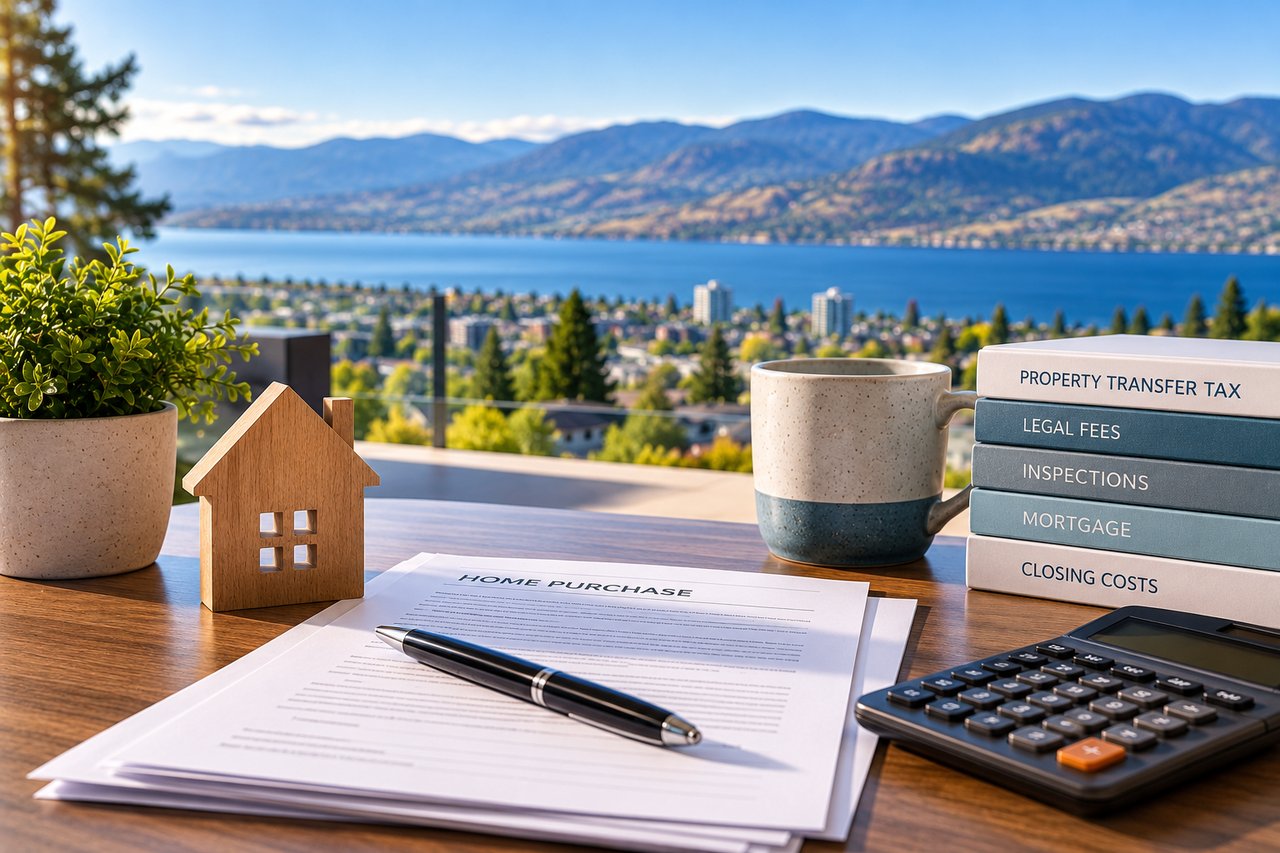
Buying a home in Kelowna involves more than saving for a down payment. You also need to budget for Property Transfer Tax, legal fees, inspections, mortgage-related expenses, and other costs that can add thousands of dollars to your purchase.
For a typical resale home in Kelowna, closing costs can range from a few thousand dollars to more than $20,000, depending on the purchase price and whether you qualify for tax exemptions. New construction can involve additional GST, although eligible buyers may qualify for rebates.
The important question isn't just how much home you can afford. It's how much money you'll actually need to complete the purchase.
New to the process? Start with our Kelowna Buyer's Guide.
What Are Closing Costs When Buying a Home in Kelowna?
Closing costs are the expenses you pay to complete your real estate purchase, beyond your down payment.
Some are government taxes. Others cover legal work, inspections, financing, and adjustments between the buyer and seller.
Here's a breakdown of common expenses for Kelowna and West Kelowna buyers.
Closing Cost | Estimated Amount |
|---|---|
BC Property Transfer Tax | $0 to $20,000+ depending on price and exemptions |
Lawyer or notary | $1,200–$2,500+ |
Home inspection | $500–$900 |
Property appraisal | $300–$600, if required |
Title insurance | Approximately $200–$500, if required |
Property tax adjustments | Varies by property and completion date |
Home insurance | Varies by property and coverage |
GST on new construction | Generally 5%, before applicable rebates |
Moving expenses | Varies |
Professional fees and inspection amounts are planning estimates, not fixed rates. Actual quotes may differ. Legal fees may also exclude disbursements and applicable taxes.
For most resale buyers, Property Transfer Tax is the expense that makes the biggest difference.
1. BC Property Transfer Tax: Usually the Biggest Closing Cost
British Columbia charges Property Transfer Tax (PTT) when ownership of most properties is registered.
The general rates are:
- 1% on the first $200,000.
- 2% on the portion between $200,000 and $2 million.
- 3% on the portion above $2 million.
- An additional 2% on the residential portion above $3 million.
Here's what that looks like at several Kelowna purchase prices.
Purchase Price | Property Transfer Tax |
|---|---|
$500,000 | $8,000 |
$600,000 | $10,000 |
$750,000 | $13,000 |
$800,000 | $14,000 |
$900,000 | $16,000 |
$1,000,000 | $18,000 |
$1,200,000 | $22,000 |
These calculations assume the purchase price equals the taxable fair market value and no exemptions apply.
Consider someone buying a $900,000 detached home in Kelowna.
They might have saved $180,000 for a 20% down payment. But they could still need another $16,000 for Property Transfer Tax, plus legal fees, inspections, and adjustments.
That can be a surprise if they've only planned around the down payment.
Fortunately, some buyers qualify for exemptions.
2. Can First-Time Homebuyers Avoid Property Transfer Tax in BC?
Yes. BC's First Time Home Buyers' Program can reduce Property Transfer Tax for eligible buyers.
Under the rules in effect in 2026:
- Homes valued at $500,000 or less may qualify for a full exemption.
- Homes valued above $500,000 and up to $835,000 may qualify for an exemption on the first $500,000 of value.
- Homes valued above $835,000 but below $860,000 may qualify for a reduced exemption.
- At $860,000 or more, the first-time buyer exemption is unavailable.
Buyers must also meet requirements involving citizenship or permanent residency, previous property ownership, residency, property size, and use as a principal residence.
Example: Buying a $700,000 Kelowna Condo
Without an exemption:
Property Transfer Tax = $12,000.
If the buyer qualifies for the full first-time buyer exemption amount:
Property Transfer Tax = $4,000.
Potential savings: $8,000.
That's money the buyer can keep available for moving, furnishings, or unexpected expenses.
However, being a first-time buyer doesn't automatically mean you qualify. Your lawyer or notary should confirm eligibility before completion.
3. Buying New Construction? The Tax Rules Are Different
This is an area where buyers need to be especially careful.
A newly built condo or townhouse may have a higher advertised purchase price once GST is included.
Most newly constructed residential properties are subject to 5% GST, unless an exemption or special rule applies.
For example:
A new townhouse priced at $800,000 before GST would normally have $40,000 in GST.
That brings the price to $840,000 before any available rebates.
BC's Newly Built Home Property Transfer Tax Exemption
Qualifying buyers of newly built principal residences may receive:
- A full Property Transfer Tax exemption on homes valued up to $1.1 million.
- A partial exemption on homes valued above $1.1 million and below $1.15 million.
This exemption is separate from GST.
A buyer does not necessarily need to be purchasing their first home to qualify.
Federal First-Time Home Buyers' GST Rebate
Eligible first-time buyers purchasing qualifying new homes may also benefit from the federal GST rebate.
The program can provide:
- Up to 100% of eligible GST, to a maximum of $50,000, on new homes valued at $1 million or less.
- A reduced rebate for homes valued between $1 million and $1.5 million.
- No rebate under this program for homes valued at $1.5 million or more.
Eligibility and purchase-agreement timing requirements matter. Buyers should also confirm whether the builder's quoted price includes GST and how any rebate is handled.
The important distinction is that GST rebates and Property Transfer Tax exemptions are two different programs.
A new home could qualify for one, both, or neither.
4. Legal Fees and Notary Costs
A lawyer or notary handles the legal work needed to transfer ownership.
Their work generally includes reviewing title, preparing documents, registering the transfer, handling mortgage funds, and completing financial adjustments.
For planning purposes, I would allow approximately $1,200 to $2,500 or more, depending on the transaction and what's included in the quote.
More complicated purchases, including certain leasehold properties or transactions involving additional lenders, may cost more.
Ask whether the quote includes disbursements, registration charges, title insurance, and applicable taxes.
5. Home Inspection Costs
A home inspection is not normally required by law, but it can be one of the more useful expenses during a purchase.
For many Kelowna properties, a general home inspection might cost approximately $500 to $900.
The price depends on the size, age, and type of property.
A general inspection may identify concerns involving roofing, plumbing, electrical systems, heating, moisture, or visible structural conditions.
However, it won't find every problem.
For older properties, rural homes, or homes with unusual features, buyers may need additional inspections.
For example, a property with a septic system, well, retaining wall, or signs of moisture damage could require specialist assessments.
A few hundred dollars spent investigating a problem may prevent a much larger expense later.
6. Mortgage Appraisal and Financing Expenses
Your mortgage lender may require an appraisal to confirm the property's value.
An appraisal can cost approximately $300 to $600, although some lenders cover it.
If your down payment is less than 20%, mortgage default insurance may also apply.
This insurance protects the lender, not the buyer.
The premium is often added to the mortgage rather than paid entirely in cash at closing. It still increases your borrowing costs.
There may also be lender-specific or broker fees, depending on the mortgage product.
Before removing a financing condition, confirm the full cost of the mortgage, not just the interest rate and monthly payment.
7. Property Tax Adjustments and Other Expenses
Another cost buyers sometimes overlook is the adjustment between the buyer and seller.
For example, if the seller has already paid the full year's property taxes, the buyer may need to reimburse the seller for the portion covering the buyer's ownership period.
If taxes remain unpaid, the adjustment can work in the opposite direction.
Your lawyer or notary calculates the amount based on the completion date.
Other possible adjustments include prepaid strata fees, utilities, or other expenses addressed in the contract.
Buyers should also budget for home insurance, utility connections, moving expenses, and any immediate repairs.
These expenses may not all appear on the legal completion statement, but they still affect how much cash you need.
8. What Are Closing Costs on an $800,000 Home in Kelowna?
Let's use a practical example.
You're buying an $800,000 resale townhouse in Kelowna with a 20% down payment.
You are not eligible for any Property Transfer Tax exemptions.
Expense | Estimated Cost |
|---|---|
Down payment (20%) | $160,000 |
Property Transfer Tax | $14,000 |
Legal fees and disbursements | $1,800 |
Home inspection | $650 |
Appraisal | $400 |
Tax and strata adjustments | $600 |
Estimated total cash required | $177,450 |
These figures are illustrative, not a quote. They exclude moving expenses, insurance premiums, and other possible charges.
In this example, the buyer needs approximately $17,450 beyond the down payment.
Now imagine the same buyer qualifies for the BC first-time homebuyer exemption.
At an $800,000 purchase price, the Property Transfer Tax could fall from $14,000 to $6,000.
That would reduce the estimated total cash requirement to $169,450.
Same property. Same purchase price.
An $8,000 difference simply because of eligibility for an exemption.
That's why I would want to confirm the tax situation before deciding exactly how much cash to put toward the down payment.
9. Are Closing Costs Different in West Kelowna or on WFN Leasehold Properties?
The general provincial Property Transfer Tax rules apply across Kelowna and West Kelowna, but the legal structure of the property matters.
For buyers considering Westbank First Nation (WFN) leasehold properties, the transaction can involve different land interests, lender requirements, and legal documentation.
Some registered leasehold transfers can trigger Property Transfer Tax. The applicable rules depend on the lease term and transaction.
Financing options may also differ from those available for a conventional freehold home.
I would not assume that a lower purchase price automatically means a cheaper transaction.
Before purchasing a leasehold property, confirm the remaining lease term, lender requirements, transfer costs, applicable taxes, and legal expenses.
10. Other Taxes Buyers Should Know About
Depending on your situation, there may be additional tax considerations.
Additional Property Transfer Tax for Foreign Buyers
The Regional District of Central Okanagan is one of the designated areas where BC's additional 20% Property Transfer Tax can apply to certain foreign buyers.
This is separate from the standard Property Transfer Tax.
There are exemptions and special rules, and federal restrictions on certain purchases by non-Canadians may also apply.
BC Speculation and Vacancy Tax
This is not normally a one-time closing cost.
However, buyers in designated areas, including Kelowna and West Kelowna, should understand whether the annual tax could apply to their future ownership and occupancy.
An exemption may be available, including for qualifying principal residences, but declaration and eligibility rules matter.
Annual Property Taxes
Property taxes are an ongoing ownership expense, not just a closing adjustment.
When comparing properties, review the current tax amount and whether the property is receiving a homeowner grant or other adjustment that may not apply to you.
11. How Much Should You Budget for Closing Costs in Kelowna?
You may have heard that buyers should set aside 1.5% to 4% of the purchase price for closing costs.
That can be a useful starting point, but it is not a reliable calculation for every buyer.
A first-time buyer purchasing a qualifying condo may pay substantially less Property Transfer Tax than someone buying a $1.2 million detached home.
A new construction buyer may have GST to consider.
A leasehold purchase may require additional legal review.
Rather than rely on a flat percentage, I recommend working backward from the property you want to buy.
Start with the purchase price, calculate the applicable Property Transfer Tax, confirm any exemptions, obtain legal and inspection quotes, and allow room for adjustments and unexpected expenses.
Frequently Asked Questions
Do buyers pay REALTOR® commissions in Kelowna?
In a typical MLS resale transaction, the seller pays the agreed real estate remuneration from the sale proceeds, with compensation handled according to the listing and buyer agreements.
However, buyers should review their own representation agreement because compensation obligations can vary.
Can closing costs be added to a mortgage?
Some costs may be financed indirectly through mortgage arrangements, but buyers should not assume they can add all closing costs to their mortgage.
Lenders generally require proof that buyers have enough funds available for their down payment and closing expenses.
When do I pay closing costs?
Inspection expenses are usually paid when the service is completed.
Most other closing expenses are settled through your lawyer or notary around the completion date.
Your legal professional will provide a statement showing the funds required.
Is the deposit part of my closing costs?
No. The deposit is generally credited toward the purchase price on completion.
It is part of the money you're contributing to the purchase, rather than an extra fee.
You still need to have the deposit available when required under the purchase contract.
The Bottom Line: Know Your Total Cost Before Making an Offer
Buying a home in Kelowna is a major financial decision, and the purchase price only tells part of the story.
Property Transfer Tax, GST, legal expenses, financing costs, and property adjustments can change how much cash you need.
The good news is that some buyers qualify for significant tax savings.
The goal isn't simply to find a home that fits your mortgage approval.
It's to find a home that fits your overall financial situation, including the money you'll need on completion and the expenses that follow.
Selling too? See what sellers pay in Closing Costs for Kelowna Sellers.
Planning to buy in Kelowna or West Kelowna?
I've put together a Kelowna Home Buyer's Guide that walks through the buying process and helps you understand what to prepare before making an offer.
Mark Coons Personal Real Estate Corporation
Mark Coons, BBA, CE
REALTOR® | eXp Realty Kelowna
Team Lead, Selling Okanagan Group
Mark relocated to Kelowna in 2018 and helps buyers and sellers make informed real estate decisions throughout the Central Okanagan.
Phone: 778-946-6454
Email: [email protected]
Government Sources
The principal tax rules and exemptions were checked against these official sources:
- bclaws.gov.bc.ca
BC First-Time Home Buyers' Exemption
news.gov.bc.ca- Province of British Columbia