Why a Price Reduction Does Not Mean the Seller Is Done Negotiating
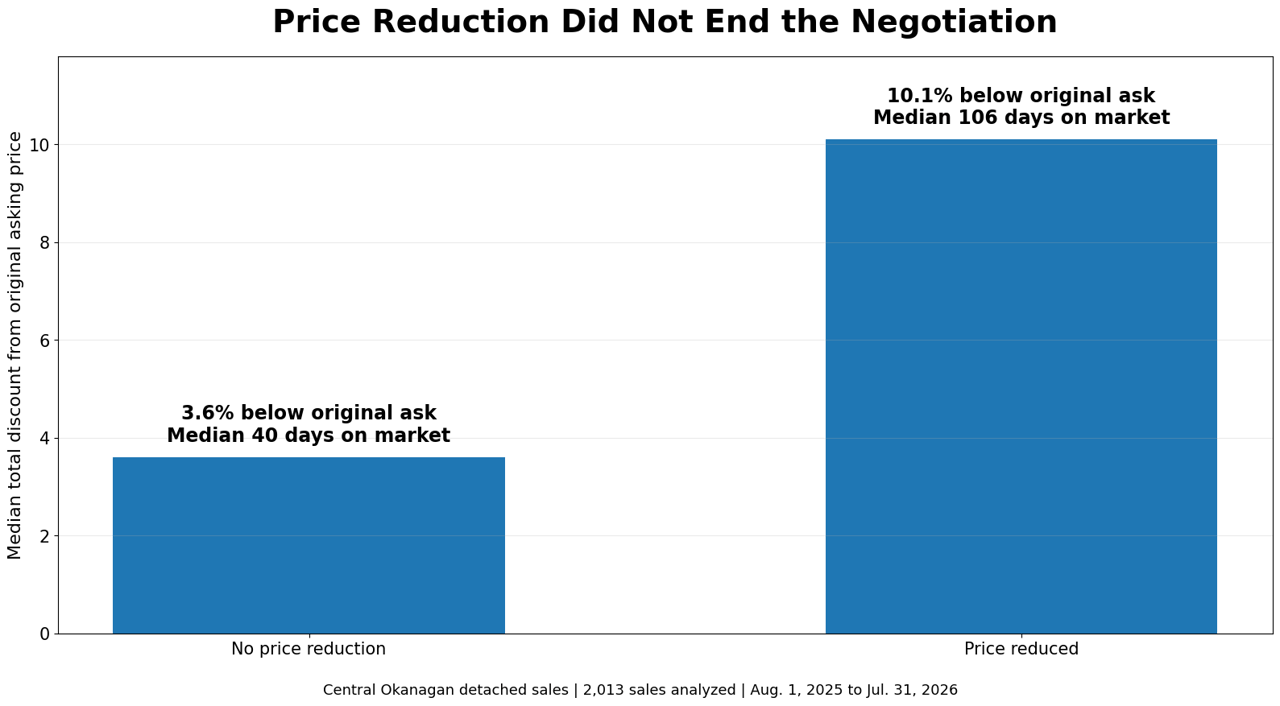
A seller lowering their asking price does not necessarily mean they have reached their bottom line. Across 2,013 Central Okanagan detached sales I analyzed, homes that had a price reduction still sold a median 6.3% below the reduced asking price. From their original asking price, the total discount was 10.1%.
I think buyers sometimes make an understandable assumption when they see a price reduction.
The seller was asking $1,100,000.
They reduced it to $999,000.
So $999,000 must be the number they are finally willing to take.
The data says that is not necessarily how it works.
I went through 2,013 detached-home sales across the Central Okanagan from August 1, 2025 through July 31, 2026.
The properties that had already reduced their asking price kept negotiating.
Quite a bit, actually.
What happened after sellers reduced their price?
Here is the comparison.
Listing history | Median days on market | Final negotiation | Total discount from original ask |
|---|---|---|---|
No price reduction | 40 days | 3.6% | 3.6% |
Price reduced | 106 days | 6.3% below reduced price | 10.1% |
The reduced listings had already made one adjustment.
Then they sold for another 6.3% below the new price.
By the time the transaction closed, the typical reduced listing was 10.1% below where the seller had originally started.
That is a much bigger gap than I expected.
The price reduction was not the end of the negotiation
This is the part that matters for a buyer.
A price reduction tells you the seller has changed their expectations.
It does not tell you how far those expectations have changed.
The property has already been exposed to buyers at the original price.
The market did not accept it.
The seller lowered the price.
Now the market gets another chance to respond.
Sometimes that new asking price works.
Sometimes it still doesn't.
In this dataset, buyers continued negotiating after the reduction.
Time was working against the seller too
The homes that never reduced sold in a median of 40 days.
The reduced group took 106 days.
That is more than twice as long.
This fits another pattern in the same 2,013 sales.
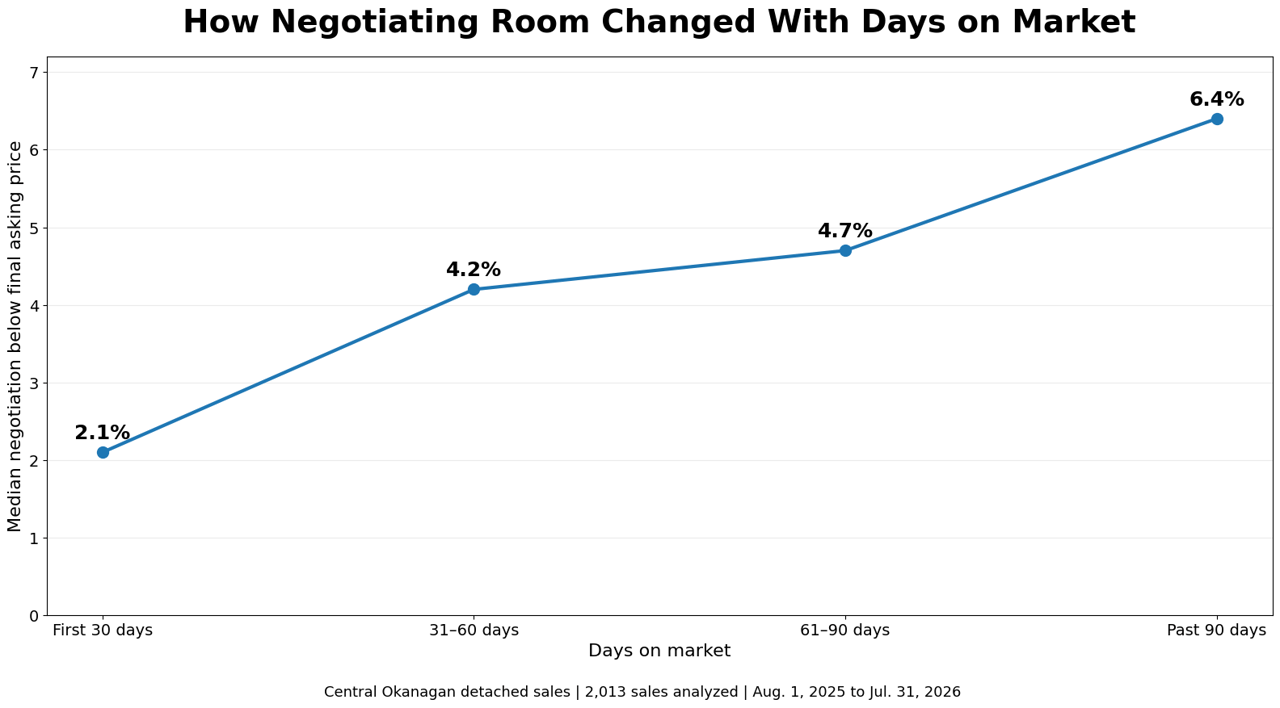
Median negotiation based on days on market was:
- first 30 days: 2.1%
- 31 to 60 days: 4.2%
- 61 to 90 days: 4.7%
- past 90 days: 6.4%
The longer the home remained available, the more room buyers tended to get.
That does not mean time automatically forces a seller to accept less.
But it does tell us something about how these transactions were actually finishing.
Why buyers should look at where the listing started
Imagine two homes both listed today at $950,000.
They look similar.
But their histories are very different.
Home A
Originally listed at $950,000.
It has been on the market for 12 days.
Home B
Originally listed at $1,075,000.
It has been on the market for 105 days.
It was reduced twice and is now asking $950,000.
Same current asking price.
Very different information.
The second seller has already spent more than three months testing what buyers will pay.
That does not guarantee they will take another discount.
But I would absolutely want to know that history before deciding what to offer.
A reduced price is not necessarily market value
There is another mistake buyers can make.
A property was $1.1 million.
Now it is $999,000.
Therefore, it must be a $101,000 better deal.
Not necessarily.
The original asking price may simply have been wrong.
If comparable homes support $925,000, reducing from $1.1 million to $999,000 does not suddenly make the property cheap.
The seller changed their asking price.
The market value did not change because the listing was edited.
That distinction matters.
This is where comparable sales still win
The listing history helps with negotiation.
Comparable sales help establish value.
I would use both.
Before deciding what to offer on a reduced property, I would want to know:
- What did the seller originally ask?
- How many reductions have there been?
- How long has the property actually been exposed to the market?
- What have the closest comparable homes sold for?
- Are there better alternatives currently available?
- Is there a property-specific reason buyers have passed on it?
Those questions help separate an actual opportunity from a property that simply started too high.
Why has it been sitting?
This is probably the most important question.
A long listing history can create negotiating room.
It can also be trying to tell you something.
Maybe the home needs substantial work.
Maybe the layout is difficult.
Maybe the lot, road, location or condition limits the buyer pool.
Maybe there is nothing materially wrong with the property and the seller simply started with unrealistic pricing.
You need to figure out which one it is.
Buying 8% below asking is not a win if you paid 5% more than comparable value.
The discount is not the goal.
Buying the right property at a defensible price is.
What would I do with a recently reduced listing?
I would not automatically rush in because a price changed.
I would pull the history first.
If the reduction happened quickly
Suppose the property launched at $1,050,000 and dropped to $999,000 after two weeks.
That seller may simply be correcting an obvious pricing mistake.
There may not be much additional room yet.
If it has been sitting for 60 days
Now I would want to understand the seller's previous pricing, comparable sales and competition.
Your own study showed median negotiation around 4.7% once homes reached the 61-to-90-day range.
If it has been sitting past 90 days and already reduced
That is where the conversation gets more interesting.
The overall 90-plus-day group sold a median 6.4% below final asking.
And reduced listings across the full study sold another 6.3% below their reduced price.
Again, neither number tells us exactly what one seller will accept.
But those are useful clues.
There is also a lesson here for sellers
If you are selling, this study points to the other side of the same problem.
Starting high and planning to reduce later did not appear to protect the seller's price.
The homes that never reduced:
- sold in a median of 40 days
- gave up 3.6% from asking
The homes that reduced:
- took 106 days
- gave up another 6.3% after the reduction
- finished 10.1% below their original asking price
That does not prove every price reduction caused a worse outcome.
The homes that needed reductions may have had other characteristics that made them harder to sell.
But it certainly does not support the idea that a seller can safely start high and simply adjust later without consequences.
What this study does not prove
There are some important limits here.
This is an analysis of 2,013 detached sales across the Central Okanagan.
It does not tell us why every seller reduced.
It does not tell us whether a particular home was overpriced by 2%, 10% or 20%.
It does not prove that the price reduction itself caused the eventual discount.
Homes that required reductions may have differed in condition, location, price range, design or other characteristics.
The useful finding is simpler.
Reduced listings, as a group, were not finishing at their reduced asking prices.
They kept negotiating.
The bigger takeaway
A price reduction tells you a seller has moved.
It does not tell you they are finished moving.
Across the 2,013 Central Okanagan detached sales I analyzed, homes that reduced still sold another 6.3% below the reduced asking price and ended up 10.1% below their original ask.
For buyers, that means the current asking price is only one piece of the negotiation.
The listing history may tell you much more.
Methodology
This analysis used 2,013 detached-home sales across the Central Okanagan from August 1, 2025 through July 31, 2026.
Properties were separated based on whether they sold without a price reduction or had been reduced before selling.
For reduced listings, I compared the original asking price, final asking price, final sale price and days on market.
The results describe the median outcome across the dataset. They should not be used as a formula for pricing or negotiating one specific property.
Location, condition, size, lot, view, price range, renovations and other property-specific factors can materially change the outcome.
Common Questions
Should I always offer below the reduced price?
No. First determine what the property is actually worth. A reduction can create an opportunity, but the home may already be correctly priced after the change.
How much more can I negotiate after a price reduction?
In this study, reduced detached homes sold a median 6.3% below their final reduced asking price. That is a market pattern, not a recommended offer amount for every property.
Does a price reduction mean something is wrong with the home?
Not necessarily. Sometimes the property itself is fine and the original asking price simply did not match what buyers were prepared to pay.
What matters more, the size of the reduction or days on market?
I would look at both. The size of the reduction shows how far the seller has already moved. Days on market tells you how long buyers have been given to respond.
Looking at a reduced listing?
Send me the address.
I can pull the original asking price, reduction history, comparable sales and competing listings and give you a range I would test rather than guessing from the current asking price alone.
Mark Coons Personal Real Estate Corporation
Mark Coons, BBA, CE
REALTOR® | eXp Realty Kelowna
Team Lead, Selling Okanagan Group
Relocated to Kelowna in 2018
778-946-6454
[email protected]
Links related to this Blog:
https://sellingkelownarealestate.com/blog/where-the-market-is-moving