The First 30 Days Can Cost a Kelowna Seller Thousands
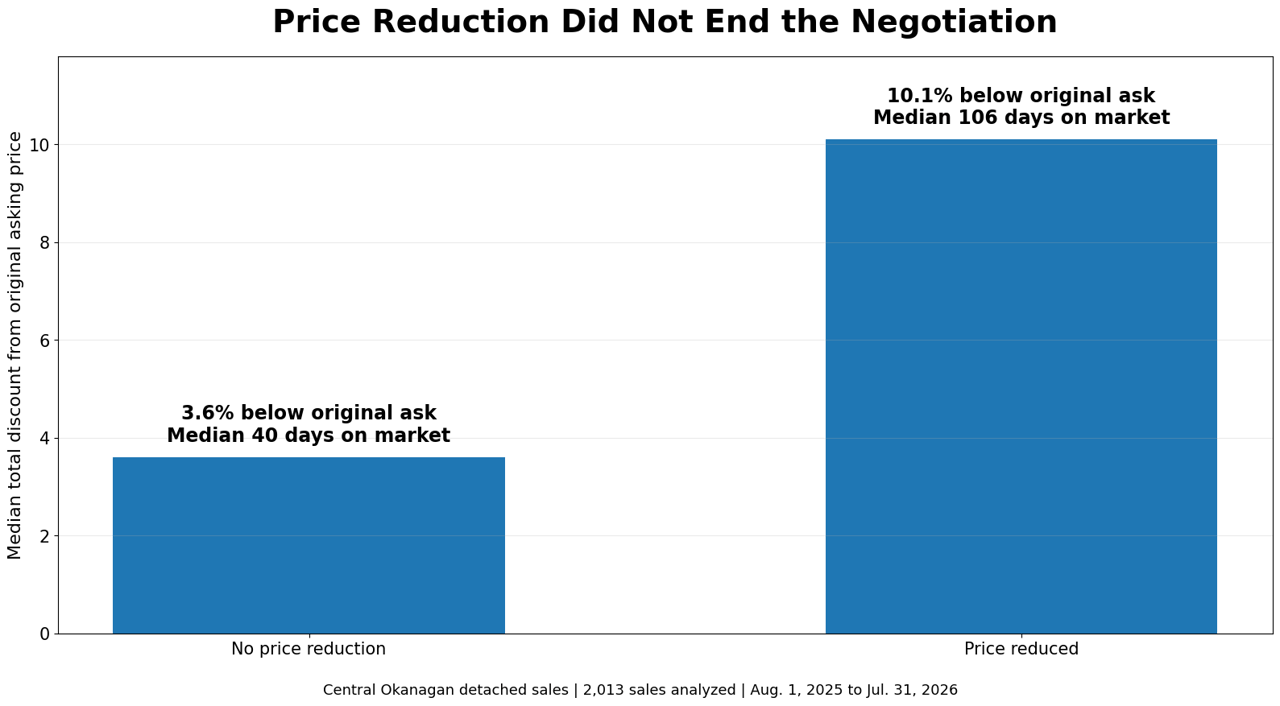
I analyzed 2,013 Central Okanagan detached-home sales from August 1, 2025 through July 31, 2026. Homes that sold without needing a price reduction took a median of 40 days and finished 3.6% below asking. Homes that needed a reduction took 106 days and ultimately finished 10.1% below their original asking price.
One of the most common seller instincts makes complete sense.
Start a little high.
See what happens.
You can always reduce later.
The theory is that starting high protects your upside. If someone is willing to pay it, great. If not, you adjust.
I wanted to see what actually happened to sellers who followed that path.
The answer was not what I would want to see if I were selling.
What happened to homes that never needed a reduction?
Across the 2,013 Central Okanagan detached sales I analyzed, homes that sold without a price reduction:
- sold in a median of 40 days
- sold 3.6% below asking
Homes that required at least one reduction:
- took a median of 106 days
- still sold 6.3% below the reduced asking price
- finished 10.1% below their original asking price
That is the part I keep coming back to.
The reduction did not simply bring the seller back to market value and end the negotiation.
Buyers kept negotiating from the new number.
What could that mean in dollars?
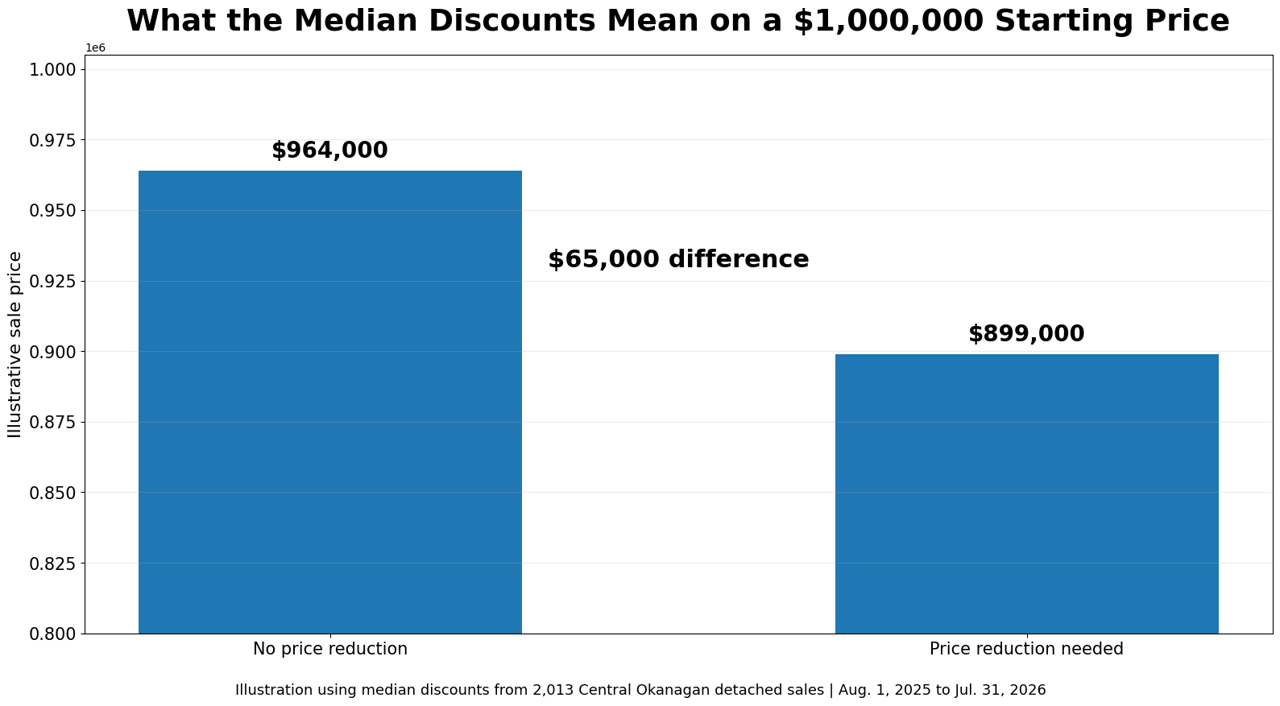
Take a home originally asking $1,000,000.
A 3.6% discount would be about $36,000.
A 10.1% total discount would be about $101,000.
That is roughly a $65,000 difference.
I am not saying every $1 million seller who starts too high will lose $65,000.
The study does not prove that.
The homes that needed reductions may have been harder to sell for other reasons.
But it does challenge the idea that there is no downside to testing a higher price first.
Buyers behave differently when a listing is fresh
There is a reason I care so much about the first part of a listing.
The newest listings get looked at by the buyers who are already watching that exact segment.
Those buyers know what else is available.
They have probably already seen the homes that have been sitting.
When something new shows up, they compare it quickly.
If the value makes sense, that is when a seller has the best chance of creating competition or at least getting a serious buyer to act.
If the price does not make sense, those buyers usually do not disappear.
They wait.
That is where the seller's leverage can start changing.
The first 30 days told a different story
I also grouped the sales by days on market.
Median negotiation from the final asking price looked like this:
Days on market | Median negotiation |
|---|---|
First 30 days | 2.1% below asking |
31 to 60 days | 4.2% below asking |
61 to 90 days | 4.7% below asking |
More than 90 days | 6.4% below asking |
The largest jump happened after the first month.
Homes selling during the first 30 days gave up a median 2.1%.
Between 31 and 60 days, that doubled to 4.2%.
Past 90 days, it reached 6.4%.
Time was not neutral.
The longer a property sat, the more negotiating room buyers tended to get.
Why starting high can feel safer
I understand why sellers want to try it.
What if someone pays the higher number?
What if we list too low?
What if the right buyer comes along next week?
Those are reasonable questions.
Pricing accurately does not mean giving the home away.
It means figuring out where buyers have already demonstrated they will act, then deciding how your home compares with those properties.
That is very different from simply picking the highest active listing nearby.
Active listings tell you what sellers want.
Sold listings tell you what buyers actually agreed to pay.
A price reduction does not reset the clock
This might be the most important point.
Imagine a home comes out at $1,150,000.
It sits.
The seller reduces to $1,099,000.
Then $1,049,000.
A buyer looking at that property does not necessarily see a fresh $1,049,000 listing.
They may see a home that has already spent months being rejected at higher prices.
The listing has history now.
The buyers can see the reductions.
Their agent can pull the previous pricing.
And the conversation changes.
Instead of:
How much do we need to pay to get this house?
It may become:
How much more will this seller move?
That is a very different negotiating position.
Why doesn't the reduction always fix it?
Because price may not have been the only issue.
Some homes sit because of:
- condition
- layout
- road noise
- location
- renovation exposure
- unusual design
- lot limitations
- too much competing inventory
Others simply started too high.
A reduction may improve value without completely fixing the problem.
And if several competing sellers reduce at the same time, your home may not become more attractive relative to everything else.
That is why the first pricing decision needs to consider the competition as well as the recent sales.
The highest asking price is not the goal
This is where sellers can accidentally optimize for the wrong number.
The goal is not to have the highest list price.
The goal is to achieve the strongest sale outcome.
Those are not the same thing.
A $1.1 million asking price that eventually becomes a $990,000 sale is not automatically better than starting at $1.025 million and selling around $1 million much sooner.
The second seller may have:
- carried the property for fewer months
- avoided multiple reductions
- kept more negotiating leverage
- had a cleaner sale
- moved on to their next purchase sooner
The final sale price matters.
So does everything it took to get there.
There is another cost sellers forget
Time itself costs money.
If you are carrying:
- mortgage interest
- property taxes
- insurance
- utilities
- strata fees
- landscaping
- maintenance
another two months on market is not free.
There can also be an opportunity cost.
If you are selling to buy something else, the home you want may move while yours is still sitting.
Or the segment you are buying into may change while you wait.
The pricing decision affects more than the eventual sale price.
What if the home is genuinely better?
Then prove it.
A lake view, larger lot, renovation, pool, suite, privacy or superior location can absolutely justify a premium.
But the premium should come from evidence.
I would want to know what buyers recently paid for those same features.
That is much stronger than saying:
The neighbour is asking $1.2 million, so we should ask $1.2 million too.
Maybe the neighbour is wrong too.
What this study does not prove
I want to be careful with the conclusion.
The data does not prove that starting too high caused every reduced listing to sell for 10.1% below its original asking price.
Homes that needed reductions could differ in condition, location, size, price range and other factors.
It also does not mean every home needs to sell in 30 days.
Some property types naturally take longer.
Luxury homes are an obvious example.
The useful finding is narrower.
Sellers who eventually needed reductions did not appear to be protected by starting higher.
As a group, they took much longer to sell and finished much farther below where they started.
How I would price a Kelowna home
I would start with four groups.
Recent sales
What did buyers actually pay for the closest substitutes?
Current competition
If a buyer does not choose your home, what else can they buy?
Failed listings
What prices has the market already rejected?
Price reductions
Which competing sellers have already changed their expectations?
That gives a much clearer picture than looking at active asking prices alone.
Then I would ask one more question:
Where does this home need to sit so the right buyer sees the value before the listing history starts working against us?
That is the pricing decision.
The bigger takeaway
Starting high can feel like the conservative choice.
The data suggests it may create a different risk.
Across 2,013 Central Okanagan detached sales, homes that sold without a price reduction finished a median 3.6% below asking and sold in 40 days.
Homes that needed a reduction took 106 days and finished 10.1% below their original asking price.
That does not mean every seller should price aggressively low.
It means the first price deserves more thought than:
We can always reduce later.
Because later, the buyer may have more leverage than you do.
Common Questions
Should I price my Kelowna home below market value?
Not automatically. The goal is to price where the evidence supports the property, not simply to be cheap.
Is the first 30 days really that important?
In this dataset, homes selling during their first 30 days gave up a median 2.1% from the final asking price. Negotiation increased as market time climbed.
Can I just reduce the price later if we start too high?
You can, but the data suggests a reduction does not necessarily restore the leverage available when a listing was new. Reduced homes still negotiated after the reduction.
How do I know what my home should actually be listed for?
Compare your home with recent sales, current competition, failed listings and price reductions in the same segment. Broad Kelowna averages are not enough.
Want me to run this on your home?
Send me the address.
I can compare your home with the properties buyers are actually choosing, the listings they are rejecting and the competing inventory you would launch against.
And if the numbers suggest waiting is the better move, I will tell you that too.
Mark Coons Personal Real Estate Corporation
Mark Coons, BBA, CE
REALTOR® | eXp Realty Kelowna
Team Lead, Selling Okanagan Group
Relocated to Kelowna in 2018
778-946-6454
[email protected]
More Links related to the Blog:
https://sellingkelownarealestate.com/blog/your-list-price-isnt-your-market-price