Why Older Kelowna Homes With Development Potential Are Struggling
Pre-1970 detached homes are behaving very differently from the rest of the Central Okanagan market. They are down about 20% from Q2 2022 on my adjusted comparison and currently carry roughly 19 months of inventory. One possible reason is that many are caught between two buyers: homeowners who see an expensive renovation and developers who cannot make the redevelopment numbers work.
There is a sentence I hear around older Kelowna properties all the time.
But the land has development potential.
That can absolutely matter.
The problem is that development potential and development value are not the same thing.
I went through Central Okanagan detached sales by the decade the homes were built.
One group looked completely different from the rest.
Homes built before 1970.
Pre-1970 homes have taken the largest correction
Once I adjusted the sales for neighbourhood and size so the comparison was more useful, this is what happened from Q2 2022 to Q2 2026:
Home age | Approximate change |
|---|---|
Pre-1970 | -20.0% |
1970s | -10.8% |
2000s | -10.4% |
2010s | -9.5% |
1980s | -9.0% |
1990s | -7.6% |
The oldest group did not just perform a little worse.
Its correction was roughly twice what several of the other decades experienced.
Then I looked at current inventory.
That made the gap harder to ignore.
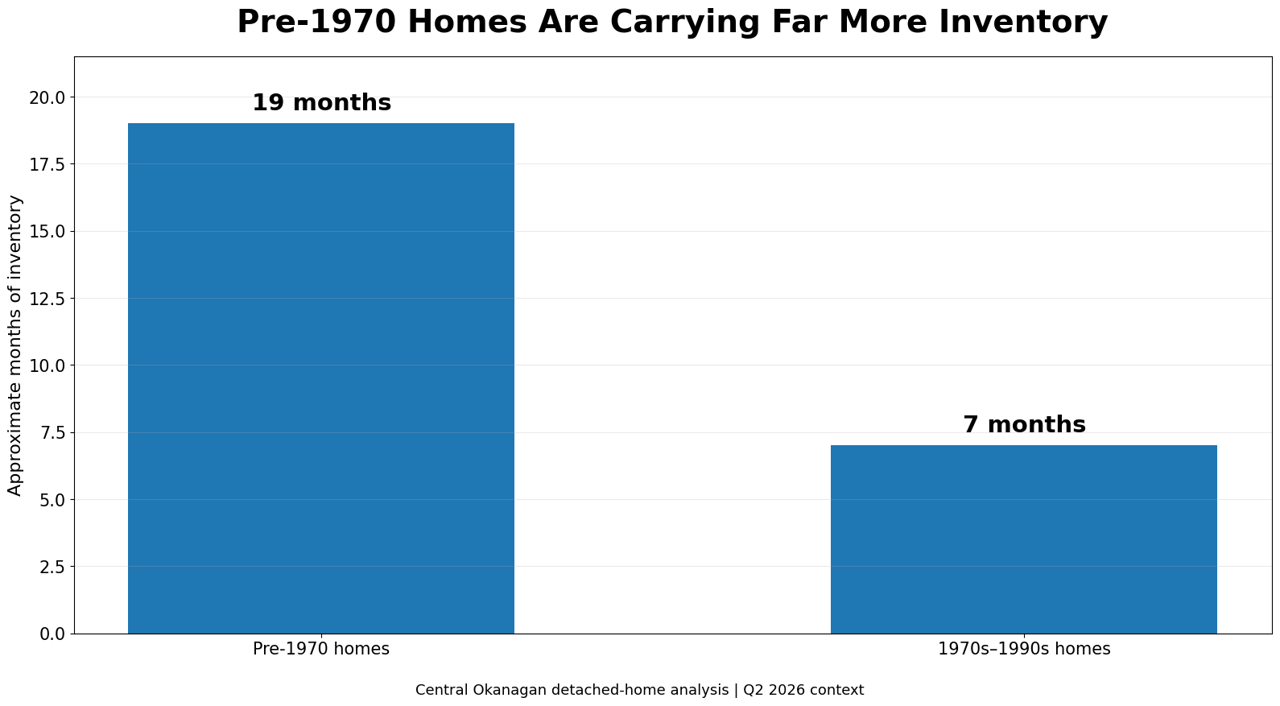
Pre-1970 homes have roughly 19 months of inventory
Pre-1970 detached homes currently carry about 19 months of inventory.
Homes from the 1970s through the 1990s are closer to seven months.
That is roughly 2.7 times as much supply relative to the recent sales pace.
Months of inventory is simply an estimate of how long the current supply could take to sell if the recent sales pace continued and no new listings were added.
Nineteen months is telling us buyers are not clearing this segment very quickly.
The question is why.
Development potential shows up far more often in these sales
I also checked the listing remarks.
In Q2 2026, development or density potential was mentioned in about 62% of pre-1970 sales.
For comparison:
- 1990s homes: about 24%
- 2000s homes: around 11% to 12%
- 2010s homes: around 11% to 12%
That does not prove development potential caused the weaker performance.
But it tells us something important about how these older properties are being marketed and valued.
A large portion are not being sold purely as houses.
The land is part of the pitch.
And that changes the buyer.
The regular homeowner sees the renovation
Imagine an older home on a good lot.
The structure might need:
- windows
- roof
- plumbing
- electrical
- kitchen
- bathrooms
- insulation
- mechanical systems
- foundation work
- major cosmetic updating
The homeowner buying it to live in starts subtracting those costs.
They may like the location.
They may like the lot.
But they are comparing the property with other homes where someone else has already spent the money.
That puts a limit on what the house itself is worth to them.
The developer sees an entirely different set of costs
The developer does not necessarily care about the kitchen.
They may remove the house.
But now they have another list:
- acquisition cost
- demolition
- design
- engineering
- servicing
- municipal fees
- financing
- construction
- holding costs
- marketing
- sales costs
- contingency
- project profit
- the price buyers will pay for the finished homes
The developer works backwards from the end value.
If the finished project cannot support the land price, the developer does not suddenly pay more because zoning allows four or six homes.
The project either works or it doesn't.
Kelowna has already expanded the amount of potential development land
This matters because development rights have become much more common.
Provincial small-scale multi-unit housing changes require multiple units to be permitted on many residential lots, and Kelowna implemented major zoning changes to accommodate additional housing.
That may create useful housing opportunities.
But it also changes the economics of scarcity.
If thousands of properties can potentially support additional density, simply having density potential does not automatically make one property rare.
The developer can compare sites.
And developers are going to compare them aggressively.
The City's 25% DCC reduction tells us something too
Kelowna has now temporarily reduced Development Cost Charges by 25%.
The reduced rates took effect August 4, 2026 and are scheduled to remain in place until September 30, 2028.
That is meaningful.
Reducing one of the costs of development should help some projects.
But I think the bigger signal is why the City considered the reduction in the first place.
Project viability has become difficult enough that development costs are being reduced to try to improve the math.
A cheaper permit does not fix an expensive land purchase.
It does not fix construction costs.
It does not guarantee the finished homes will sell at the price the project requires.
And it does not create buyers.
This is where some older properties get stuck
I think there are properties sitting in the middle of two different valuations.
The homeowner says:
I have to put too much money into the house.
The developer says:
I cannot pay that much for the land and still make the project work.
The seller may be looking at the zoning and expecting a redevelopment premium.
Neither buyer is willing to pay it.
That can leave the property sitting.
The 19 months of inventory in the pre-1970 group is consistent with that problem.
It does not prove that is the cause.
But it is certainly worth investigating.
More density can actually make land pricing harder
This sounds backwards.
If the government allows more homes on a property, shouldn't the land become more valuable?
Sometimes.
But value depends on more than the number of units allowed.
Take two hypothetical sites that both allow four homes.
One may have:
- easy access
- simple servicing
- flat land
- usable dimensions
- good end-buyer demand
- straightforward construction
The other may have:
- difficult grade
- demolition issues
- utility upgrades
- awkward lot dimensions
- expensive retaining
- poor access
- weaker resale values
Same density.
Very different land value.
The zoning tells you what may be possible.
The feasibility analysis tells you what it may be worth.
The end buyer ultimately sets the land value
This is the part I think gets missed most often.
A developer may be buying the land today.
But somebody eventually needs to pay for the homes that get built on it.
If four townhomes need to sell for $1.1 million each to make a project work, but comparable buyers are only paying $900,000, the developer cannot fix that by wanting the project to work.
Something has to change.
Maybe:
- the land price comes down
- costs come down
- more density is needed
- the product changes
- finished values increase
- the developer walks away
Land value is downstream from the value of the finished product.
This is why I would not value an older home using zoning alone
If I owned an older Kelowna home with density potential, I would want two valuations.
1. What is it worth as a home?
Compare it with actual buyers purchasing similar older houses.
Account for:
- condition
- renovations
- lot
- location
- size
- suite
- view
- other resale features
2. What is it worth as a development site?
Now run an entirely different analysis.
Look at:
- permitted density
- buildable area
- setbacks
- parking
- access
- servicing
- demolition
- construction assumptions
- DCCs and other fees
- financing
- likely finished sale or rental values
- absorption
- developer margin
Whichever buyer can economically justify the higher number may determine the property's best use.
But neither valuation should simply assume:
More density equals more value.
There can still be very good development opportunities
This is not an argument that development land is bad.
Quite the opposite.
Weakness can create opportunity for builders who understand the numbers.
If sellers begin adjusting expectations while development costs are also being reduced, some sites may start working again.
The best opportunities may be the properties where:
- the land basis makes sense
- servicing is straightforward
- density is usable
- the finished product matches real buyer demand
- the seller understands the project's economics
The opportunity is not finding the property with the most impressive zoning description.
It is finding the site where the numbers still work after everything is included.
What would change this market?
There are several things I would watch.
Lower land prices
That directly improves project feasibility.
Lower construction or financing costs
That creates more room in the development budget.
Higher finished-home values
If buyers begin paying more for the completed product, developers can justify more for land.
Faster absorption
A project that sells quickly carries less market and financing risk.
More effective incentives
Kelowna's temporary DCC reduction is one example. If incentives materially lower project costs, some sites that failed before may begin to work.
The bigger takeaway
Pre-1970 homes are not behaving like the rest of the Central Okanagan detached market.
They have experienced the largest adjusted correction in my study and currently carry roughly 19 months of inventory.
Development potential appears in about 62% of their recent sales.
That does not mean density is hurting these properties.
It means many of these properties are being valued partly as redevelopment land at the same time that development economics have become harder.
That can leave the seller stuck between two buyers.
The homeowner sees the cost of fixing the house.
The developer sees the cost of replacing it.
And neither one cares what the zoning is called if the price does not work.
Methodology
This analysis uses Central Okanagan detached-home sales and active listings grouped by the decade in which the homes were built.
For the Q2 2022 to Q2 2026 comparison, homes were adjusted into more comparable neighbourhood and size groups to reduce the distortion created by changes in which properties happened to sell.
Development and density references were identified from listing remarks. A mention indicates that the property was marketed with some form of development or density potential. It does not confirm what could legally or financially be built.
Months of inventory compares current active supply with the recent sales pace.
The analysis shows an association between older housing, development-oriented marketing and weaker market performance. It does not prove development potential caused the price decline or higher inventory.
Site-specific zoning, title, servicing, setbacks, development regulations and financial feasibility should always be independently verified.
Common Questions
Does redevelopment zoning automatically increase a home's value?
No. It can add value, but only if a buyer can economically use the additional development rights.
Why would a developer offer less than a homeowner expects?
The developer has to account for all project costs and still earn an acceptable return after selling or renting the finished units.
Does the 25% Kelowna DCC reduction make every development site viable?
No. It reduces one cost. Land, construction, financing, servicing, timelines and finished values still matter.
Should I renovate an older home or sell it as development land?
That depends on which use produces the strongest net value. I would compare the property's resale value as a home against a realistic residual land value as a development site before making that decision.
Own an older property with development potential?
Send me the address.
I can separate the value of the existing home from the development angle and look at what a builder would actually have to make work.
Sometimes the development potential adds meaningful value.
Sometimes the best buyer is still someone who wants the house.
Knowing the difference matters.
Mark Coons Personal Real Estate Corporation
Mark Coons, BBA, CE
REALTOR® | eXp Realty Kelowna
Team Lead, Selling Okanagan Group
Relocated to Kelowna in 2018
778-946-6454
[email protected]
More Links:
https://sellingkelownarealestate.com/blog/your-list-price-isnt-your-market-price
https://sellingkelownarealestate.com/blog/kelowna-cuts-development-fees-by-25
https://sellingkelownarealestate.com/blog/kelownas-inventory-isnt-what-it-seems