What Did the 14% of 2022 Buyers Who Made Money Actually Buy?
I went back and did the part of this study I was most curious about.
Not:
Who lost money after buying in 2022?
We already know most of the people who resold did.
I wanted to know about the other group.
What did the buyers who actually made money buy?
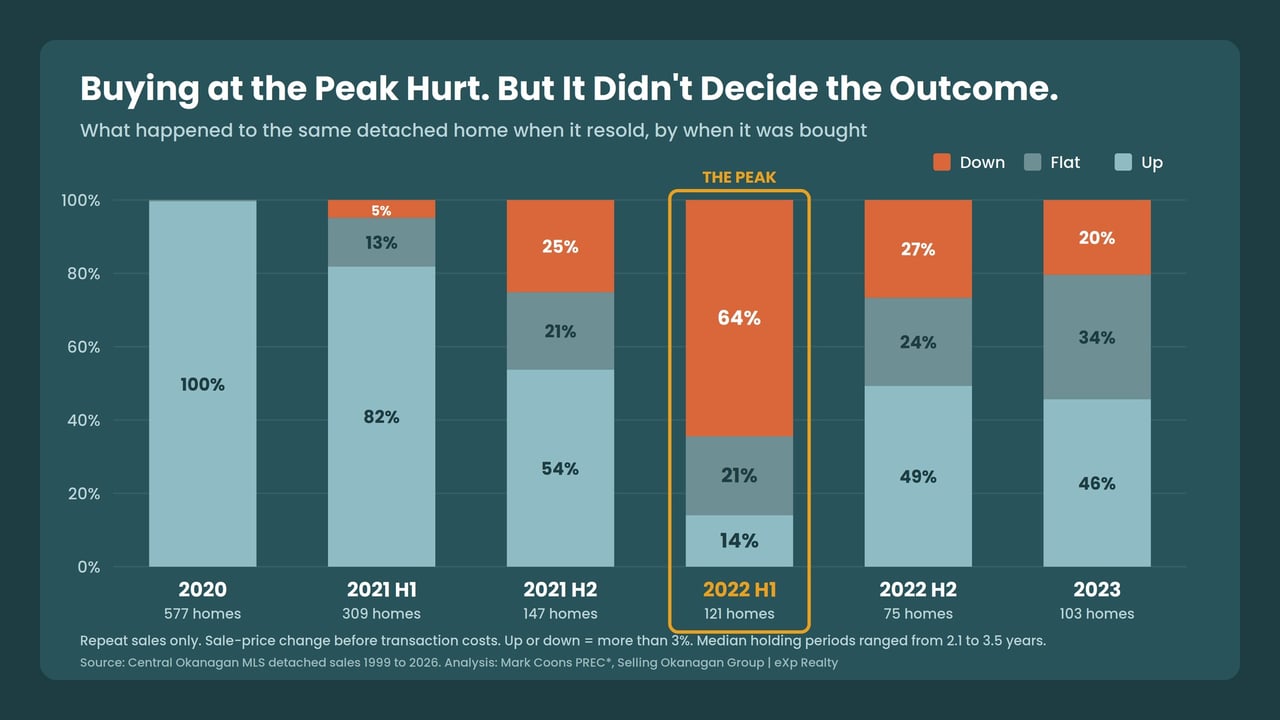
Because about 14% of the clean repeat sales I tracked from the first half of 2022 later sold for more than 3% above their original purchase price.
They bought near the peak.
They went through the same interest-rate increases.
They owned through the same slower Kelowna market.
And somehow their homes still sold for more.
So I went property by property looking for the reason.
What I found wasn't quite what I expected.
The clearest difference was the price they paid
This was the strongest signal in the data.
I compared each property's 2022 purchase price per square foot with the median price per square foot in its own Central Okanagan subarea during the same six-month period.
Among the properties that later gained more than 3%, roughly 71% had originally been purchased below their area's median price per square foot.
Among the other repeat sales?
About 41% had.
The typical winner had originally been bought roughly 3% below its local area's median price per square foot.
The typical non-winner had been purchased roughly 4% above it.
That doesn't mean price per square foot determines whether a property is a good deal.
It doesn't adjust perfectly for renovations, views, land, condition, waterfront or other features.
But across the group, the pattern was difficult to ignore.
The buyers who did better later generally appeared to have bought better going in.
They weren't winning because they bought newer homes
This one surprised me.
The typical home in the winning group was about 24 years old when it was purchased in 2022.
The typical home in the rest of the repeat-sale group?
Also about 24 years old.
Almost no difference.
So the data doesn't support a simple conclusion like:
“Buy newer and you'll protect your value.”
Some newer homes did well.
Some older homes did well.
Age alone wasn't what separated them.
They tended to have more land
There was a more noticeable difference when I looked at lot size.
The median lot among the apparent winners was about 11,300 square feet.
For the other repeat-sale properties, it was closer to 8,300 square feet.
That's roughly 3,000 extra square feet of land.
The winning properties were also somewhat larger inside: about 2,765 square feet at the median versus roughly 2,492 square feet for the rest.
I wouldn't turn that into a rule that bigger houses always appreciate more.
They don't.
But it suggests that buyers continued putting value on properties offering something harder to recreate: usable space and land.
Holding longer didn't explain it
I expected the winners might simply have owned their homes longer.
They didn't.
The typical winner in this property-level group held for about 2.1 years before selling.
The other repeat sales were held for roughly 2.6 years.
So the winners actually sold sooner.
That matters because it removes an easy explanation.
They didn't outperform simply because they waited longer for the market to recover.
Something about the property and the original purchase mattered.
There wasn't one magic neighbourhood
The winners were spread across the Central Okanagan.
Lower Mission showed up several times.
So did South East Kelowna.
There were also winners in Lakeview Heights, Peachland, North Glenmore, Wilden, West Kelowna Estates, Lake Country, McKinley Landing and other areas.
The sample is much too small to declare one neighbourhood the winner.
And I think that's actually the useful finding.
Location mattered, but buying in one specific Kelowna neighbourhood wasn't the answer.
There were successful purchases on both sides of the bridge and across very different price ranges.
What about suites?
I expected income potential to be one of the clearest differences.
It wasn't.
I looked at basement descriptions for separate entrances and walkouts.
At the time these buyers purchased in 2022, separate entrances showed up at almost the same rate among the winners and everyone else.
Walkout basements didn't clearly separate the groups either.
That doesn't mean suites aren't valuable.
For many buyers they absolutely are.
But this dataset does not give me enough evidence to say:
“The 2022 buyers who made money bought homes with suites.”
The numbers don't support that conclusion.
And there were some properties that broke the rules completely
This might be the most important warning when using averages.
One of the stronger-performing properties in the study was purchased at a price per square foot dramatically above its broader subarea average.
It still later sold for more than 20% above its 2022 purchase price.
So was the buyer wrong to pay that premium?
Apparently not.
That is the problem with treating price per square foot as an appraisal.
Some properties have characteristics that the average simply cannot capture.
Land.
Location.
Privacy.
Water access.
Views.
Redevelopment potential.
Condition.
Architecture.
Or something else that is difficult to replace.
The numbers help you find the question.
You still need to understand the property.
So what actually separated the winners?
After going property by property, I don't think the lesson is:
Buy a certain neighbourhood.
Buy a certain age of house.
Buy something with a suite.
Or hold for an exact number of years.
The strongest measurable difference was much simpler.
A lot of the winners appear to have bought well in the first place.
Not necessarily cheaply.
But well relative to the alternatives around them.
They were also more likely to own somewhat larger homes on larger lots.
And some owned properties with characteristics that were difficult to compare directly with the average home.
That changes how I think about the original 2022 story.
Yes, timing mattered.
Buying during the peak made things harder.
But timing didn't decide everyone's result.
What would I do with this if I were buying today?
I wouldn't spend all my energy trying to predict whether Kelowna prices will be 5% higher or lower next year.
I'd spend more time making sure I'm buying the right property at the right price.
How does its price compare with actual nearby sales?
What am I paying a premium for?
Is that premium something another buyer is likely to value later?
Does the property have permanent weaknesses?
Could I buy something similar for less?
And if the market goes nowhere for three years, am I still comfortable owning it?
Because this study gives us a pretty good real-world experiment.
These buyers all purchased during roughly the same six-month period.
They all entered one of the most expensive markets the Central Okanagan had experienced.
Yet their results were completely different.
The market mattered.
But what they bought and what they paid mattered too.
And that might be the more useful lesson for anyone buying a home today.
If you're looking at a property and want to know how its price actually compares with similar homes—not just the Kelowna average—send me the address.
I'll dig into the numbers.
Because sometimes the best protection against buying at the wrong time is simply making sure you don't buy the wrong property at the wrong price.
Mark Coons, BBA, CE
PERSONAL REALTOR CORPORATION® | eXp Realty Kelowna
Team Lead, Selling Okanagan Group
Relocated to Kelowna in 2018
📞 778-946-6454
📩 [email protected]