Why Two Kelowna Homes Bought in 2022 Could Have Completely Different Results
Two people could have bought detached homes in Kelowna in 2022.
They could have bought within a few months of each other.
They could have held for roughly the same amount of time.
And one could have lost more than 20%.
The other could have made money.
Same market.
Same general timing.
Completely different result.
That is why I think one of the most misleading things we do in real estate is talk about “the market” as though every homeowner experienced the same thing.
They didn’t.
What actually happened to buyers from the 2022 peak?
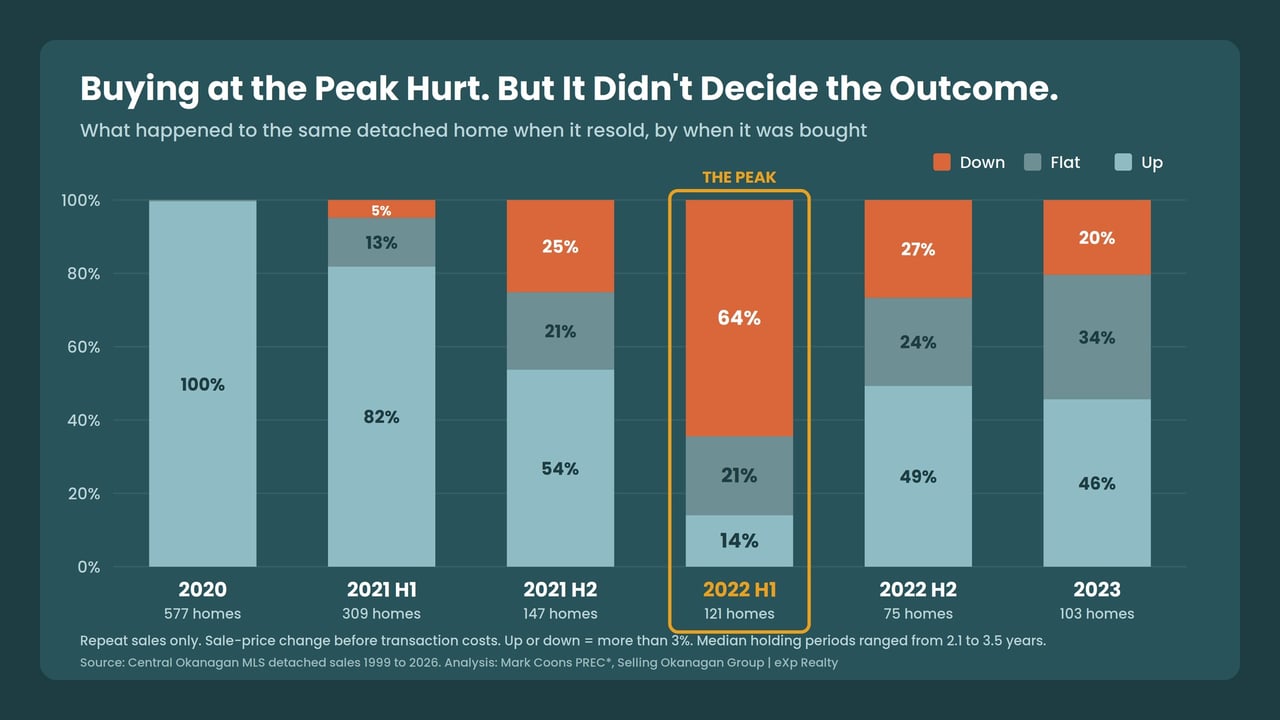
I pulled every detached home sold in the Central Okanagan between January and June 2022.
There were 1,350 purchases during that six-month period.
About one in ten of those properties has sold again since.
After removing homes where renovations, additions, rebuilds or major data changes made the comparison unreliable, I was left with 121 properties I could compare reasonably cleanly.
Same property.
Bought around the peak.
Sold again later.
The results were very different.
- 64% resold for more than 3% below their original purchase price.
- 21% were roughly flat.
- 14% sold for more than 3% above what they originally paid.
The typical resale was roughly 7% below the 2022 purchase price.
That tells us buying near the peak clearly mattered.
But there is another question I think is more interesting.
Why did some homes lose significantly more than others?
And why did some actually increase in value?
Buying in 2022 wasn't automatically the problem
It would be easy to stop at the headline:
“2022 buyers lost money.”
But that is not actually what the data says.
Most of the homes that resold were down.
Some were down substantially.
But a meaningful group held their value, and another group sold for more than the owners originally paid.
That means purchase year alone cannot explain the result.
Something else mattered.
Most likely, several things did.
The first difference: what you paid
Two similar houses can have very different investment results simply because one buyer paid more aggressively.
That matters most in a fast market.
During periods where buyers are competing, writing unconditional offers and bidding over asking price, it becomes easier to pay ahead of the underlying value of the property.
Imagine two homes that may have reasonably been worth around $900,000.
One buyer purchases for $910,000.
Another gets caught in competition and pays $1,020,000.
Even if both homes are worth $950,000 a few years later, those homeowners will tell completely different stories about the market.
One gained value.
The other lost value.
Same market.
Different starting point.
The second difference: not every home follows the average
A benchmark price is useful.
An average price is useful.
A median price is useful.
But none of them tell you exactly what happened to one specific property.
A renovated home on a quiet street with a suite, good parking and a usable yard may behave very differently from a dated house on a busy road.
Even if they are technically in the same neighbourhood.
Buyers do not buy market statistics.
They buy homes.
And when the market becomes slower, buyers usually become more selective.
That can create an even bigger gap between desirable properties and properties with compromises.
The third difference: neighbourhood matters
Kelowna is not one single housing market.
Neither is the Central Okanagan.
Lower Mission is different from Rutland.
Glenmore is different from Black Mountain.
Lakeview Heights is different from Westbank.
Even inside individual neighbourhoods, one street can perform differently from another.
Views, traffic, school catchments, lot size, wildfire exposure, access, age of construction and nearby development can all influence what buyers are willing to pay.
So when someone says:
“Kelowna prices are down 7%.”
My next question is:
Which Kelowna home?
Because that 7% might have very little to do with yours.
The fourth difference: property characteristics matter more in a slower market
During an extremely strong seller's market, buyers will often compromise.
They might accept:
- an awkward floor plan,
- an older kitchen,
- road noise,
- steep driveways,
- deferred maintenance,
- limited parking,
- small yards,
- unusual layouts,
- or a location that wasn't originally their first choice.
Why?
Because there are few alternatives.
When inventory increases, that changes.
Buyers suddenly have choices.
And when buyers have choices, weaknesses become expensive.
That is one reason two homes that seemed similarly priced in 2022 may have performed very differently afterward.
The fifth difference: price range matters
Different parts of the housing market can behave differently at the same time.
A $750,000 detached home does not necessarily have the same buyer pool as a $1.5 million home.
Higher-priced homes can be more sensitive to financing costs, discretionary spending and buyer confidence.
Entry-level homes may have stronger demand but can also be more affected by mortgage qualification.
That means even saying:
“Detached homes are down X%.”
still hides a lot.
The more useful question may be:
What happened to homes like yours?
The winners might tell us more than the losers
The most interesting group to me is actually the 14% that sold for more than their 2022 purchase price.
Remember, these owners bought during one of the most expensive periods our market had seen.
Yet they still came out ahead on sale price.
I want to know what those homes had in common.
Were they in certain neighbourhoods?
Did they have suites?
Better lots?
Views?
More land?
Were they renovated?
Did the original buyers simply negotiate better?
Or were they buying properties that were temporarily overlooked during the frenzy?
Those questions may tell us far more about real estate than simply knowing whether the overall market went up or down.
What this means if you're selling
If you bought in 2022, do not automatically assume you're underwater.
And don't assume you're fine either.
Your purchase price matters.
Your home matters.
Your neighbourhood matters.
And what buyers currently value matters.
The only useful way to answer the question is to compare your property against today's alternatives and against homes that are actually similar to yours.
What this means if you're buying
Do not spend too much time trying to perfectly predict the market.
Nobody knows exactly where prices will be three years from now.
Instead, pay attention to the things you can control.
Buy a property that is likely to remain desirable.
Understand its weaknesses.
Know what comparable properties are selling for.
Avoid getting caught up in competition simply because everyone else is bidding.
And give yourself enough time.
Because one of the clearest lessons from the 2022 data is this:
But the individual property and the price you pay can matter just as much.
Two buyers can buy during the same market.
One can later say buying in 2022 was a terrible decision.
Another can say it worked out just fine.
And both can be telling the truth.
If you bought a home around the 2021–2022 peak and want to know how your property has actually performed, send me the address.
I can compare it against current sales and similar repeat-sale properties.
Not the Kelowna average.
Your home.
Mark Coons, BBA, CE
PERSONAL REALTOR CORPORATION® | eXp Realty Kelowna
Team Lead, Selling Okanagan Group
Relocated to Kelowna in 2018
📞 778-946-6454
📩 [email protected]