How Long Do You Actually Need to Own a Kelowna Home?
“How long should I plan to own a home before buying?”
You will hear a lot of simple answers.
Five years.
Seven years.
Buy whenever you can and hold forever.
But I wanted to know what the actual Central Okanagan sales data says.
So I looked back across 27 years of detached home sales and compared what owners originally paid with what those same homes later sold for.
The result was pretty clear.
There is no magic number of years that guarantees you make money.
But your holding period matters a lot.
And short ownership is much less forgiving than most people realize.
The biggest risk is needing to sell too soon
A home can be a great long-term purchase and still be a bad short-term one.
That distinction matters.
Take owners who sold after owning for roughly 2 to 3 years.
During the long, flatter market from 2010 through 2015, about 30% sold for more than 3% below what they originally paid.
Now compare that with owners selling after similar holding periods from 2024 through 2026.
About 32% sold for more than 3% below their purchase price.
Almost identical.
Different decade.
Different interest rates.
Different home prices.
Very similar outcome.
That tells me something important:
Short ownership during a flat or declining market has always carried risk.
This isn't something unique to today's Kelowna real estate market.
What happens when you stay longer?
This is where things become more interesting.
I compared owners who sold after holding for roughly 5 to 7 years.
During 2010–2015, around 30% still sold below what they had originally paid.
For recent sellers with a similar holding period?
About 1% did.
Same basic holding period.
Completely different result.
Why?
Because the purchase price still matters.
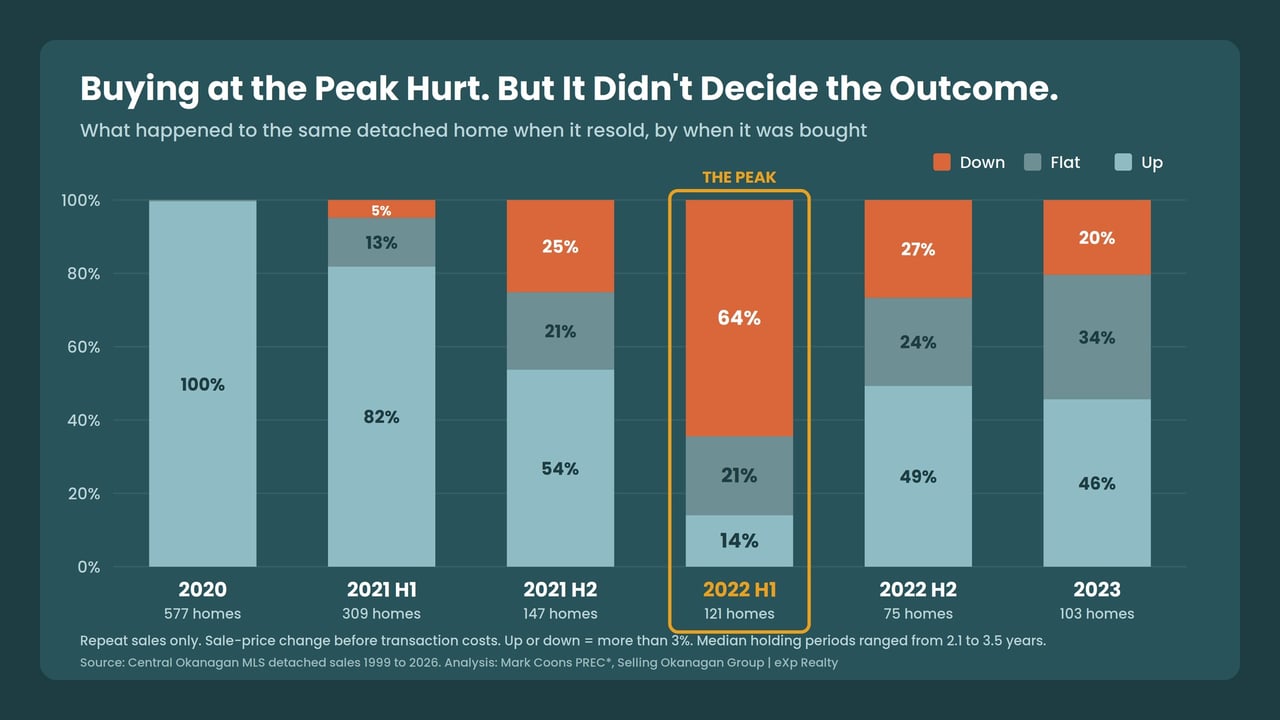
Many of today's 5-to-7-year owners bought before the huge increase in home values during 2020 and 2021.
They built up a significant price cushion before the market flattened.
Many owners selling during the earlier flat period had bought much closer to the 2007 market peak.
They didn't have that same cushion.
So time matters.
But where the market was when you bought matters too.
What about owning for 10 years?
This was probably the clearest number in the entire study.
Across 27 years of Central Okanagan detached home sales, I found 4,348 homes that had been owned for at least 10 years before being resold.
Only 10 sold for less than the owner originally paid.
Ten.
That does not mean owning a home for 10 years guarantees you make money.
It doesn't.
But it shows how dramatically the risk of selling below your original purchase price has historically fallen when owners have had a long enough timeline.
So is 10 years the answer?
Not exactly.
The lesson isn't:
“You must own every house for 10 years.”
The lesson is:
The shorter your timeline, the more important your purchase price becomes.
If you buy a home today and know you may need to move again in two years, you have much less room for error.
If prices fall 5%, transaction costs alone can make the move painful.
But if you expect to own the property for 7, 10 or 15 years, short-term market swings become less important.
You have more time for:
- the market to recover,
- inflation to raise nominal home values,
- your mortgage balance to decline,
- rents and incomes to change,
- neighbourhoods to improve,
- and demand to move through another market cycle.
Time gives you options.
Sale price isn't the same thing as profit
There is another important catch.
When I say a property later sold for more than its original purchase price, that does not mean the owner necessarily made money.
There are costs on both sides of home ownership.
Depending on the situation, those can include:
- real estate commissions,
- legal fees,
- mortgage penalties,
- moving expenses,
- maintenance,
- renovations,
- property taxes,
- insurance,
- and the cost of buying the next home.
Imagine buying for $800,000 and selling three years later for $825,000.
On paper, the house increased by $25,000.
But after the costs of buying, owning and selling it, that homeowner may still have gone backwards financially.
That is another reason short-term ownership can be difficult.
The house doesn't just need to hold its value.
It often needs to appreciate enough to overcome the costs of getting in and out.
Why the five-year rule is too simple
You often hear that buyers should plan on staying in a home for at least five years.
It's not terrible advice.
But it can create false confidence.
Five years after buying near the bottom of a market can look very different from five years after buying near the top.
The home itself matters too.
Buying a highly desirable property at a sensible price may give you more flexibility.
Overpaying for a compromised property can make even a longer holding period uncomfortable.
Instead of asking only:
“Will I be here for five years?”
I would ask:
“How much flexibility do I have if life changes earlier than I expect?”
That is the more useful question.
What if you're buying a Kelowna home today?
I wouldn't try to perfectly time the market.
Nobody can reliably tell you where Kelowna home prices will be two years from now.
Instead, I would focus on reducing the things you can control.
Buy within a comfortable budget.
Know what comparable homes are actually selling for.
Be careful about paying a premium during competition.
Look for properties with features future buyers are likely to value.
And most importantly, think honestly about your timeline.
If there is a good chance you'll need to sell again in two or three years, that should affect what you buy and how aggressively you pay for it.
If you're buying something that could realistically work for you for the next decade, short-term market movements matter a lot less.
What if you already own?
Your purchase year is important.
But it doesn't tell the whole story.
Someone who bought in 2017 and someone who bought in early 2022 may both be looking at today's market very differently.
Your actual position depends on:
- what you paid,
- what your home would sell for today,
- how much mortgage remains,
- what it would cost to move,
- and what you would be buying next.
That is why I don't think homeowners should make decisions based only on headlines saying Kelowna prices are “up” or “down.”
The better question is:
What happened to your home since you bought it?
So how long should you own a Kelowna home?
There isn't one number that works for everyone.
But the historical data points in a pretty simple direction.
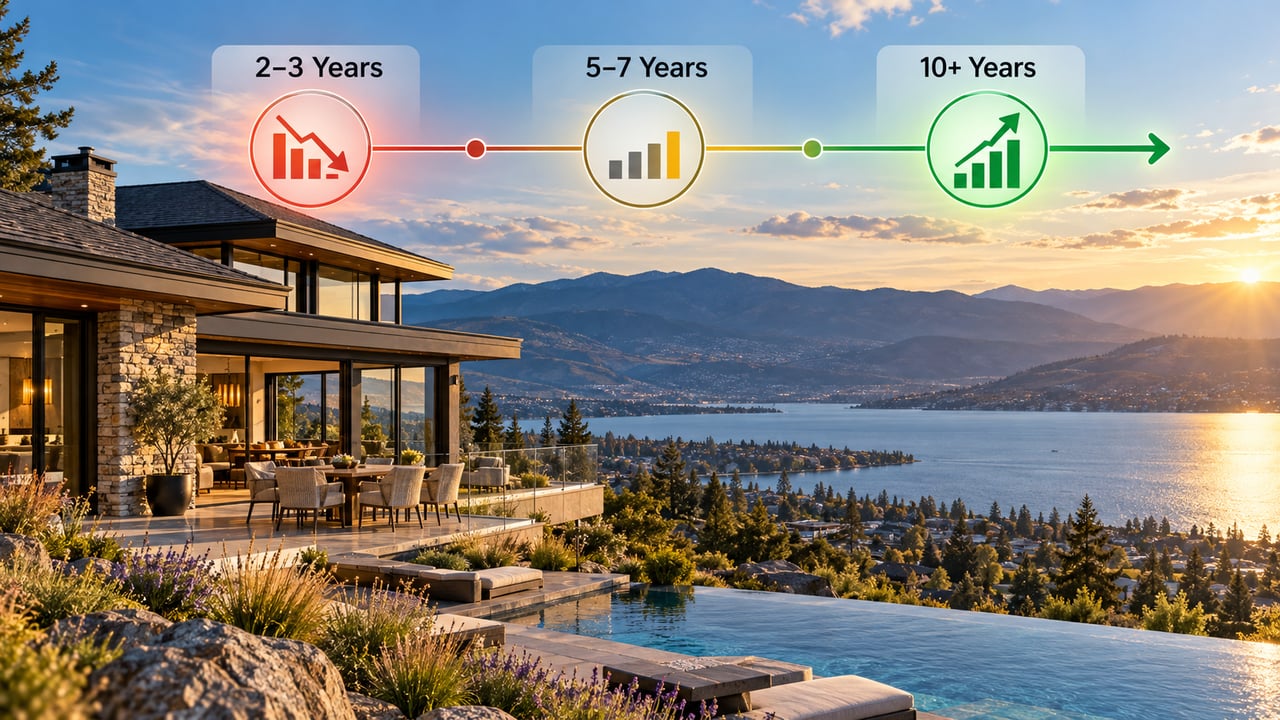
Two or three years can be risky.
Five to seven years gives you more room, but your purchase timing still matters.
And historically, owners who were able to hold detached homes for 10 years or longer were extremely unlikely to later sell below their original purchase price.
The lesson isn't that real estate always goes up.
It doesn't.
The lesson is that time gives you room to survive the periods when it doesn't.
If you're thinking about buying and want to know whether your timeline makes sense for today's Kelowna market, send me what you're considering.
And if you already own, send me your address and when you bought it.
I'll show you how your actual home has performed.
Not the market average.
Yours.
Mark Coons, BBA, CE
PERSONAL REALTOR CORPORATION® | eXp Realty Kelowna
Team Lead, Selling Okanagan Group
Relocated to Kelowna in 2018
📞 778-946-6454
📩 [email protected]