Quick Answer: Kelowna's condo market splits in two. Apartments still held by developers carry roughly 17 months of supply. Apartments being resold by owners carry 6.6. Standard market reports average them into one number that describes neither market, which is why the headline reads flat while resale prices quietly fall.
Analysis as at September 2, 2026 | Read time: 10 minutes
About the data in this article. This is a point-in-time analysis, not a page I maintain. Every figure below is dated and sourced where it appears. My own MLS figures come from a Central Okanagan Matrix pull dated September 2, 2026, covering single family, apartment, and townhouse or half duplex listings in Kelowna, West Kelowna, Lake Country and Peachland. Big White, manufactured homes and vacant lots are excluded, so my totals will not match Association of Interior REALTORS board figures, which use a wider set. Year to date comparisons run January 1 to August 31, 2026 against the same period in 2025. Conditions after September 2026 are not reflected here.
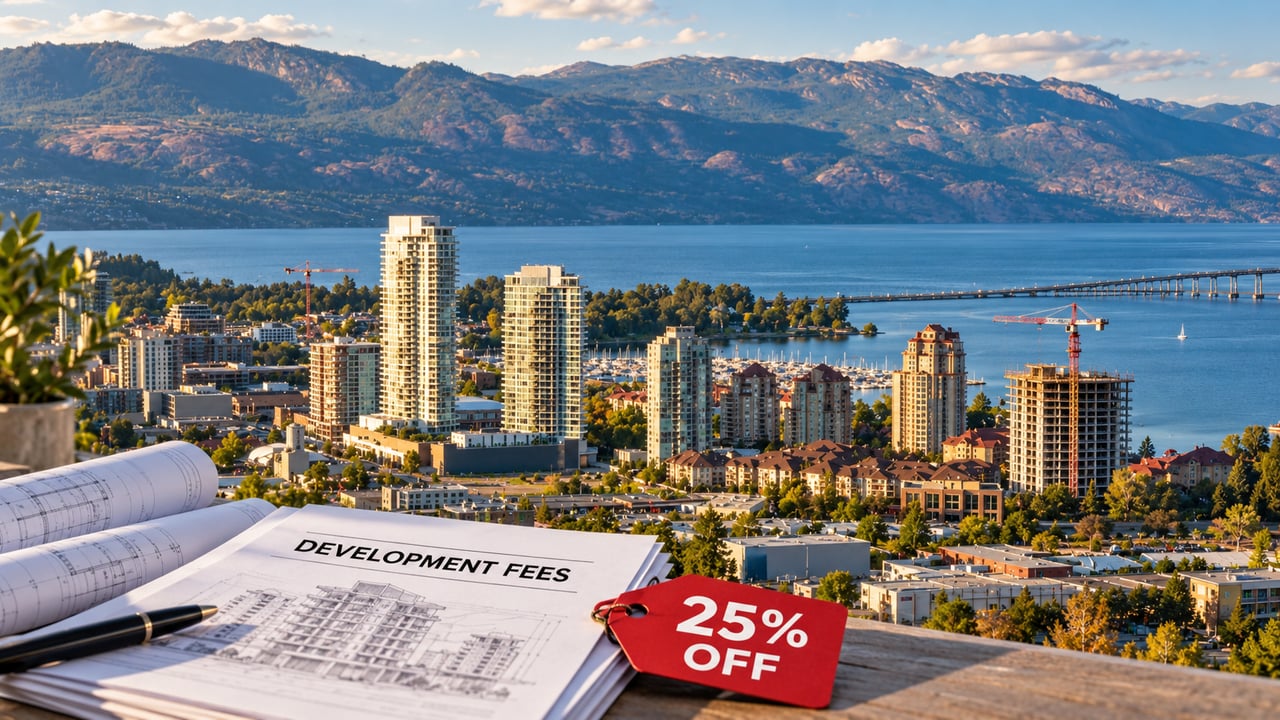
The city just put its development fees on sale
On August 4, 2026, Kelowna's temporary Development Cost Charge reduction took effect. 25 per cent off, running until September 30, 2028, under Bylaw No. 12930, which council adopted on July 27, 2026.
A DCC is what a builder pays the city on each new unit to fund roads, sewers, water mains and parkland. As at the City's April 2026 report to council, Kelowna's residential DCCs ranged from roughly $28,000 on an apartment to $52,000 on a single family home, varying by location.
Most coverage framed it as relief for builders. The more useful question is what a discount tells you about the seller.
Who discounts something that's selling?
Nobody. You discount when the buyer stopped showing up.
And the discount barely moves the math. Per the City of Kelowna's own April 20, 2026 report to council, DCCs represent 3 to 6 per cent of total costs on most residential projects. Cutting them by a quarter takes roughly one per cent off a build. That does not rescue a stalled project.
So the dollar value is not the story. The act is.
Worth noting how it got there. Staff recommended about 20 per cent for one year. Council went further and adopted 25 per cent for two. The city read its own market as worse than its staff did.
Two condo markets in one city
Working from my September 2, 2026 Matrix pull, I separated every active Central Okanagan listing into units still held by the developer and units owned by people reselling.
My rule, and you can check it against the list: a unit counts as developer held when two things are true on that date. It sits in a building carrying two or more active listings, and that building was completed in 2025 or later. Concentration is what separates builder inventory from ordinary turnover, and the 2025 cutoff is where the test stops picking up investor clusters rather than original stock.
The rule is deliberately blunt. It will catch a handful of investor blocks that are not developer owned, and it will miss units a builder holds one at a time. I would rather publish a rule you can check than a judgment call you cannot.
As at September 2, 2026 there were 224 of them, across 44 buildings. That is 224 units out of 2,582 active listings, 8.7 per cent of everything on the market that day.
They are not spread evenly. On that date, two out of every three active condo listings built in the last four years were developer inventory, not owners cashing out. A good share of that stock sits in downtown Kelowna condos, where most of the recent tower completions landed.
The months of supply gap
Central Okanagan, as at September 2, 2026. Source: my own MLS analysis.
Segment | Months of supply |
Developer held apartments | 17.0 |
Resale apartments | 6.6 |
Developer held townhomes | 16.8 |
Resale townhomes | 6.6 |
Developer held detached | 14.0 |
Resale detached | 7.7 |
Same city. Same month. Same property type. Two and a half times the selling time on condos and townhomes, and still nearly twice on detached, depending only on who holds the keys.
Every market report you read blends those two into one condo number. That number describes neither market.
Why 17 months is a floor, not a ceiling
That figure only counts what developers have chosen to put on MLS.
Most do not list an entire building at once. They release in phases, hold floors back, and keep units off the system until they are ready to move them. Those units exist. They are finished or nearly finished. They are simply invisible to anyone counting listings.
Assignments are invisible too. Someone who bought a presale in 2022 and is now trying to sell the contract before completion never appears as a listing.
The measurable part of the overhang is 17 months. The unmeasurable part sits on top of it, and I cannot size it. Neither can anyone else.
If you are shopping new construction, that is the single most useful thing on this page. The inventory you can see is not the inventory you are negotiating against.
Meanwhile, the half you can actually shop is tightening
Set the developer stock aside and look at what regular owners were listing across the Central Okanagan. All figures below compare August 2026 to August 2025, or January through August 2026 to the same period in 2025, from my own MLS analysis:
- Active resale listings at August 31, 2026, all three core types: down 13 per cent year over year
- Detached: down 18 per cent
- Apartments: down 14.2 per cent
- New listings, January 1 to August 31, 2026: 6,590 against 7,681 in the same period of 2025, down 14.2 per cent
- Sales over the same window: 2,647 against 2,695, down 1.8 per cent
Read those last two together. Sellers are leaving this market roughly seven times faster than buyers are.
In July 2026 the sales to new listings ratio hit 52 per cent, the highest monthly reading in the two years to August 2026, and months of supply fell from 8.0 in July 2025 to 6.2 in July 2026. I am using July rather than August because August sales were still being reported when I pulled the data. If you want the board level view alongside mine, I break it down every month in the latest Central Okanagan monthly market statistics.
And sell through is rising. That is the share of listings that actually sell rather than expiring or being cancelled, and almost nobody publishes it. Measured January through August, detached went from 39.3 per cent in 2025 to 43.8 per cent in 2026. Apartments went from 40.9 to 44.1. Both are the highest of the three years I compared.
A market drowning in supply does not clear a rising share of its listings.
Get the full list — all 44 buildings
Every building holding developer inventory in the Central Okanagan, with units, build year, price range and how long the builder has been carrying the release. Plus the five questions to ask before you offer.
Send Me the 44 Buildings Report — Free. No spam. Just the data.
See the latest homes for sale in Kelowna here
The developer play: $157,000 in price cuts, $655,000 in credits
Here is where the two halves connect.
A price list dated June 2026 from one downtown Kelowna project covers ten move in ready homes, showing old price and new price side by side. Developer pricing changes frequently, so treat this as a snapshot of that project in mid 2026 rather than a standing offer.
The published reductions across those ten units total $157,000. Against $9.5 million of original asking, that is 1.65 per cent.
The decorating credits attached to the same ten units total $655,000. That is 6.9 per cent.
Combined, a buyer walks away with roughly 8.5 per cent off. The sale record will show 1.65 per cent.
On those units, list price works out to about $1,018 per square foot. Net of credits it is closer to $947. Seven per cent, invisible.
A decorating credit is money toward finishing the home. Blinds, window coverings, furniture. From my own conversations, what those budgets can be spent on is negotiable. That is observation rather than measurement, but it means the credit functions close to cash for anyone who was furnishing the place anyway.
It never touches the sale price.
Why the market looks flat when it isn't
This is what the concession structure does to published statistics.
Median price per square foot on resale product, January through August 2026 against the same period in 2025:
- Apartments: $432 to $417, down 3.5 per cent
- Townhomes: $410 to $385, down 6.0 per cent
- Detached: $400 to $395, down 1.3 per cent
Now the blended figures, which include new construction: apartments down 0.6 per cent, detached down 0.7 per cent.
Apartments are the tell. Resale condo is down 3.5 per cent per foot, but the blended number reads 0.6.
The gap is mix. New construction went from 9.7 per cent of condo sales to 15.5 per cent, and new build sells at $772 a foot against $417 for resale. More expensive product entering the sample pulls the median up while the stock underneath it falls.
And because concessions never reach the sale record, that $772 is overstated too. Which means every published price per foot figure for new construction in this market, including mine, is high by whatever the typical credit is.
Developers hold price. They don't cut it.
As at September 2, 2026, 14.8 per cent of active new build apartment listings had taken a price reduction. Older apartments, 35.9 per cent. New build detached, 18.3 per cent against 34.2 per cent for older stock.
That is not pricing discipline. It is a discount being delivered somewhere the MLS has no field for.
It holds even among the listings that failed. Of the listings that gave up and expired across 2025 and 2026, 30 per cent of new build had ever taken a reduction, against 40.7 per cent of resale. A builder would rather carry a unit than reprice the ones still unsold behind it.
The one exception: townhomes
I am not going to hide the segment that breaks the pattern.
Townhomes were the only property type where resale inventory grew. Comparing August 2026 to August 2025, developer held townhome stock rose 4.5 per cent while resale townhome listings rose 5.4 per cent. Measured against August 2024, developer stock fell 7.1 per cent and resale rose 12.4 per cent.
That is owners adding to supply, not builders.
Townhomes are also the only type where price per foot is falling on both the resale and blended measure, down 6 per cent either way. No mix effect is hiding anything. It is just down.
If you own a townhome in the Central Okanagan, your position is different from your neighbour in a house. More competition, softer pricing, and no averaging trick masking it. Building level results vary more than most owners expect, which is the point I made when I looked at how individual Kelowna condo buildings performed since the 2022 peak.
What the city wrote in its own report
The April 20 report to council is worth reading directly.
Staff wrote that the housing market today may appear well supplied, but that there is a risk this is "a short-term condition that will be followed by another shortage."
They also gave the mechanism. Demand and population growth slowed while construction and financing costs rose, so projects stopped penciling out. But multi family takes years from approval to occupancy, so the report says the full effect will not show in permitting for another one to two years.
The report describes today's supply as the product of decisions and investments made years ago that are only now concluding. The city is calling its own housing supply a time capsule.
The starts data agrees. The Central Okanagan Economic Development Commission's second quarter 2026 report recorded 1,143 housing units starting construction in Q2 2026, a 37 per cent decline from Q2 2025. Multi family accounted for almost all of it, falling from 1,679 starts to 1,056.
Construction sites still look busy across Kelowna. Those are projects financed and approved in 2021 and 2022, working their way to completion.
One more detail with a date on it. The city has a full DCC program review on hold, and staff expect it to raise rates. The 25 per cent discount is not a trend. It is a two year gap before an increase, and it closes September 30, 2028.
What I am not telling you
That prices are about to run. They are not.
Per the Central Okanagan Economic Development Commission's Q2 2026 report, regional unemployment sat at 8.3 per cent, up 2.2 points from Q2 2025. City reporting in April 2026 put Kelowna's rental vacancy rate above 6 per cent. Supply is tightening because sellers gave up, not because buyers showed up. For the national read on where demand goes next, CMHC's Housing Market Outlook is the one I watch.
The developer overhang is not growing either. On my data it peaked at 254 MLS listed units in August 2025 and sat at 224 a year later, down almost 12 per cent. New build condo sales for January through August 2026 came in at 115 against 70 in the same period of 2025, up 64 per cent, with the median moving from about $526,000 to $564,000. That inventory is draining. Slowly, but it is moving.
And the DCC cut has honest limits the city named itself. Staff estimated a 20 per cent cut would produce 200 to 350 additional homes, said a reduction alone may not make many projects viable, and noted that some builders will simply reschedule to catch the discount rather than build anything new.
What this means depending on what you own
If you own a detached home or a condo
Your competition is shrinking. Fewer sellers, a rising share of them succeeding, and the pool you compete in is not the pool making news.
If you own a townhome
The opposite. More competition and real price softness. Pricing strategy matters more for you this fall than for anyone else in this market.
If you are buying
The softness is concentrated in developer inventory, and it does not arrive as a lower asking price. It arrives as everything around the price, and only if you ask. If you are starting from scratch, my walkthrough on buying a home in the Central Okanagan covers the rest of the process.
If you are waiting
Name the window. "I will move when developer supply drops below X months" is a plan. "I will wait until the market feels better" is not one.
Frequently asked questions
Is now a bad time to buy a condo in Kelowna?
It depends entirely on which condo. As at September 2026, Central Okanagan resale apartments sat at 6.6 months of supply with inventory down 14 per cent year over year, while developer held new construction sat at roughly 17 months. Those are opposite conditions in the same city.
Are Kelowna condo prices dropping?
Yes, and by more than the headline number suggests. The Association of Interior REALTORS puts the Central Okanagan condominium benchmark at $465,700 in August 2026, down 5.5 per cent year over year. That is the MLS Home Price Index, which adjusts for what actually sold, so the new construction mix cannot flatter it. My own resale numbers point the same way and land a little softer, down about 3.5 per cent per square foot through August. The figure that disagrees with both is the blended median most coverage quotes, down 0.6 per cent, and that gap is what this whole post is about. One caveat worth stating: August activity across the Interior was slowed by wildfire evacuations, so read a single month carefully. July’s benchmark was $490,700.
Should I negotiate the price on a new build condo?
Ask what comes with it before you argue about price. As at September 2026, only 14.8 per cent of active new build apartment listings had taken a price reduction, but developers were running large decorating credits. On one downtown project's June 2026 price list the credits were roughly four times the size of the published price cuts.
Will the DCC reduction make homes cheaper?
Not meaningfully. DCCs are 3 to 6 per cent of a project's cost by the city's own estimate, so a 25 per cent cut is roughly 1 per cent off a build. Its value is as a signal about what the city expects, not as savings.
Is Kelowna heading for another housing shortage?
The City of Kelowna's April 2026 report to council says current conditions may be temporary and warns of another shortage ahead. Central Okanagan housing starts fell 37 per cent in the second quarter of 2026 against the same quarter in 2025. Whether that produces a shortage depends on whether demand recovers.
Talk to me about which market you're in
If you own a condo or townhome in the Central Okanagan and you want to know whether your building sits on the developer side or the resale side of this split, call or text me at 778-946-6454. I track all 44 buildings holding developer inventory and I will tell you where yours stands.
If you are shopping new construction, call before you write the offer. What is on the price sheet is not what the deal is worth. On the one price list I worked through in mid 2026 that gap ran about 7 per cent, and the only way to know the current number on a given project is to ask.
Mark Coons PREC* | Selling Okanagan Group | eXp Realty
778-946-6454
[email protected]
sellingokanagangroup.com
About the Author. Mark Coons PREC* is a REALTOR® , Personal real Estate Corporation with eXp Realty and founder of the Selling Okanagan Group. Mark has a Bachelor of Bussiness Administration and Certificate in Economics and tracks 27 years of Central Okanagan sales data and publishes regular market updates at sellingkelownarealestate.com. Based in West Kelowna, Mark serves in the Okanagan.