The 1970s BC Box Study
Are older homes still one of the best ways to buy a detached house in the Central Okanagan?
The short answer: A 1970s home may offer a much lower purchase price than a newer detached house, but that does not automatically make it a better deal. The real question is how much house, land and usable space you get after accounting for repairs, renovations and ongoing ownership costs.
In my recent review of Central Okanagan detached sales, homes built in the 1970s sold for a reported median of $825,000. Homes built in 2020 or later had a median of approximately $1.49 million.
That is a $665,000 difference between the two groups.
But there is a lot hiding behind those numbers.
Why I Started Looking at 1970s Homes
A few weeks ago, I was sitting with family friends talking about Canada's 2026 federal budget.
We ended up discussing something bigger than the budget itself.
What kind of home will our kids actually be able to afford 10 or 15 years from now?
Around the same time, I was working with buyers who were trying to narrow down what style of home made sense for them.
We kept coming back to the age of the houses.
And one type kept showing up.
The BC Box.
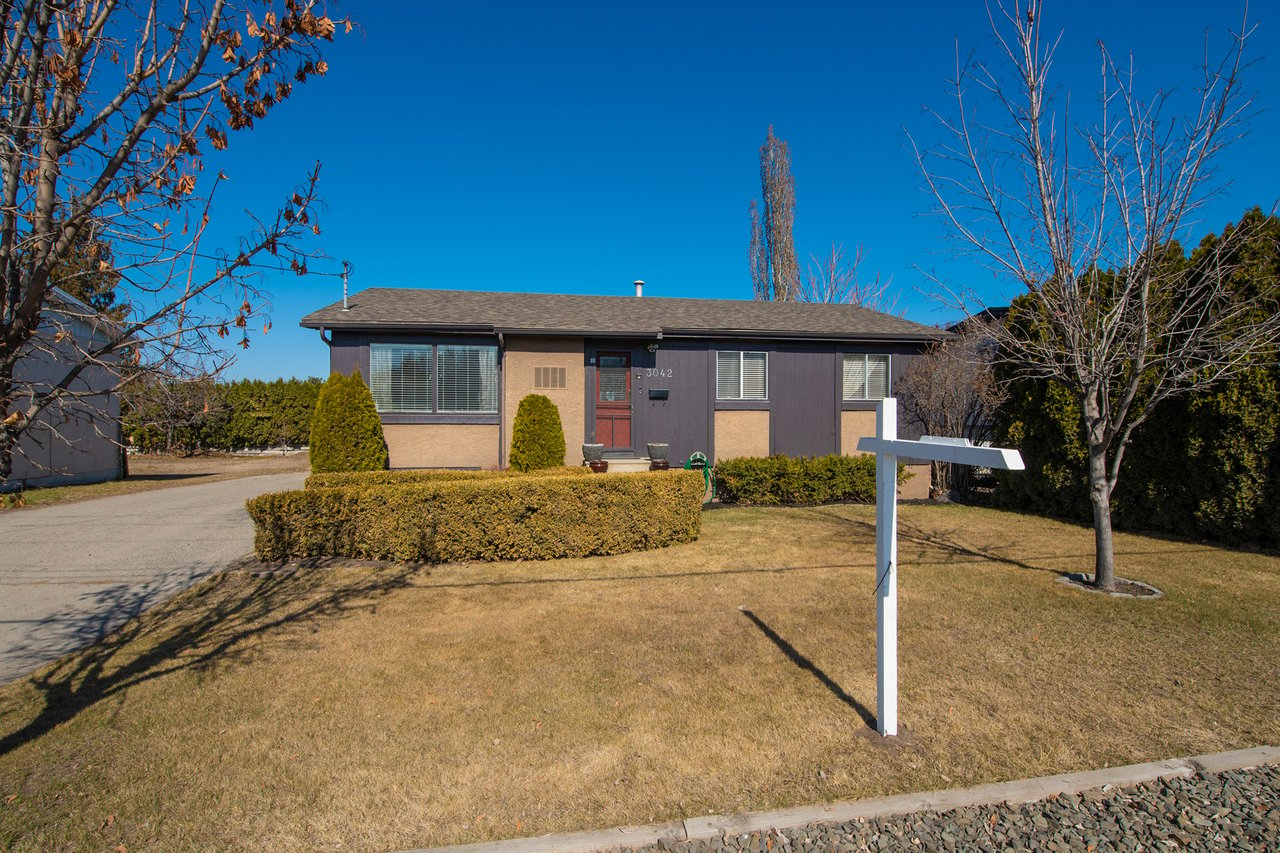
If you grew up around Kelowna, you probably know it. A simple two-level house, often with a front entry and stairs leading up to the main living area or down to the basement.
They are not usually the homes that get the most attention online.
But for decades, these types of houses have provided something families want: a detached home, usable living space and some room to grow.
I wanted to understand how they fit into today's market.
What Does a 1970s Detached Home Cost in the Central Okanagan?
Here is what my November 2026 research summary showed.
Detached home age | Median sale price |
|---|---|
Built in the 1970s | $825,000 |
Built in 2020 or later | Approximately $1,490,000 |
Difference between medians | $665,000 |
The research also found that roughly one in six detached homes sold during the study period had been built in the 1970s.
That makes this a meaningful part of the resale market, not just a handful of unusual properties.
A couple of points matter here.
First, these are Central Okanagan figures. They should not be confused with prices for the City of Kelowna alone.
Second, a median is the middle sale price in a group. It is not an appraisal of a typical BC Box.
The newer group may contain larger houses, newer neighbourhoods, different lot sizes and more expensive features. That means we cannot treat the $665,000 gap as the value of renovations or the cost of buying new construction.
Still, it shows why older detached homes deserve a closer look.
Source: Selling Okanagan Group MLS research summary, November 11, 2026. See methodology notes below.
What Makes a BC Box Appealing?
The biggest advantage is not necessarily that the home is old.
It is what the property may offer at its price.
Depending on the house, a buyer could get:
- A detached home with no shared walls
- A yard and outdoor space
- Separate living areas across two levels
- A basement that could serve several different family needs
- A layout that may allow changes over time
- A lower initial purchase price than many newer detached properties
For someone moving out of a townhouse or condo, that can be a meaningful change.
But I would be careful about assuming every older home has a large lot, a legal suite or redevelopment potential. Those details need to be checked on the actual property.
A house may have the right layout for a family without being suitable for the renovations they have in mind.
That distinction matters.
The Lower Purchase Price Is Only Half the Story
This is where I think buyers need to slow down.
Imagine two 1970s houses in similar locations.
One has had its roof, windows, electrical system, heating equipment and major plumbing updated.
The other still has many of its original systems.
They might look similar in listing photos.
They are not the same purchase.
A cheaper home can become expensive if several major repairs happen soon after moving in.
The right way to compare them is to look beyond the asking price.
A simple example
Let's use the $825,000 median sale price from my research as a starting point. This is an illustration, not an estimate for a particular property.
Cost | Example |
|---|---|
Purchase price | $825,000 |
Planned repairs and improvements | $75,000 |
Combined purchase and improvement budget | $900,000 |
That does not mean the house is worth $900,000 after renovations.
It means the buyer needs to plan for $900,000 in purchase and improvement costs, before purchase taxes, legal fees, financing costs, insurance and other expenses.
The $75,000 repair allowance is hypothetical. Some homes may need much less. Others may require significantly more.
And there is another issue.
Not every renovation dollar adds an equal amount of resale value.
A new roof may be necessary, but that does not mean a buyer will pay you the full replacement cost when you sell.
The goal is to buy a home that works financially and practically, not just one that looks inexpensive beside newer houses.
Five Things I Would Check Before Buying a 1970s Home
1. Electrical, plumbing and insurance
An older home may have had several updates over the years, or very few.
I would want to know what wiring is present, whether the electrical panel and major connections have been assessed, and what plumbing materials remain.
I would also check insurability before removing conditions.
Do not assume a house has a problem simply because it was built in the 1970s. Get the systems inspected and have any concerns assessed by qualified professionals.
2. The roof, windows and heating system
A home can look well maintained while still having expensive work coming due.
Ask for the age of the roof, service records for the heating equipment and details about window replacements.
I would also consider energy costs.
A lower mortgage payment is less helpful if monthly repairs and utility costs are much higher than expected.
3. Asbestos before renovations
Many Canadian homes built before 1990 contain materials that may include asbestos.
That does not mean every material is dangerous simply because it is present.
The concern is disturbing asbestos-containing materials during repairs or renovations.
If you are planning to remove ceilings, flooring, walls or other older materials, arrange appropriate professional assessment before starting the work. [1]
4. Moisture, drainage and the basement
A basement may offer valuable extra living space, but I would pay close attention to signs of water entry, foundation movement, grading and drainage.
A finished basement can hide conditions that need closer investigation.
I would also ask about radon testing. Health Canada recommends a long-term test of at least three months to properly assess radon levels in a home. [2]
5. Whether the layout actually works
This one gets overlooked.
Can the bedrooms, stairs, bathrooms and living areas work for your family?
Would you need to remove walls, move plumbing or make major structural changes to get the space you want?
A house with good bones can still be the wrong house if changing its layout costs more than you are prepared to spend.
You can download our free Kelowna Home Buyer's Guide for help with the broader buying process.
Are 1970s Homes Actually Holding Their Value?
I have already studied this question from another angle.
In an earlier analysis of Central Okanagan detached properties, I compared price changes from Q2 2022 to Q2 2026 while adjusting for neighbourhood and home size.
That analysis found:
Home age | Approximate adjusted price change |
|---|---|
1970s | -10.8% |
1980s | -9.0% |
1990s | -7.6% |
2000s | -10.4% |
2010s | -9.5% |
The 1970s group was not the strongest performer.
But it also did not behave like the pre-1970 group, which experienced a larger adjusted decline.
That is an important distinction.
A home built in 1975 is not automatically in the same market as a small house built in 1950 and being marketed mainly for its redevelopment potential.
Buyers should compare the home they want with similar homes in the same area, not with every property that happens to be old.
You can read the full research in Why 1990s Homes Are Winning.
Does an Older House Mean You Can Negotiate More?
Not necessarily.
In my earlier study of 2,013 Central Okanagan detached sales from August 1, 2025 through July 31, 2026, the median discount from the final asking price was approximately 3.7% for 1970s homes.
Most other decades were close to that level.
What made a clearer difference was how long a home had been listed.
Properties that stayed on the market longer generally showed more negotiating room.
That does not mean every stale listing is a good deal. It means buyers should consider price history, condition, comparable sales and seller expectations together.
For more detail, see When Negotiating Room Grows.
Are We Still Building the Next Generation of BC Boxes?
This is the bigger question for me.
Canada's 2026 federal budget proposes nearly $45 billion in housing measures on a cash basis, covering several parts of the housing system, including affordable housing, financing, infrastructure and construction barriers. [3]
Those policies may help create more homes.
But there is an important difference between adding more housing units and adding more detached houses that families can afford.
Townhomes, duplexes, fourplexes and apartments all have a role. They can provide more choices and use land more efficiently.
A detached house with a private yard serves a different need.
There is no guarantee that future construction will replace older detached homes with equally affordable new detached homes.
That is why I think existing houses from the 1970s deserve attention.
Not because every BC Box is special.
Because they represent a kind of housing that some families still want, and that may be difficult to reproduce at a similar price today.
The real test will be what gets built, what those homes cost and whether families can actually afford them.
So, Would I Buy a 1970s BC Box in Kelowna?
I would absolutely consider one.
But I would not buy it just because it is older or cheaper than a newer home.
I would want to know:
- Is the price fair compared with similar homes nearby?
- What major repairs are likely over the next five to ten years?
- Can I afford the house without relying on future price increases?
- Does the layout work without a major renovation?
- Would I still be comfortable owning it if the market stayed flat for several years?
If those answers work, an older detached home may be a very practical choice.
If the house needs extensive work, has a poor layout and is priced as though everything has already been updated, the lower purchase price may not be enough.
The year on the listing is only the beginning of the conversation.
Frequently Asked Questions
What is a BC Box house?
In the Okanagan, people often use the term BC Box to describe a simple, practical older detached-home style, commonly a two-level or bi-level design. It is an informal description, not an official MLS property classification. Not every house built in the 1970s is a BC Box.
Are 1970s houses cheaper than new homes in Kelowna?
In my November 2026 Central Okanagan research summary, detached homes built in the 1970s had a reported median sale price of $825,000 compared with approximately $1.49 million for homes built in 2020 or later. That is a comparison of two different groups of properties, not a like-for-like appraisal.
Is it risky to buy a 50-year-old house?
Age creates reasons to investigate, not automatic reasons to avoid a property. Inspection results, maintenance history, renovations, insurance and expected repair costs matter more than the build year on its own.
Can I turn the basement of a BC Box into a rental suite?
Possibly, but do not assume it is permitted or financially practical. Zoning, building permits, fire separation, entrances, ceiling heights, parking, servicing and other requirements must be checked for the particular property.
Should I buy an older home or a newer townhouse?
That depends on your budget, space needs and future plans. An older detached home may offer more control over the property but higher repair risk. A newer townhouse may offer newer systems and less direct exterior maintenance, though strata fees, bylaws and shared responsibilities need to be considered.
Want to Know Whether an Older Home Is Actually Good Value?
If you are comparing a BC Box with a newer home or townhouse, send me the address or price range you are considering.
I can help you compare similar recent sales, look at the condition and expected work, and build a clearer picture of what the purchase could cost.
Email me at [email protected] or call/text 778-946-6454.
And if you are simply keeping an eye on the market, subscribe to our weekly Okanagan real estate email for research and market updates.
You can also browse the latest Okanagan homes for sale.
Research Notes and Footnotes
Original local research: Mark Coons, Selling Okanagan Group, Okanagan Real Estate Market 11/11/2026, November 11, 2026. The email reports approximately one in six Central Okanagan detached sales built in the 1970s, a $825,000 median for that cohort and an approximately $1.49 million median for homes built from 2020 onward. The underlying MLS Matrix export and sample counts must be checked before publication.
Existing local research: Why 1990s Homes Are Winning and When Negotiating Room Grows. These are separate historical studies with their own date ranges and methodologies.
[1] Asbestos: Health Canada, Chemical safety for DIY projects and renovations; WorkSafeBC, A home renovation shouldn't actually take your breath away.
[2] Radon: Health Canada, Testing your home for radon.
[3] Federal housing measures: Government of Canada, Budget 2026: Budget in Brief.
About the author: Mark Coons, PREC*, BBA, CE, is a real estate professional with Selling Okanagan Group, brokered by eXp Realty in Kelowna, British Columbia. Mark works with buyers, sellers and investors across Kelowna and the Central Okanagan, focusing on local research and practical real estate decisions.