B.C. Rent Increase 2027: What the 2.2% Cap Means for Kelowna Landlords
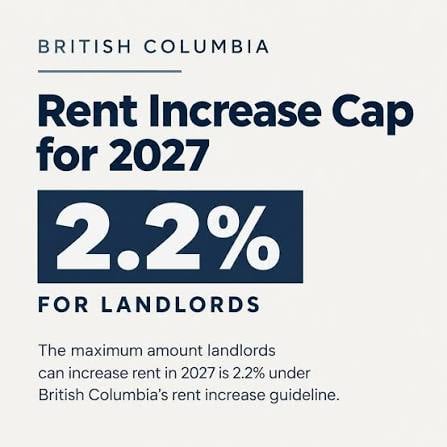
British Columbia has set the maximum allowable residential rent increase at 2.2% for 2027, down from 2.3% in 2026. The new limit takes effect January 1, 2027.
That is the headline.
But if you own a rental property in Kelowna, I think there is a more important question:
What happens when your rent can increase by 2.2%, but your expenses do not have the same cap?
That is where this becomes much more interesting for landlords and real estate investors.
What Is the B.C. Rent Increase Limit for 2027?
The maximum standard residential rent increase in British Columbia for 2027 is 2.2%.
The Province calculates the allowable increase using the 12-month average change in B.C.'s Consumer Price Index ending in July of the previous year. The Province also says this will be the seventh straight year the allowable increase has been capped at or below inflation.
But January 1 does not mean every landlord can automatically raise the rent that day.
For an existing tenancy, at least 12 months generally need to have passed since the rent was first set or since the last lawful increase. The landlord must also provide at least three full months' notice using the approved form.
So the 2.2% is the maximum standard increase.
The timing rules still matter.
What Does a 2.2% Increase Actually Mean in Dollars?
Here is what the maximum increase looks like:
Current Monthly Rent | 2.2% Increase | New Monthly Rent | Added Annual Rent |
|---|---|---|---|
$2,000 | $44 | $2,044 | $528 |
$2,500 | $55 | $2,555 | $660 |
$3,000 | $66 | $3,066 | $792 |
$3,500 | $77 | $3,577 | $924 |
Take a property collecting $2,500 per month.
A full 2.2% increase adds $55 per month, or $660 per year in gross rental income.
Now compare that $660 with what happened to the property's insurance, property taxes, repairs, strata fees, utilities, management costs and mortgage payments.
That is the part I think gets missed.
A 2.2% increase in rent does not mean a 2.2% increase in profit.
Your income is regulated.
Many of your expenses are not.
Kelowna's Rental Market Changes the Math
There is another important piece of this story that a province-wide rent cap does not show.
Kelowna has much more rental availability than it did a few years ago.
The City of Kelowna reported a 6.9% vacancy rate for the City in 2025, up from 3.8% in 2024. The broader Kelowna metro area was reported at 6.4%. The figures come from CMHC rental-market data.
That distinction matters.
When vacancy is extremely low, landlords have very little competition for tenants.
When vacancy rises, tenants have more choices.
That can mean more competition based on price, location, condition, amenities and incentives.
So a Kelowna investor really needs to understand two different numbers:
The legal rent increase: What can you charge an existing tenant?
The market rent: What will a new tenant actually pay for the property today?
Those can be very different numbers.
👉 See the latest homes for sale in Kelowna here
Existing Tenants and New Tenancies Are Different
The annual 2.2% limit applies to increases during an existing tenancy.
Before a new tenancy begins, the landlord and tenant negotiate the starting rent and agree on the services included in that rent.
That means you should not automatically use 2.2% to estimate what a vacant investment property could rent for.
If I were looking at a Kelowna investment property, I would want to know both numbers.
In-place rent: What is the current tenant paying?
Current market rent: What are comparable rentals actually achieving today?
The gap between those two numbers can materially change how I would look at the property.
Vacancy Could Matter More Than the Rent Increase
Here is a simple example.
A property rents for $3,000 per month.
A 2.2% increase adds $66 per month.
That is $792 per year.
Now imagine the property sits vacant for one month between tenants.
That costs $3,000 in lost gross rent.
One month of vacancy is almost four times the additional annual income created by that year's maximum rent increase.
That does not mean every landlord should expect a month of vacancy.
It shows why I would spend just as much time studying vacancy and tenant demand as I would studying the allowable rent increase.
Expenses May Be the Bigger Issue
Imagine two Kelowna rental properties.
Both collect $3,000 per month.
Both landlords apply the same 2.2% annual increase.
Both gain $792 in annual gross income.
But the first owner has a small mortgage, stable insurance costs and few repairs.
The second just renewed a large mortgage, has higher strata fees and needs several thousand dollars of maintenance.
Same rent increase.
Completely different investment.
This is why I would not judge a rental property's performance by rent growth alone.
You need to look at the entire property.
What I Would Check Before Buying a Kelowna Rental Property in 2027
Start with the actual rent being collected today.
Then compare it with realistic market rent, not simply the highest asking rent you can find online.
I would also estimate a reasonable vacancy allowance based on the type and location of the property.
Then work through the actual ownership costs: taxes, insurance, strata fees where applicable, repairs, maintenance, utilities and management.
Finally, put the financing back into the equation.
A property can look profitable before the mortgage payment and completely different after it.
For some investors, a mortgage renewal could have a much larger effect on monthly cash flow than the additional income created by the 2.2% allowable rent increase.
📥 Download our free Kelowna Home Buyer’s Guide today
Does Higher Vacancy Mean Kelowna Rental Property Is a Bad Investment?
No.
It means I would want better numbers.
A property might still make sense because of the purchase price, existing cash flow, a secondary suite, development potential, land value, future rental upside or long-term appreciation.
But I would be cautious about an investment that only works if rents continue rising quickly every year.
Higher vacancy gives investors another reason to stress-test that assumption.
A deal should still make sense when your assumptions are a little less optimistic.
What About Landlords Whose Costs Rise Faster Than 2.2%?
B.C. does have separate processes that may allow rent increases above the normal annual limit in certain situations.
The Residential Tenancy Branch says landlords may seek an additional increase for certain expenses or eligible capital expenditures, or a tenant may voluntarily agree in writing to a higher increase. These have their own requirements and should not be treated as an automatic right to increase rent beyond the annual limit.
For a property-specific situation, I would verify the current Residential Tenancy Branch rules rather than relying on a general article.
The Trade-Off for Tenants and Landlords
There are two sides to this.
For an existing tenant, limiting annual rent increases creates more predictability around housing costs.
For a landlord, rental income may not increase at the same rate as every cost of owning the property.
Both things can be true.
For an investor deciding whether to buy, however, the question remains the same:
Does the property work financially under realistic assumptions?
That is much more useful than simply asking whether rents are going up.
What I Would Watch Next in Kelowna
Going into 2027, I think the annual rent cap is only one piece of the rental-market story.
I would pay close attention to Kelowna vacancy, asking rents on newly available properties, concessions and incentives, new purpose-built rental supply, mortgage rates and changes in major ownership expenses.
I would also watch whether the big increase in available rental supply continues or starts to tighten.
If vacancy remains elevated, landlords may continue facing more competition.
If vacancy starts falling, the balance may shift again.
📩 Subscribe to our weekly email update for listings and market insights
The Bottom Line
B.C.'s maximum standard residential rent increase will be 2.2% in 2027.
But I do not think 2.2% is the most important number for a Kelowna landlord.
The bigger question is whether the property's rent, vacancy, expenses, financing and purchase price still work together.
The rent cap tells you how quickly rent on an existing tenancy may increase.
It does not tell you whether a property is a good investment.
Those are two different questions.
If you are looking at buying, holding or selling a rental property in Kelowna or the Central Okanagan, I would rather run the actual numbers on the individual property than make the decision based on a broad headline.
This article is general real estate information and is not legal, tax or financial advice. Residential tenancy rules can change. Verify your specific situation with the B.C. Residential Tenancy Branch and the appropriate professional.
Sources
Province of British Columbia — Annual rent increase lowers as Province again caps it at inflation, August 27, 2026
View the B.C. government announcement
Province of British Columbia — Residential Tenancies: Rent Increases
View current B.C. rent-increase rules
Province of British Columbia — Rent and starting-rent information
View B.C. Residential Tenancy Branch rent information
B.C. Residential Tenancy Act — Sections 41–43
View the Residential Tenancy Act
B.C. Residential Tenancy Regulation — Annual rent increase calculation
View the Residential Tenancy Regulation
Province of British Columbia — Additional rent increases for costs and expenditures
View additional rent-increase rules
City of Kelowna — January 12, 2026 Council highlights
Includes the CMHC-based 2024 and 2025 Kelowna vacancy figures.
View the City of Kelowna vacancy-rate source
Western Investor — B.C. caps residential rent increases at 2.2% in 2027
View the original Western Investor article
About the Author
Mark Coons Personal Real Estate Corporation
Mark Coons, BBA, CE
REALTOR® | eXp Realty Kelowna
Team Lead, Selling Okanagan Group
Relocated to Kelowna in 2018
778-946-6454
[email protected]