The Two Kelowna Markets: Homes Buyers Want and Homes Buyers Keep Passing On
Buyers have not disappeared from the Central Okanagan market. During the first half of September 2026, 129 detached homes, townhomes and apartments sold. The bigger divide is between the properties buyers are choosing and the inventory they continue to pass over.
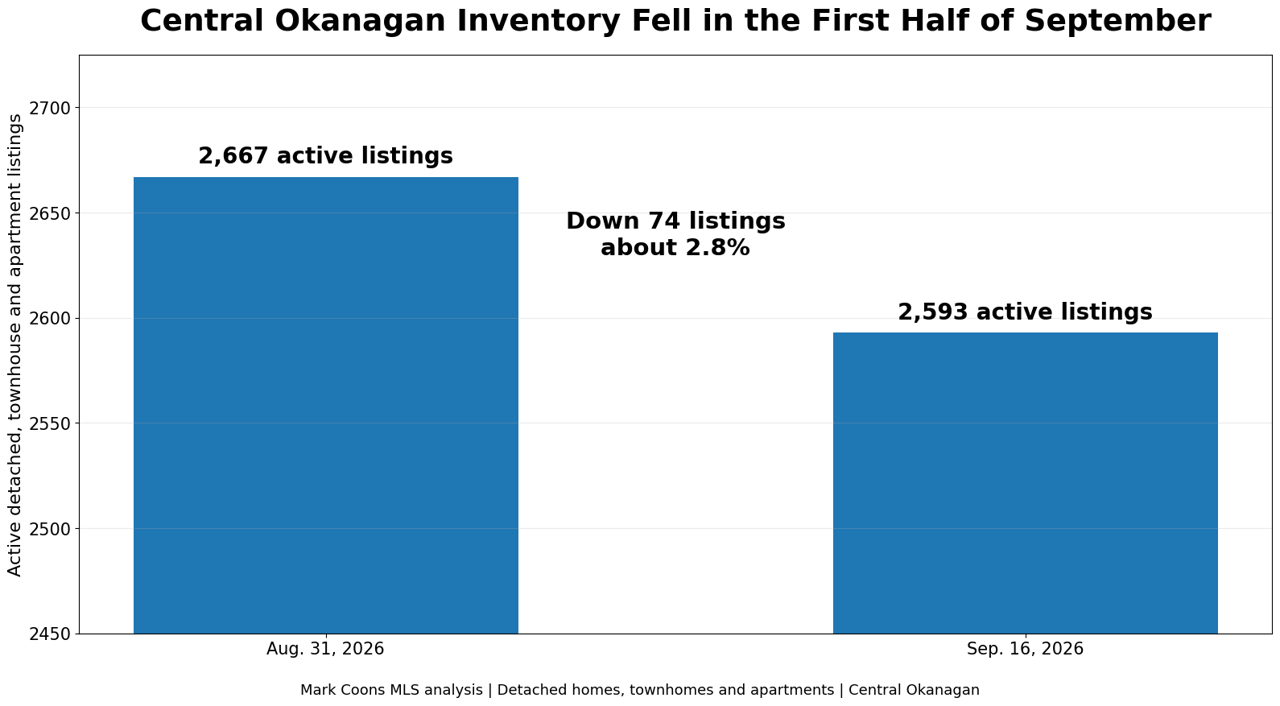
There are roughly 2,600 detached homes, townhomes and apartments for sale across the Central Okanagan.
That sounds like one market.
I don't think it is behaving like one.
There is the market of homes buyers are choosing.
Then there is the market of homes buyers have already had weeks or months to consider and still have not bought.
That distinction matters a lot more to a seller than the total listing count.
The homes selling are not getting slower
This is what first caught my attention.
Homes that sold during the first half of September had a median current market time of about 51 days.
In August, it was around 55 days.
So despite all the talk about a slow market, the homes actually selling did not suddenly take longer.
Now compare that with what is still available.
Across roughly 2,600 active detached homes, townhomes and apartments, the median listing had accumulated about 105 days of market exposure.
Nearly seven out of ten had been exposed for at least 60 days.
More than half had been exposed for 90 days or longer.
There is an important measurement caution here. Current market time on sold listings and cumulative exposure on active properties are not perfectly identical metrics.
But the gap is still useful.
The inventory sitting on the market is considerably older than the homes buyers are actually choosing.
Buyers haven't disappeared either
From September 1 through September 15, I counted 129 sales across detached homes, townhomes and apartments.
During the same portion of August, there were 136.
That is a decline of about 5%.
I would not call half a month a trend.
But I also would not describe that as buyers disappearing.
They are still making purchases.
They just have enough choice to be selective.
And that changes the problem for a seller.
The question becomes less:
Are there buyers?
And more:
Why are buyers choosing another home instead of mine?
That is a much more useful question.
Inventory can be high without every home being real competition
If you own a detached home in Glenmore, the apartment sitting downtown is not your competition.
Neither is a $2 million acreage.
Even within the same neighbourhood and price range, two homes can attract completely different buyer reactions.
Condition matters.
Layout matters.
Renovation quality matters.
Lot, view, suite, parking and location matter.
And price matters.
So when I say there are approximately 2,600 active listings, that number tells us something about the broad market.
It tells us very little about what one seller is actually competing against.
Your real market may be six homes.
Or three.
Sometimes one.
The market has already given a lot of these listings feedback
Roughly one-third of the current inventory I reviewed was already priced below its original asking price.
For those that had reduced, the typical adjustment was around 4%.
In one week alone, I counted:
- 164 price reductions
- 82 cancelled listings
- 30 expired listings
Then there are the relists.
From September 9 through September 15, 257 active listings came onto the market.
Roughly 95 of them had already been exposed to buyers before.
About 37%.
And among the residential relists I could trace back to their previous listing, roughly three out of four returned at a lower price.
The typical reset was about 4.4%.
That tells us the market is not simply accumulating homes.
It is testing them.
Some pass the test.
Others keep getting sent back for another try.
A listing being old does not automatically mean the house is bad
This distinction matters.
Sometimes a property has been sitting because something is genuinely difficult.
Maybe there is a location issue.
Maybe the layout limits the buyer pool.
Maybe it needs a major renovation.
Maybe there is road noise, an awkward lot or another feature buyers keep rejecting.
But sometimes the house is fine.
The price was the problem.
Or the presentation.
Or buyers had several similar choices and preferred another one.
Market time is feedback.
It is not a diagnosis.
You still need to figure out why the property is sitting.
Price may be the easiest problem to see, but it is not always the real problem
This is where sellers can make another mistake.
The home has not sold.
So cut the price.
Sometimes that is exactly what needs to happen.
Other times, the seller is solving the wrong problem.
Imagine two similar homes asking $1 million.
One is renovated, has good parking, a functional layout and photographs well.
The other needs work, has an unusual floor plan and competes poorly against everything buyers are seeing.
Matching the first home's price may still not make the second home equally attractive.
A reduction can improve the value proposition.
It cannot change the house.
That is why I would want to understand what buyers are rejecting before deciding how to respond.
The question sellers should ask after 30, 60 or 90 days
I would not start with:
How much should we reduce?
I would start with:
What have buyers been choosing instead?
Then compare.
Are the sold homes:
- newer?
- renovated?
- smaller but better located?
- larger?
- priced lower?
- more functional?
- offering better lots?
- selling with suites?
- avoiding a feature buyers do not like?
That is the deeper study I want to do next.
Because market time tells us there is a split.
It does not yet tell us every reason behind it.
This is where broad market statistics stop being enough
Suppose I tell a seller:
There are 2,600 listings.
That is information.
Now suppose I tell them:
There are six properties competing directly with you.
Two have sold.
One reduced.
One cancelled.
The two remaining homes have both been sitting for more than 90 days.
And the homes buyers chose had renovated kitchens and were priced 5% below where you are today.
That changes the conversation.
The market average did not change.
Our understanding of the seller's actual market did.
That is the level where pricing decisions should be made.
Buyers should look at the split differently
For buyers, the growing pile of older inventory is worth watching.
But I would not assume every old listing is a bargain.
Sometimes 100 days on market means the seller finally has motivation.
Sometimes it means the asking price is still wrong.
Sometimes it means other buyers found something about the property they did not want to accept.
The opportunity is not simply:
Find the oldest house.
It is:
Find the older listing where the problem is price or seller expectations rather than something you will regret owning.
That is a much better place to negotiate.
Sellers are also running out of one thing: time before winter
September starts to force decisions.
Some homeowners will reduce.
Some will cancel and relist.
Some will keep holding.
Some will decide to come off the market and try again in spring.
That creates an important divide.
A seller who genuinely needs to move this fall may react very differently from someone who is perfectly comfortable waiting another six months.
Two listings can have the same asking price and the same days on market.
Their sellers may have completely different motivations.
That is why market time is a clue, not the whole answer.
What I would want to measure next
The market-time gap is enough to tell us something interesting is happening.
But I want to go further.
The next useful study would compare the homes buyers actually purchased against the homes still sitting based on:
Price
Are buyers choosing the lower-priced alternatives, or are they paying premiums for better homes?
Size
Are larger properties accumulating while more efficient homes move?
Age
Are buyers avoiding certain decades or choosing updated older housing over newer homes?
Condition
How often do sold listings mention renovations compared with long-standing active inventory?
Price reductions
How common are reductions among the listings still sitting, and how does that compare with properties that eventually sold?
Cumulative market exposure
At what point does a listing's probability of selling begin changing materially?
Those are much better questions than simply asking whether Kelowna is a buyer's or seller's market.
Because there may be several markets operating inside the same headline number.
The takeaway for a seller
The fact that buyers are still buying should actually make a stale listing more useful as information.
If nobody were buying anything, a home sitting would tell us very little.
But homes are selling.
That means buyers are making choices.
If similar properties continue to sell while yours remains available, eventually the question should not be:
When will the market improve?
It should be:
What is the market telling us about this property?
Maybe the answer is price.
Maybe it is presentation.
Maybe it is condition.
Maybe your home simply appeals to a smaller buyer pool and needs more time.
The important part is finding out which one.
Because right now, the Central Okanagan does not look like one market where everything is moving slowly.
It looks more like two.
The homes buyers choose.
And the homes they keep passing on.
This analysis is based on my review of Central Okanagan MLS activity covering detached homes, townhomes and apartments.
Approximately 2,600 properties were active during the September analysis. The median active listing had accumulated roughly 105 days of exposure, nearly seven in ten had at least 60 days of exposure, and more than half had at least 90 days.
There were 129 sales from September 1 through September 15, 2026. Those sales had a median current market time of approximately 51 days, compared with roughly 55 days for August sales.
Current market time and cumulative market exposure are not identical measurements, so the figures should not be treated as a perfect apples-to-apples DOM comparison.
The data supports the conclusion that active inventory is heavily weighted toward older listings while homes continue to sell.
It does not yet establish exactly which property characteristics cause one listing to sell and another to remain active. A deeper matched analysis by price, size, age, condition indicators and location would be required to answer that.
Is your home sitting while others are selling?
Send me the address.
I can compare it with the homes buyers have actually chosen, the properties still competing against it and the listing history in your exact segment.
Sometimes the market is rejecting the price.
Sometimes it is rejecting something else.
Finding out which one matters before simply making another change.
Mark Coons Personal Real Estate Corporation
Mark Coons, BBA, CE
REALTOR® | eXp Realty Kelowna
Team Lead, Selling Okanagan Group
Relocated to Kelowna in 2018
778-946-6454
[email protected]