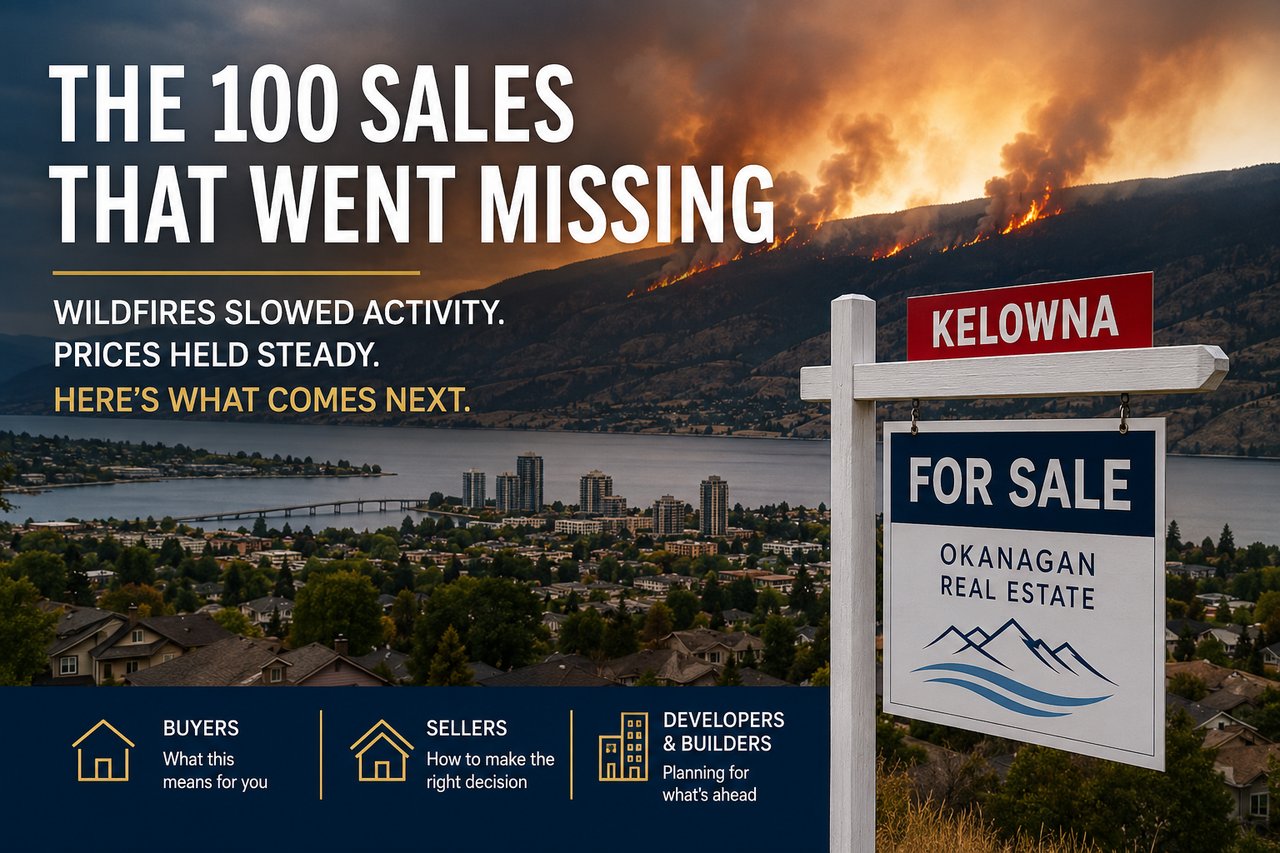
Did Wildfires Hurt the Kelowna Real Estate Market? The 100 Sales That Went Missing in August
Happy Wednesday!
The question I heard more than any other in August was some version of this:
Did the wildfires hurt the Kelowna real estate market?
The short answer?
Surprisingly, prices say no.
But sales activity tells a very different story, and it is still too early to know what happens next.
Okanagan Home Sales Fell Much More Than Normal in August
I pulled every reported residential sale in the Central Okanagan, South Okanagan and North Okanagan and compared the first 23 days of August with the same period in 2024 and 2025.
August normally slows down.
It did in both previous years.
But not like this.
In 2024, sales dropped about 11%.
In 2025, they dropped about 7%.
In August 2026:
- Central Okanagan sales dropped 32%
- South Okanagan sales dropped 34%
- North Okanagan sales dropped 27%
Across the three Okanagan regions, that works out to roughly 100 fewer sales in 23 days than I would have expected based on the recent pattern.
But here is the part that surprised me.
Kelowna Home Prices Did Not Suddenly Drop
Prices did not move with sales.
The percentage of the original asking price sellers actually received stayed almost unchanged.
That was true inside areas affected by wildfire and outside them.
We did not suddenly see sellers dumping properties.
Buyers did not appear to smell blood and start throwing out extreme low offers.
The Okanagan housing market did not reprice. Transaction volume disappeared while prices largely stayed where they were.
That distinction matters.
Did the fires lower Kelowna home prices?
Based on August's data, there is no clear evidence that wildfires caused Kelowna or Okanagan home values to suddenly fall.
They appear to have affected the ability or willingness of some people to complete transactions instead.
And insurance may be part of the reason.
Why Some Okanagan Real Estate Deals May Have Stopped
In our market, the reported sold date is generally the date subjects are removed.
Not possession day.
Subject removal is the point when the deal becomes firm.
Before getting there, most financed buyers need to confirm they can obtain property insurance.
When there is an out-of-control wildfire nearby, getting insurance can become more difficult.
Not always impossible.
Just harder.
And if you are financing your purchase, no insurance binder can mean no mortgage funding.
No funding means no firm deal.
Cash buyers are in a different position, but even they have to decide whether they are comfortable closing without insurance or confident coverage will be available before completion.
There are limits to what I can prove here.
The insurance issue is something I have seen in my own Kelowna real estate files and heard from other local agents.
MLS data does not tell me why a buyer decided not to write an offer or why a deal failed to become firm.
So I would call this an observation, not a measurement.
Were Kelowna Sellers Giving Up Because of the Fires?
Not yet, based on the August numbers.
Cancelled and expired listings were almost identical from July to August:
Cancelled listings: 114 to 113
Expired listings: 88 to 88
But I am not going to make that statistic mean more than it does.
Listings expire based on the expiry date written into the original listing agreement.
Cancellations and expiries also behave differently throughout the year.
Cancellations tend to peak during the summer.
Expiries do almost the opposite.
Historically, expiries sit around 93% of normal levels in August before jumping to approximately 152% of normal in October and 155% in December.
So flat cancellations in August are not proof that Kelowna sellers remain confident.
The part of the market where seller frustration usually becomes more visible has not arrived yet.
Ask me again in six weeks.
The Bigger Question: Will Okanagan Buyers Come Back?
This is what I am watching now.
Not whether sellers stay listed.
Will the buyers who disappeared in August come back in September and October?
If that demand returns, August may have simply been a delay.
If it does not return, there may be something deeper happening with buyer confidence.
September and October should tell us much more.
And there is another reason those two months matter.
Wildfire Season Is Starting to Look Like Part of the Okanagan Real Estate Cycle
Think about the last few years.
Major wildfire activity has become a repeated part of life in the Okanagan.
White Rock Lake in 2021.
McDougall Creek in 2023.
Hullcar Mountain in 2024.
Peachland in 2025.
Bald Range and Bradley Creek in 2026.
Go back further and there is the 2003 Okanagan Mountain Park fire, which destroyed 239 homes.
At the time, that was talked about as a once-in-a-lifetime event.
At some point, something that happens repeatedly stops behaving like an unexpected event and starts behaving more like a season.
And that may be happening with the Kelowna and Okanagan housing market.
Are Okanagan Buyers Becoming More Used to Wildfire Risk?
Maybe.
This is the part I keep chewing on.
When I compared August 2026 with 2024 and 2025, those summers also had wildfire activity.
So I am not comparing a wildfire summer with a perfectly normal summer.
I am essentially comparing a major wildfire year with years that experienced smaller wildfire disruptions.
Against a completely clean summer, the sales gap could have been larger.
Given what appears to be becoming normal in the Okanagan, we may eventually have to accept that August real estate activity regularly includes some amount of wildfire disruption.
You can already see buyers adapting.
People ask about:
- Defensible space around a home
- Roofing materials
- Trees and vegetation near the house
- Evacuation routes
- Insurance availability and cost
Those questions are starting to come up the same way buyers ask about the age of a roof, furnace or hot water tank.
Insurance is also coming up earlier in the buying process instead of being left until subject removal.
That is what normalization looks like.
And it cuts both ways.
It is worse because wildfire risk is something Okanagan homeowners have to take seriously.
But it can also make the housing market more resilient because people know the risk exists and begin planning around it.
Unexpected shocks can move markets quickly.
Known risks tend to get worked into people's decisions.
So far in 2026, home prices have shown very little sign of panicking.
I think that may be part of the reason.
I would rather live in a place that understands the risk and learns how to handle it than somewhere that continues to be surprised by it.
I am not pretending wildfires are nothing.
But buyers, sellers, municipalities and communities across the Okanagan are getting better at dealing with them.
In the housing data, that may be showing up as lower transaction volume without the same panic in pricing.
What This Means for the Kelowna Real Estate Market This Fall
Wildfire season is one factor.
The real estate calendar is another.
And the calendar keeps moving.
I reviewed homes listed during 2024 and 2025 and sorted the results based on the month they originally came to market.
Homes listed in September:
51 days to sell
96.1% of original asking price
Homes listed in October:
65 days to sell
95.4% of original asking price
October has historically been one of the hardest months of the year to launch a listing.
And there is another important piece of the fall market that often gets misunderstood.
Inventory does not fall because every seller suddenly gives up.
The market stops refilling.
Central Okanagan new listings historically run around 950 in July.
By December, that falls to around 290.
That means September is one of the last periods of the year where Kelowna buyers can have strong selection while sellers still have meaningful buyer activity.
If You Are Selling a Home in Kelowna
The wildfire may not have cost you equity.
It may have cost you a buyer.
Those are very different problems.
If your Kelowna home did not sell in August and your first reaction is to pull the listing and wait until spring, understand what you are trading.
You could be skipping the final active fall selling window, moving into the slowest portion of the year and waiting another five or six months to try again.
Sometimes waiting is still the correct decision.
If you are not ready to sell, I will tell you that.
But make waiting a strategy.
Do not make it a reaction.
If You Are Buying a Home in Kelowna
September and October can be very interesting months for Kelowna home buyers.
Historically:
Homes take longer to sell.
Sellers receive slightly less of their original asking price.
Competition can become less aggressive.
And buyers may have more negotiating power.
You trade some selection for potentially better terms.
This year has another wrinkle.
There could be buyers sitting on the sidelines who wanted to purchase in August but could not move forward because of wildfire concerns or insurance issues.
If they return quickly, the fall buying window could become more competitive.
If they do not, buyers may have more negotiating power for longer.
I do not know which one happens yet.
That is exactly what I will be watching.
What This Means for Kelowna Developers and Home Builders
There is another group that should be paying attention to this data: Kelowna developers and home builders.
Especially anyone planning infill multifamily housing, townhomes, fourplexes or small-scale multifamily projects.
Short-term sales weakness does not automatically mean Kelowna needs less housing.
Development operates on a much longer timeline than resale real estate.
A project being planned today may not deliver finished homes for several years.
That means builders should be careful about using one slow month — or even one slow year — as proof of what demand will look like when their project completes.
The more useful questions are:
What type of housing are buyers actually absorbing?
At what price?
In which Kelowna neighbourhoods?
And how much competing ownership inventory will still exist when the project is ready?
That is a much better way to evaluate a Kelowna infill development opportunity than simply asking whether today's market is "good" or "bad."
The Question I Would Ask Right Now
Do not ask:
How is the Kelowna real estate market?
That question is too broad.
Ask:
Did the wildfire actually change my real estate decision, or did it simply change my timing?
For most of the people I spoke with during August, it changed the timing.
And timing is something we can plan around.
If you are thinking about buying or selling a home in Kelowna, relocating to the Okanagan, or evaluating a Kelowna infill multifamily development site, reply to this email or call/text me at 778-946-6454.
I can help you look at the actual numbers behind your specific neighbourhood, property type or development opportunity instead of relying on the headline.
Frequently Asked Questions About Kelowna Real Estate and Wildfires
Did the 2026 wildfires lower Kelowna home prices?
August data did not show a major wildfire-driven decline in selling prices. The larger change was in the number of homes that sold.
Can wildfires affect getting a mortgage in Kelowna?
Indirectly, yes. A financed buyer will normally need acceptable property insurance before the lender funds the mortgage. Active wildfire conditions can sometimes make new insurance coverage harder to obtain.
Is September a good time to sell a home in Kelowna?
Historically, September has performed better than October for new listings. Sellers considering a fall sale should weigh the remaining buyer activity against the seasonal slowdown that normally follows.
Is September or October a good time to buy a home in Kelowna?
They can be strong months for buyers because homes historically take longer to sell and sellers tend to accept slightly less of their original asking price. However, available inventory also starts falling.
Mark & Maddie Coons
Selling Okanagan Group | eXp Realty Kelowna
(O) 778-946-6454 | (C) 250-801-0361
[email protected]