Is it better to rent or buy in Kelowna right now?
The rent-vs.-buy decision in Kelowna depends on how long you plan to stay, your financial discipline, and what lifestyle flexibility means to you. There is no universal right answer, but the numbers in each scenario are very different.
This question lands in my inbox regularly, and I'll tell you the same thing I tell everyone who asks it: the rent versus buy debate isn't one side winning and the other losing. It's a calculation that runs on your specific situation, your timeline, and what you're actually trying to build.
I've spent over a decade working in the Central Okanagan real estate market, backed by 27 years of MLS data covering approximately 66,000 single-family detached resale transactions. What that dataset tells me is that ownership has created meaningful wealth for the majority of people who held property in this market over the long run. But it also tells me timing, entry price, and carrying capacity matter. Buying the wrong property at the wrong price for the wrong reason is not automatically better than renting.
Here's an honest breakdown of both sides.
The Case for Buying in the Okanagan
The clearest argument for ownership is forced equity accumulation. Every mortgage payment includes a principal component that builds your net worth directly. In the early years, most of your payment goes toward interest, but that ratio shifts over time. Over a 25-year amortization, you own your home outright.
A practical example for the current Kelowna market: a purchase at $750,000 with a 20% down payment ($150,000) leaves you with a $600,000 mortgage. At a 5-year fixed rate in the 4.5% to 5% range, your monthly payment is approximately $3,200 to $3,400. In year one, roughly $11,000 to $12,000 of that goes to principal. By year five, you'll have paid down $60,000 to $70,000 in principal, in addition to whatever appreciation has occurred in the underlying property value.
Over the 27 years captured in the dataset I work from, long-run appreciation in the Central Okanagan has averaged meaningfully above inflation, though with real cycles along the way. Peachland, Lake Country, the Lower Mission, Upper Mission, and Glenmore have all outperformed significantly over that window, though individual results vary by entry price and hold period.
Beyond the numbers, ownership provides stability. Your monthly costs don't increase at a landlord's discretion. You can renovate, reconfigure, and make the space yours. And the inflationary protection of locking in your housing cost at today's prices becomes more valuable over time.
The Case for Renting
Renting isn't a financial failure. It's a different allocation of capital, and in some situations it's the smarter move.
The key variable is what you do with the money you're not tying up in a down payment and the monthly gap between a rent payment and an ownership cost. A comparable property that sells for $750,000 in Kelowna might rent for $2,800 to $3,200 per month. The total monthly cost of owning that same property, including mortgage, property taxes, insurance, and maintenance allowance, runs closer to $4,100 to $4,500. That gap, if invested consistently into a diversified portfolio at a modest return, can build meaningful wealth over 5 to 10 years.
Your $150,000 down payment, if left invested rather than committed to real estate, has the potential to grow to $185,000 to $200,000 over five years at a 4% to 5% average annual return. Add $800 per month in invested savings on the carrying cost gap and the portfolio math gets competitive.
The critical word in that paragraph is "if." Renters who genuinely invest the difference between rent and what ownership would cost are building wealth through a different mechanism. Renters who spend the difference are not.
The Honest Middle Ground
What I see most often in the Central Okanagan is that buyers who purchased at reasonable prices with a clear plan to stay for five or more years have done well. The hold period is the biggest variable. Real estate transaction costs in BC are significant: property transfer tax, legal fees, and selling costs on the way out often total 4% to 6% of the transaction value. You need appreciation and equity accumulation to overcome those costs before ownership beats renting on a financial basis. That typically takes three to five years minimum, depending on market conditions.
If you're planning to be in the Okanagan for two years, renting almost certainly makes more financial sense. If you're planning to stay for seven-plus years and can carry the payment comfortably without stretching, the ownership math tends to win over time.
What the Kelowna Market Looks Like Right Now
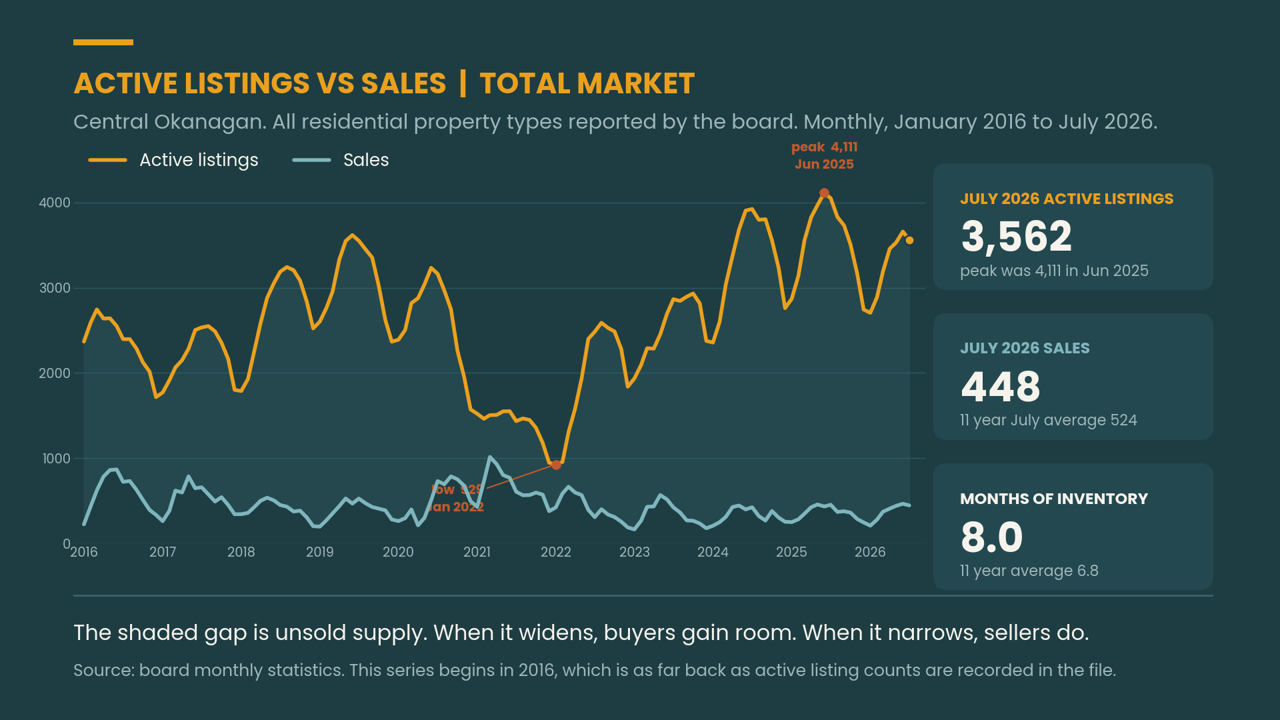
Rents across the Central Okanagan have softened somewhat from 2023 peaks. Current asking rents for two-bedroom apartments in Kelowna range from approximately $2,100 to $2,600 per month, while two-bedroom condos in areas like Pandosy or the downtown core list for more. On the ownership side, entry-level condos in Kelowna start in the low-to-mid $400s, which produces monthly ownership costs (mortgage plus strata plus taxes plus insurance) in the $2,800 to $3,400 range.
At those numbers, the gap between renting and owning is narrower than it has been in recent years, which makes the ownership case easier to justify, particularly for buyers who have their down payment ready and a clear hold-period intention.
Frequently Asked Questions
Is Kelowna a good place to buy real estate right now?
For buyers with a five-plus year horizon, reasonable down payment, and comfortable carrying capacity, Kelowna remains a market with strong long-run fundamentals. The 27-year Central Okanagan dataset supports sustained demand driven by lifestyle migration, limited supply in core areas, and demographic tailwinds. Short-term conditions always vary.
What is the average rent in Kelowna in 2026?
Current average asking rents for two-bedroom units in the Kelowna area are approximately $2,200 to $2,600 per month depending on building type and location. Newer construction in Lake Country and West Kelowna tends to list at similar ranges.
How much do I need to buy a home in Kelowna?
Minimum down payment in Canada is 5% on homes under $500,000 and 10% on the portion above that up to $999,999. For a $700,000 purchase, that's approximately $45,000 minimum, plus closing costs (property transfer tax, legal fees, and inspection) typically adds $15,000 to $20,000. Many buyers in Kelowna target 10% to 20% down to manage CMHC mortgage insurance premiums.
How long do you need to own a home in Kelowna for it to make financial sense?
In most scenarios, you need to hold for a minimum of three to five years to overcome transaction costs and build enough equity to outperform the renting-and-investing alternative. Five to seven years is a more comfortable horizon for the math to work clearly in ownership's favour.
Does renting in Kelowna mean I'm throwing money away?
No. Rent payments provide housing, flexibility, and freedom from maintenance obligations. The difference between renting and "wasting money" lies in what you do with the capital you're not committing to ownership. Renting with a disciplined savings and investment strategy is a legitimate wealth-building path.
Making the Right Call for Your Situation
There's no single correct answer to the rent-versus-buy question for Kelowna. What I can tell you is that both paths reward discipline and punish financial drift. The clearest way to evaluate the decision is to run the actual numbers for your specific budget, timeline, and goals rather than relying on a general rule.
Sign up for my weekly Okanagan market email at sellingokanagangroup.com to stay current on what's actually happening with pricing, inventory, and rental data in the Central Okanagan.
Mark Coons, BBA, CE
REALTOR® | eXp Realty Kelowna
Team Lead, Selling Okanagan Group
Relocated to Kelowna in 2018
📞 778-946-6454
📩 [email protected]