Okanagan Real Estate Market 2026: Stable Isn’t the Same as Growth
Most real estate market updates are written to make the market sound better than it really is.
This is not going to be one of those.
The Okanagan real estate market in 2026 is not booming. Sales are not flying. Buyers are not lining up like they were in 2021. Sellers are not getting whatever price they want.
But the market is also not falling apart.
That is the important part.
The Okanagan is in a different position than many other parts of BC. We have more inventory, slower buyer decisions, and more negotiation than we had during the pandemic market. But we also have a strong base of homeowners, a more diversified local economy, and a lifestyle-driven buyer pool that still sees long-term value in this region.
So the real question is not:
“Is the market good or bad?”
The better question is:
Where is the Okanagan real estate market strong, where is it weak, and what does that mean if you are buying, selling, or investing in 2026?
What Is Happening in the Okanagan Real Estate Market?
The Okanagan housing market is stable, but stable does not mean strong growth.
BCREA’s 2026 housing forecast shows that many parts of BC are still dealing with slower sales, affordability pressure, and buyer hesitation. The Okanagan, however, is forecast to hold up better than many other regions.
That does not mean every seller is winning.
It means the market is more balanced.
Buyers have more choice. Sellers have more competition. Pricing matters. Presentation matters. And the right strategy depends heavily on property type.
| Question | Honest Answer |
|---|---|
| Is the Okanagan market crashing? | No. It is softer, but not crashing. |
| Are buyers getting deals? | Yes, especially on overpriced or stale listings. |
| Are sellers still in control? | Not like 2021. Sellers need to be sharper. |
| Which segment looks strongest? | Townhomes are showing surprising strength. |
| Which segment is still uncertain? | Condos, although STR rule clarity may help select buildings. |
| Is this a good time to move? | It depends on your property, timeline, and next step. |
The BC Story vs. the Okanagan Story
Across BC, the market has been dealing with three years of shocks.
Higher interest rates.
Inflation.
Global uncertainty.
Tariffs.
War.
Lower confidence.
For many buyers, affordability has become harder. For many sellers, the market feels slower than expected. And for many homeowners, the simple decision to move has become more complicated.
But the Okanagan has not followed the exact same path as Greater Vancouver or the Fraser Valley.
In 2025, the Okanagan performed better than many other BC markets. While several larger markets saw weaker sales activity, the Okanagan held up better.
That does not mean we are immune.
It means our market has different pressure points.
The Okanagan did not fall as hard as some other regions, and it is not forecast to fall the same way either.
There are three big reasons for that.
Reason 1: Many Kelowna Homeowners Are Not Under the Same Mortgage Pressure
One of the biggest differences in the Kelowna and Okanagan market is the homeowner base.
A large share of Kelowna homeowners are mortgage-free. That matters because homeowners without mortgage payments are not under the same pressure when rates rise.
When owners are not being squeezed by renewals, they are less likely to panic sell.
They may still sell.
They may still downsize.
They may still move for lifestyle, family, health, retirement, or a new chapter.
But they are usually selling because they want to, not because they have to.
That is a major difference.
In a market with a lot of forced selling, prices can drop quickly. In a market where many owners have equity and low debt, prices usually do not collapse as easily.
This is one reason why waiting for a major “crash” in Kelowna may not be the best strategy.
Could prices soften in some segments?
Yes.
Could buyers get better deals?
Yes.
But a full market collapse is harder when many owners are not financially forced to sell.
Reason 2: The Okanagan Economy Is More Diversified Than People Think
A lot of people think the Okanagan is just tourism, wineries, and retirees.
That is part of the story, but it is not the whole story.
The regional economy is more diversified than many people realize.
Kelowna has healthcare, education, tourism, services, trades, construction, tech, and a growing airport.
Vernon has a strong base in manufacturing, retail, construction, and regional services.
Penticton has a large industrial and manufacturing base that often gets overlooked.
That matters because the Okanagan is not a one-industry market.
When one part of the economy slows, another part can help support the region.
This does not mean we avoid every downturn. We do not.
But it does mean the Okanagan has more economic support than many people give it credit for.
Reason 3: The Buyer Pool Is Different
The Okanagan buyer pool is not the same as the Fraser Valley or Greater Vancouver.
Many buyers here are lifestyle-driven.
Some are coming from the Lower Mainland.
Some are coming from Alberta.
Some are retirees.
Some are remote workers.
Some are families looking for a different quality of life.
Some are investors looking at long-term rental demand, short-term rental rules, or future redevelopment.
This matters because not every buyer is making a decision based only on interest rates.
Of course rates matter.
But for many Okanagan buyers, the move is also about lifestyle.
They want space.
They want weather.
They want the lake.
They want trails.
They want wineries.
They want schools, sports, family, and a better day-to-day life.
That lifestyle demand does not disappear just because the market gets slower.
It may pause.
It may become more selective.
But it does not disappear.
The 10-Year Central Okanagan Sales Picture
When you zoom out, the market becomes easier to understand.
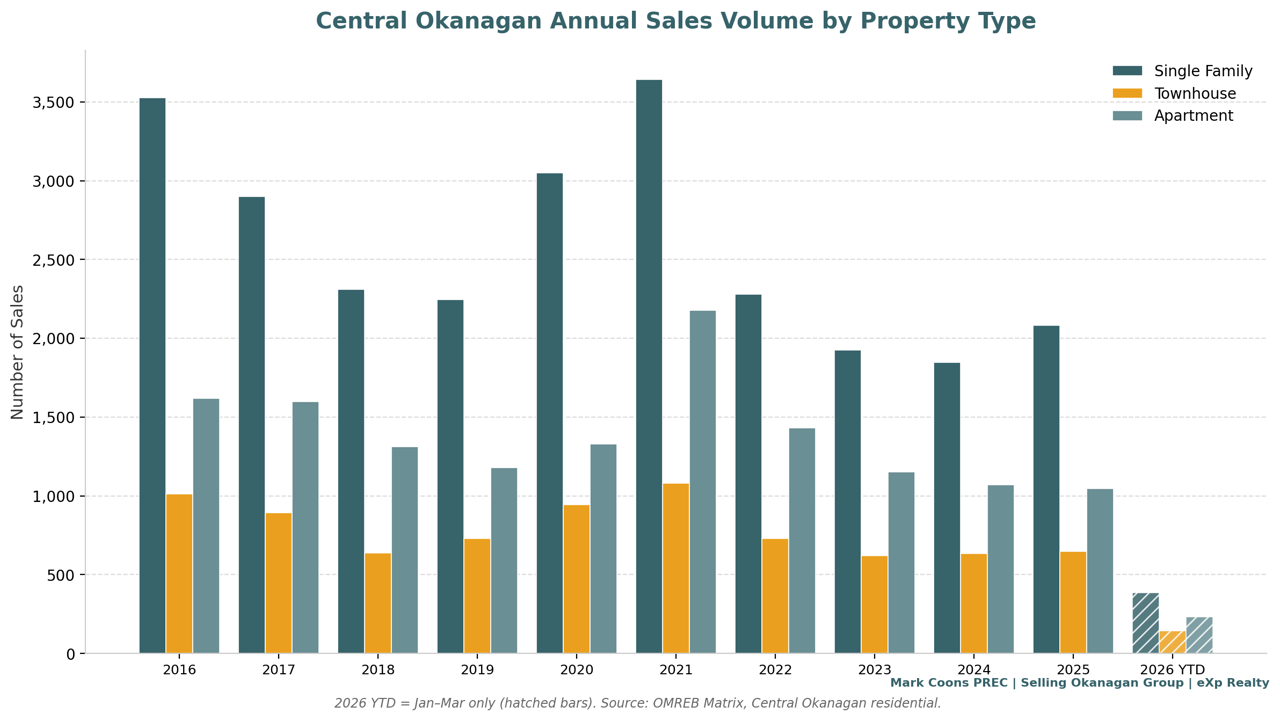
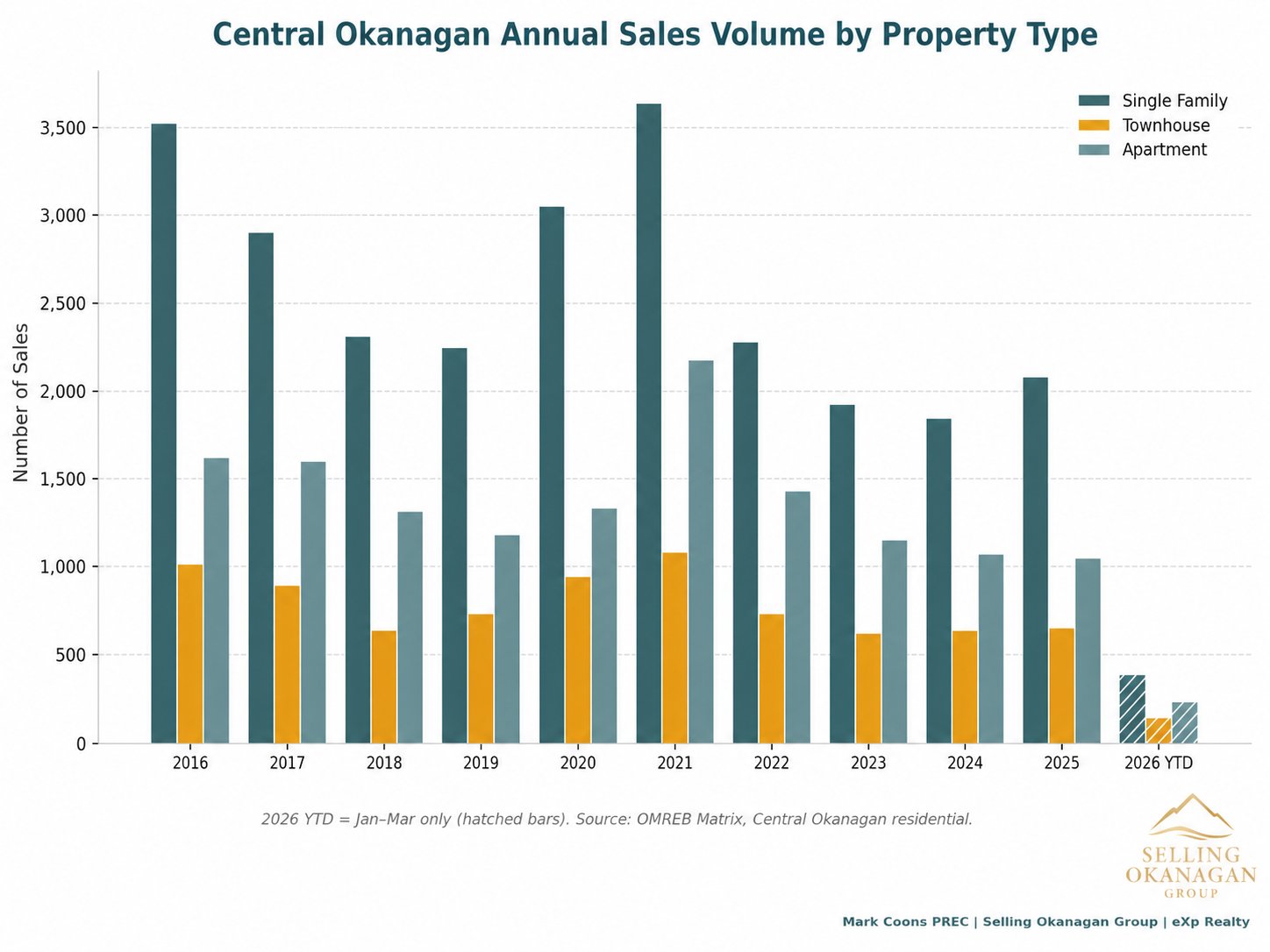
Sales volumes peaked in 2021. That was the pandemic boom. Cheap money, low inventory, and massive demand pushed the market to levels that were not normal.
Then the market cooled in 2022, 2023, and 2024.
By 2025, we started to see some stabilization. Single-family homes had the clearest recovery bounce, with sales improving compared to 2024.
But we are still nowhere near the activity levels of 2021.
That is important.
The market is not dead.
But it is not back to peak conditions either.
Central Okanagan Average Sale Prices
Prices tell a different story than sales volume.
Single-family home prices peaked in 2022 and have not fully returned to that level.
That is important because it shows the market is still working through the peak.
A homeowner who bought at the top of the market may not feel like prices have fully recovered yet.
But a homeowner who bought five or ten years ago likely still has a large amount of equity.
That is why the market can feel very different depending on when someone bought.
The most interesting segment right now may be townhomes.
Townhome prices have shown surprising strength and appear to be holding up better than many people expected.
That makes sense.
Townhomes sit in the middle of the market.
They are often more affordable than detached homes, but they give buyers more space than a condo. For families, downsizers, and some investors, that middle ground is attractive.
Condos remain more complicated.
The condo market was hit hard by higher rates, weaker investor math, and short-term rental uncertainty. But that may now be starting to shift in select buildings.
| Year | Single Family | Townhouse | Apartment |
|---|---|---|---|
| 2016 | $651,931 | $406,729 | $291,790 |
| 2017 | $723,981 | $451,333 | $332,291 |
| 2018 | $766,038 | $490,103 | $347,083 |
| 2019 | $747,203 | $493,248 | $361,976 |
| 2020 | $865,856 | $540,784 | $366,724 |
| 2021 | $1,064,276 | $647,620 | $447,329 |
| 2022 | $1,227,650 | $748,178 | $548,394 |
| 2023 | $1,143,126 | $711,641 | $494,801 |
| 2024 | $1,103,544 | $700,674 | $480,651 |
| 2025 | $1,157,555 | $713,670 | $484,488 |
| 2026 YTD | $1,084,799 | $761,074 | $474,493 |
The biggest takeaway is simple.
Single-family homes are still below their 2022 peak.
Townhomes are showing strength.
Apartments are still softer than the peak, but not collapsing.
That is why you cannot look at the Okanagan market as one single market.
Detached homes, townhomes, and condos are all behaving differently.
Q1 2026: The Honest Update
Q1 2026 was not a breakout quarter.
Compared to Q1 2025, sales were softer in single-family homes and townhomes, while condos were roughly flat.
Single-family homes were the soft spot.
The average sale price dropped, and the median sale price dropped even more. That tells me the issue may not be that every home is worth significantly less. It likely means fewer higher-end homes were selling in the quarter.
That is a different problem.
It is not always a market crash.
Sometimes it is a mix problem.
If fewer luxury or high-end homes sell, the average price can drop even if the middle of the market is holding up better.
Townhomes and condos were more stable on price, but days on market increased.
That tells us buyers are taking longer to make decisions.
They are looking.
They are comparing.
They are negotiating.
They are not rushing.
Sale-to-list ratios in the 96% to 97% range show that many buyers are negotiating around 3% to 4% off list price.
That is not a fire sale.
But it is also not a seller-dominated market.
It is a market where buyers have room to negotiate and sellers need to price properly.
The Kelowna Condo Market and Short-Term Rental Shift
The condo market has been one of the most difficult segments to read.
For the last couple of years, Kelowna condos were hit by several things at once:
Higher interest rates.
Weaker investor cash flow.
More inventory.
Short-term rental uncertainty.
Changing provincial rules.
That combination created hesitation.
Many investors stepped back. Some buyers paused. Some sellers had to adjust expectations.
But the short-term rental picture is now getting clearer.
The City of Kelowna has confirmed rules for short-term rentals, including the difference between minor short-term rental use in a principal residence and major short-term rental use where permitted as a principal use.
That matters for select condo buildings.
If a building qualifies under the short-term rental subzone rules, it may have a different buyer pool than a standard condo building.
This does not mean every short-term rental condo is automatically a good investment.
It does mean the buildings with clear legal short-term rental use may deserve a second look.
The key is address-level confirmation.
Before buying, investors need to confirm:
Is the building eligible?
Is the unit eligible?
Does the strata allow it?
Is a business licence required?
What are the operating costs?
What are the realistic rental numbers?
What happens if rules change again?
This is not a market where you guess.
You verify first.
What Is Not Great Right Now
This is the part many market updates skip.
There are real headwinds in the Okanagan right now.
Sales are still slower than the peak years.
Active listings are high.
Buyers have more choice.
Some sellers are still priced too high.
Unemployment has been a concern.
Population growth has slowed.
Some people are leaving BC for Alberta because of jobs and affordability.
Housing starts have pulled back.
Interest rates are not going back to pandemic lows.
These are real issues.
None of them should be ignored.
But they also do not automatically mean the market is broken.
Most of these pressures are cyclical.
They affect timing, confidence, and negotiation power.
They do not erase the long-term reasons people want to live in the Okanagan.
What the Data Is Not Telling You Yet
The challenge with real estate data is that it usually tells us what already happened.
Sales data is backward-looking.
Price data is backward-looking.
Days on market is backward-looking.
By the time the market shift clearly shows up in the numbers, the early opportunity may already be gone.
What I am seeing lately is more buyer conversation from Alberta and the Lower Mainland.
That does not mean the market has fully turned.
It is still anecdotal.
But sentiment often moves before the stats do.
People start asking questions.
Then they start watching listings.
Then they start booking showings.
Then offers start happening.
By the time it shows up in the next quarterly report, the first move may already be underway.
So I would not say the market is booming.
That would be too strong.
But I would say this:
The market feels more active than the lagging data shows.
What This Means If You Are Selling in the Okanagan
If you are thinking about selling, you are not selling into a runaway market.
You are selling into a more competitive market.
That means you need to be sharper.
The old strategy was simple:
List the home.
Wait for buyers.
Review offers.
That is not the market we are in now.
In 2026, sellers need to focus on:
Correct pricing.
Strong presentation.
Good photos and video.
Clear positioning.
Smart timing.
Understanding the competition.
Knowing who the likely buyer is.
The homes that sit are usually not just “bad homes.”
They are often homes with a mismatch between price, condition, marketing, and buyer expectations.
If you price too high, buyers may ignore you.
If you wait too long to adjust, the listing can become stale.
If you prepare properly from the start, you give yourself a better chance of selling without chasing the market down.
What This Means If You Are Buying in the Okanagan
If you are a buyer, this market gives you more breathing room than 2021.
You usually have more time.
You have more selection.
You may have more room to negotiate.
You may be able to include subjects and do proper due diligence.
That is a good thing.
But waiting for a major crash may not be the best plan.
The Okanagan has a strong base of equity-rich homeowners. Many sellers are not under pressure to give their homes away.
So instead of asking, “Will the market crash?” a better question is:
Can I find the right property, at the right price, with the right terms, in a market where I have more leverage than I had before?
That is a more useful way to look at it.
What This Means If You Are an Investor
For investors, the market is more selective than it used to be.
You cannot just buy any condo and expect the numbers to work.
You need to understand:
Rental demand.
Strata rules.
Short-term rental eligibility.
Financing costs.
Insurance.
Vacancy risk.
Long-term resale demand.
Future supply.
Local policy changes.
The short-term rental buildings are worth watching, but they are not all equal.
Some may have better locations.
Some may have better amenities.
Some may have stronger rental history.
Some may have higher strata fees.
Some may be better for lifestyle buyers than pure investors.
The opportunity is not “buy anything STR eligible.”
The opportunity is finding the right unit in the right building at the right price.
Bottom Line: Is the Okanagan Real Estate Market Recovering?
The honest answer is this:
The Okanagan real estate market is in better shape than many headlines suggest, but it is not as strong as some sellers hoped it would be.
We are stable.
But stable is not the same as growth.
The market has real tailwinds:
A strong mortgage-free homeowner base.
Lifestyle demand.
A diversified regional economy.
Buyer interest from outside the region.
Long-term appeal.
Short-term rental clarity in select buildings.
But it also has real headwinds:
High inventory.
Slower sales.
Buyer hesitation.
Affordability pressure.
Employment concerns.
Competition from Alberta.
Higher borrowing costs.
That is why broad market statements are not very helpful right now.
This is not a market where every buyer wins.
It is not a market where every seller wins.
It is a market where strategy matters.
If you are buying, selling, investing, downsizing, or relocating, the right move depends on your exact situation.
Not the headline.
Not the average.
Not someone else’s opinion.
Your timing, property type, price point, financing, and next step matter more than the market-wide story.
Thinking About Buying or Selling in the Okanagan?
If you are trying to decide whether to buy, sell, hold, downsize, or invest in the Okanagan this year, I am happy to help you look at the numbers.
Just an honest conversation about your situation and what makes the most sense.
You can book a time here:
https://calendly.com/sellingkelownarealestate
Or reach out directly.
Mark Coons Personal Real Estate Corporation, BBA, CE
Team Lead, Selling Okanagan Group
eXp Realty Kelowna
Relocated to Kelowna in 2018
778-946-6454
[email protected]
Frequently Asked Questions About the Okanagan Real Estate Market
Is the Okanagan real estate market crashing in 2026?
No. The Okanagan real estate market is softer than the peak years, but it is not crashing. Buyers have more choice, sellers have more competition, and pricing matters more than it did in 2021.
Are Kelowna home prices going down?
Some property types and price ranges have softened, especially compared to the peak of the market. Single-family homes remain below their 2022 average price peak, while townhomes have shown more strength.
Is now a good time to buy a home in Kelowna?
It can be a good time if you find the right property at the right price. Buyers have more room to negotiate than they did during the pandemic market, but waiting for a major crash may not be realistic in every segment.
Is now a good time to sell in Kelowna?
It can still be a good time to sell, but sellers need a strong strategy. Pricing, preparation, marketing, and understanding the competition are more important now than they were in a faster market.
What is the strongest part of the Okanagan real estate market right now?
Townhomes appear to be one of the more resilient segments based on recent pricing trends. They offer more space than condos but are often more affordable than detached homes.
What is happening with Kelowna condos?
The condo market has been more difficult because of higher rates, investor hesitation, and short-term rental rule changes. However, buildings with clear short-term rental eligibility may attract renewed buyer interest.
Should investors look at Kelowna short-term rental condos?
Some short-term rental eligible buildings may be worth a second look, but investors need to verify building eligibility, strata rules, licensing, expenses, and rental assumptions before buying.