What Vancouver’s Empty Condo Problem Could Teach Kelowna
Vancouver’s empty condo problem has become one of the biggest housing stories in British Columbia.
Thousands of completed condos are sitting empty. Developers are stuck. Investors have pulled back. Buyers are more cautious. And now the government is stepping in to convert some of those vacant condos into affordable housing.
It is easy for people in Kelowna to look at that and say, “That is a Vancouver problem.”
And to be fair, it mostly is.
Kelowna is not Vancouver. We do not have the same population. We do not have the same number of towers. We do not have the same level of international investor demand. We do not have the same scale of empty high-rise condos sitting in the market.
But that does not mean Kelowna should ignore the lesson.
Because while Vancouver has the headline, Kelowna has its own quieter version of the same issue.
We have new condo supply. We have completed units still looking for buyers. We have projects under construction. We have presale buyers trying to close in a very different market than the one they bought in. And we have local buyers asking much harder questions than they did a few years ago.
So the real question is not, “Is Kelowna becoming Vancouver?”
The better question is this:
Does Kelowna have too many new condos, or too many of the wrong condos at the wrong price?
That is the conversation buyers, sellers, and developers should be having right now.
Vancouver is showing what happens when the math stops working
Vancouver’s condo problem did not happen overnight.
A lot of these projects were planned, financed, marketed, and sold when the market looked very different. Interest rates were lower. Investors were more active. Presale demand was stronger. And many people believed prices would keep moving higher.
Then the market changed.
Interest rates went up. Monthly payments became harder to carry. Investors became more careful. Short-term rental rules changed. Foreign buyer rules changed. Local buyers had more choice. And resale values did not always support the prices people agreed to pay years earlier.
The buildings still got built.
But not every buyer showed up at the finish line.
That is how a market ends up with completed condos sitting empty.
It is not just about too much supply. It is about the wrong supply meeting a different market than the one it was built for.
That is the lesson Kelowna needs to take seriously.
Kelowna’s condo market is smaller, but not immune
Kelowna does not have Vancouver’s level of empty condo inventory.
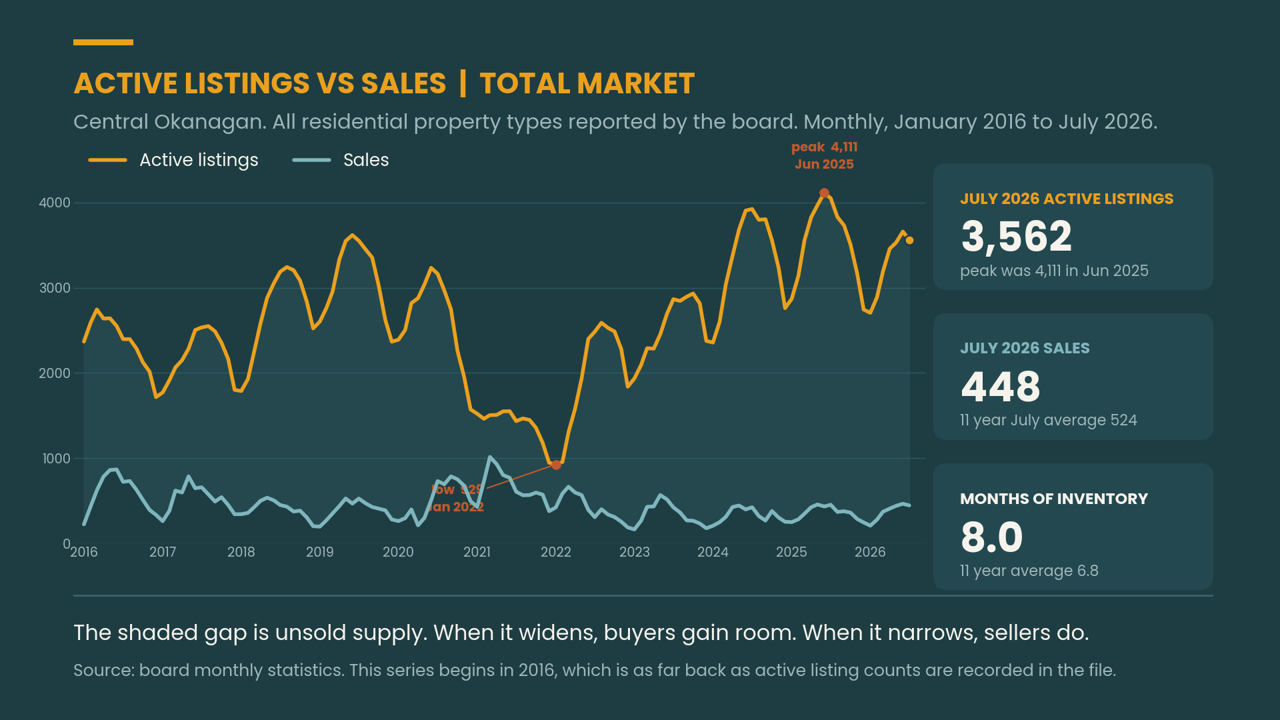
But Kelowna does have a real amount of new condo supply still moving through the system.
According to CMHC data, Kelowna has hundreds of completed but unabsorbed condo units, along with many more condo units still under construction. That means the public MLS numbers do not always show the full supply picture.
A buyer might search for Okanagan homes for sale or Kelowna condos for sale and see one version of the market.
But behind that, there may also be developer-held units, assignment sales, units not listed on MLS, rental units that could become resale units later, and projects that are still coming toward completion.
That matters.
Because condo values are not only based on what is listed today.
They are also affected by what is coming tomorrow.
The issue is not that nobody wants condos in Kelowna
This is where the conversation needs to stay balanced.
Kelowna still needs condos.
Condos are an important part of the housing market. They help first-time buyers get into ownership. They give downsizers an easier lifestyle. They create options for students, young professionals, hospital workers, investors, and people who want to live close to downtown, the lake, restaurants, shops, and transit.
Good condos in good locations still sell.
Well-priced condos still attract buyers.
The right condo can still be a great home and a smart long-term purchase.
But the market is becoming more selective.
Buyers are not just buying something because it is new. They are asking whether the price makes sense. They are looking at monthly payments, strata fees, parking, storage, rental rules, insurance, building reputation, and resale value.
That is a healthy thing.
For a long time, the condo market was driven by the idea that prices would keep rising. Today, buyers are being forced to look at the real math.
And some units do not look as strong once that math is done.
New does not always mean better value
One of the biggest mistakes in real estate is assuming that new automatically means better.
A new condo may have beautiful finishings, modern amenities, better windows, newer appliances, and less short-term maintenance. Those are real benefits.
But buyers are still comparing it to everything else they can buy.
A buyer looking at a new condo in Kelowna might also compare it to an older, larger condo in Lower Mission. Or a townhouse in West Kelowna. Or a resale unit in Glenmore. Or a more affordable option in Rutland. Or a lakeview condo in an older building with better square footage.
That is where some new condo pricing can become difficult.
If the new unit is smaller, has higher strata fees, limited parking, less storage, and a higher price per square foot, the buyer may not care that it is new.
They may choose value instead.
This is part of what Vancouver is showing us.
A shiny new building does not fix bad math.
What this means for Kelowna condo buyers
For Kelowna condo buyers, this market can create opportunity.
More supply usually means more choice. More choice means buyers can take a breath. They can compare buildings. They can look at recent sales. They can ask better questions. They can negotiate more carefully.
That is very different from the market a few years ago, when some buyers felt they had to rush into anything available.
But opportunity does not mean every condo is a good buy.
Buyers need to look beyond the list price.
Before buying a Kelowna condo, ask how many similar units are for sale in the building. Look at what has actually sold, not just what people are asking. Find out if there are developer units still available. Ask whether there are assignment sales competing with resale units. Look at the strata fees and the contingency reserve fund. Understand the rental rules.
And most importantly, ask whether the lender is likely to support the price.
In a market with more new condo supply, appraisal risk becomes a bigger deal. A buyer and seller can agree on a price, but if the appraisal comes in lower, the deal can become harder to close.
That does not mean buyers should be scared.
It means they should be prepared.
What this means for Kelowna condo sellers
For condo sellers in Kelowna, the Vancouver story is a reminder that the market does not care what someone paid before.
It cares what a buyer is willing and able to pay today.
That can be hard to hear, especially for owners who bought near the peak or purchased a presale years ago. A seller may have a number in mind based on their purchase price, upgrades, mortgage payout, or what they hoped the property would be worth.
But buyers are looking at today’s options.
If a seller is competing against new developer inventory, the competition can be even tougher. Developers may be able to offer incentives that a normal resale seller cannot. They may offer decorating credits, parking incentives, appliance packages, GST-related promotions, or other buyer bonuses.
That does not mean resale condos cannot sell.
They absolutely can.
But the pricing and positioning have to be sharp.
The best strategy is not to chase the market down. The best strategy is to understand the market before listing. That means looking at recent sold prices, active competition, building-specific supply, days on market, and the type of buyer most likely to purchase the unit.
In this kind of market, the highest asking price does not win.
The clearest value usually does.
What developers in Kelowna should learn
Developers and builders in Kelowna should also be paying close attention.
The old condo model depended heavily on investor demand. Build smaller units. Sell early. Use presales to help finance the project. Count on rising prices and strong absorption.
That model is under more pressure now.
Investors are doing harder math. Local buyers are more careful. Lenders are more cautious. And end users are asking whether the unit actually works for their life.
For developers in Kelowna, the lesson is not to stop building condos.
The lesson is to build condos people actually want to live in.
That may mean better floor plans. More livable two-bedroom units. More storage. Better parking solutions. Lower monthly costs. Realistic pricing. Stronger rental math. And locations where people want to live long term, not just places that looked good on a spreadsheet.
Kelowna still needs housing.
But housing supply only helps if it matches real demand.
The hidden inventory problem
One of the biggest issues in the Kelowna condo market is that the public numbers do not always tell the whole story.
MLS gives buyers and sellers one part of the picture.
But it may not show all completed developer inventory. It may not show every assignment sale. It may not show units being held back. It may not show future competition from buildings that are close to occupancy.
This is why the market can feel different on the ground than it looks online.
A seller may think there are only a few competing listings.
But a buyer may be comparing that unit to developer options, private sales, upcoming completions, and resale condos in several nearby buildings.
That hidden supply affects buyer confidence.
And buyer confidence affects price.
So, does Kelowna have too many new condos?
Not exactly.
Kelowna does not have too many condos in every category, every building, and every location.
But Kelowna may have too much of certain types of condo supply.
Too many small investor-style units.
Too many units priced for a market that has already changed.
Too many projects depending on buyers who are no longer as active.
Too many assumptions that people will pay more just because something is new.
The right condos will still sell.
The wrong ones will need to adjust.
That is not a crash story. That is a market story.
The real lesson from Vancouver
Vancouver’s empty condo problem teaches one simple lesson:
Markets eventually tell the truth.
If prices are too high, buyers pause.
If the product is wrong, buyers choose something else.
If investors leave, the end user has to carry the market.
If lenders get cautious, appraisals get harder.
And if too much similar product finishes at the same time, sellers have to compete.
Kelowna is not Vancouver.
But Kelowna should not ignore Vancouver either.
The warning is not that every new condo is bad. The warning is that new supply needs to match real demand, real incomes, real lending rules, and real buyer confidence.
That is where the market is heading.
Final thoughts
Vancouver has the big headline.
Kelowna has the quieter lesson.
Our condo market is still moving. Good units are still selling. Buyers still want the Okanagan lifestyle. Sellers can still get strong results with the right strategy. Developers can still build successful projects.
But the easy market is gone.
Today’s Kelowna condo market rewards good pricing, good floor plans, good locations, and clear value.
For buyers, that means there may be real opportunity if you know what to look for.
For sellers, it means pricing based on hope is risky.
For developers, it means the next project has to be built for the real buyer, not just the spreadsheet buyer.
If you are buying, selling, or developing condos in Kelowna and want to understand how this market affects your next move, call or text me at 778-946-6454.
Mark Coons, BBA, CE
REALTOR® | eXp Realty Kelowna
Team Lead, Selling Okanagan Group
Relocated to Kelowna in 2018
📞 778-946-6454
📩 [email protected]