Is BC’s Condo Buyback a Bailout or an Affordable Housing Fix?
BC’s condo buyback plan is one of those housing announcements that sounds simple at first.
There are empty condos.
People need housing.
The government steps in, buys or helps finance the purchase of those condos, and turns them into affordable homes.
On the surface, that sounds practical.
Why wait years for new affordable housing to be built when completed units are already sitting there?
That is the easy argument.
But housing is rarely that simple.
Because the moment government becomes the buyer of last resort for unsold private condos, the story changes. It is no longer just about creating affordable housing faster. It becomes a much bigger question about who takes the loss when the market changes.
Is this an affordable housing fix?
Or is it a bailout for developers who built the wrong product at the wrong price?
That is the real debate.
What is the BC condo buyback plan?
The federal and BC governments announced a new partnership aimed at building more homes, lowering some development costs, and funding local infrastructure.
Part of the announcement included the Canada-BC Partnership on Condo Conversion.
The plan is to convert more than 2,200 vacant condo units in priority growth areas into affordable homes through Build Canada Homes and BC Housing.
The larger announcement also included more than $5 billion in federal infrastructure investment over 10 years, up to $3.2 billion combined federal and provincial support to reduce development charges for multi-unit housing in priority communities, and a one-time $284 million federal transfer to BC to reduce barriers to new construction.
That is the official version.
The goal is faster housing.
The promise is affordability.
The concern is who gets protected.
Why people are calling it a bailout
The word “bailout” is strong.
But it is not hard to see why people are using it.
In Metro Vancouver, there are thousands of completed and unabsorbed condo units. That means units have been finished, but have not been absorbed by the market.
In plain English, builders finished the product, but enough buyers did not show up.
That is a market signal.
It usually means one of a few things.
The price is too high.
The product is wrong.
The buyer pool changed.
The investor math stopped working.
Or the market simply has too much of the same thing at the same time.
In a normal market, that pressure forces prices to adjust. Developers may need to discount. Investors may need to take a loss. Lenders may get more careful. Future projects may need to be redesigned or repriced.
That is painful.
But it is also how markets correct.
When government steps in and absorbs a large block of inventory, the correction may not fully happen. The developer or owner may avoid the full pain of the bad bet. The market does not get the same clean price signal.
That is why people are calling it a bailout.
Not because affordable housing is bad.
But because public money may be used to clean up a private market problem.
Why it could still help
This is where the debate gets more complicated.
There is a good side to the plan.
If BC can take vacant condos and turn them into affordable housing faster than building from scratch, that helps real people sooner.
There are families who need housing now.
There are workers who cannot afford to live near their jobs.
There are seniors, young people, and lower-income renters getting squeezed every month.
If completed units are sitting empty, using them for affordable housing may be faster than waiting five years for new projects to go through zoning, permitting, financing, construction, and completion.
That part makes sense.
Empty homes do not help anyone.
A completed condo used as affordable housing is better than a completed condo sitting dark.
So yes, the plan could help some people.
It could add affordable homes faster.
It could keep some construction-related jobs alive.
It could reduce some pressure in specific areas.
But that does not answer the bigger question.
At what price?
The price is the whole story
The biggest missing piece is the price per unit.
That number matters more than the press conference.
If the government or its partners buy the condos at a deep discount, then taxpayers may be getting a better deal and the market is still forcing some pain onto the developers or owners.
That would look less like a bailout.
But if the units are purchased at prices that keep developers whole, protect lenders, or avoid the natural market discount, then it starts to look very different.
Then the public may be paying to hold up values that the private market no longer supported.
That is where the fairness question comes in.
A builder makes money when the market goes up.
An investor makes money when the market goes up.
A developer benefits when presale demand is strong and prices rise.
But when the market turns, should the public absorb the loss?
That is the uncomfortable part.
Profits were private.
Losses may become public.
That is why this story is getting attention.
The market was already sending a message
The most important part of this story is the signal.
The market was already saying something.
It was saying there were too many completed condos sitting unsold.
It was saying some prices were too high.
It was saying investor demand had changed.
It was saying end users were not willing or able to absorb all the supply at the prices being asked.
That signal matters.
When government steps in and buys a large amount of that supply, the signal gets harder to read.
Maybe prices should have come down more.
Maybe future projects should have been redesigned.
Maybe lenders should have become more cautious.
Maybe land values needed to adjust.
Maybe the whole development model needed a reset.
But if government becomes the safety net, the lesson may be delayed.
And when the lesson gets delayed, the next mistake can get bigger.
What this means for housing affordability
This is the part I keep coming back to.
The announcement is being framed around affordability.
But we have to be honest about what kind of affordability we are talking about.
If these condos become below-market rental homes, then yes, they may become more affordable for the people who get access to them.
That is good.
But does this make housing more affordable for the average buyer?
Does it lower home prices?
Does it help a first-time buyer in Kelowna buy a starter condo?
Does it help a young family buy a townhome?
Does it help a worker save a down payment?
Maybe not.
In fact, if the program helps hold up condo values by removing unsold inventory from the market, it could make the ownership side less affordable.
That is the tension.
Affordable housing programs can help some people directly while still keeping the broader market expensive.
Both things can be true.
Why Kelowna should care
Some people in Kelowna may look at this and say, “This is a Vancouver issue.”
For now, they are mostly right.
The condo conversion plan appears to be focused on priority growth areas, and Metro Vancouver is where the empty condo headline is loudest.
But Kelowna should still pay attention.
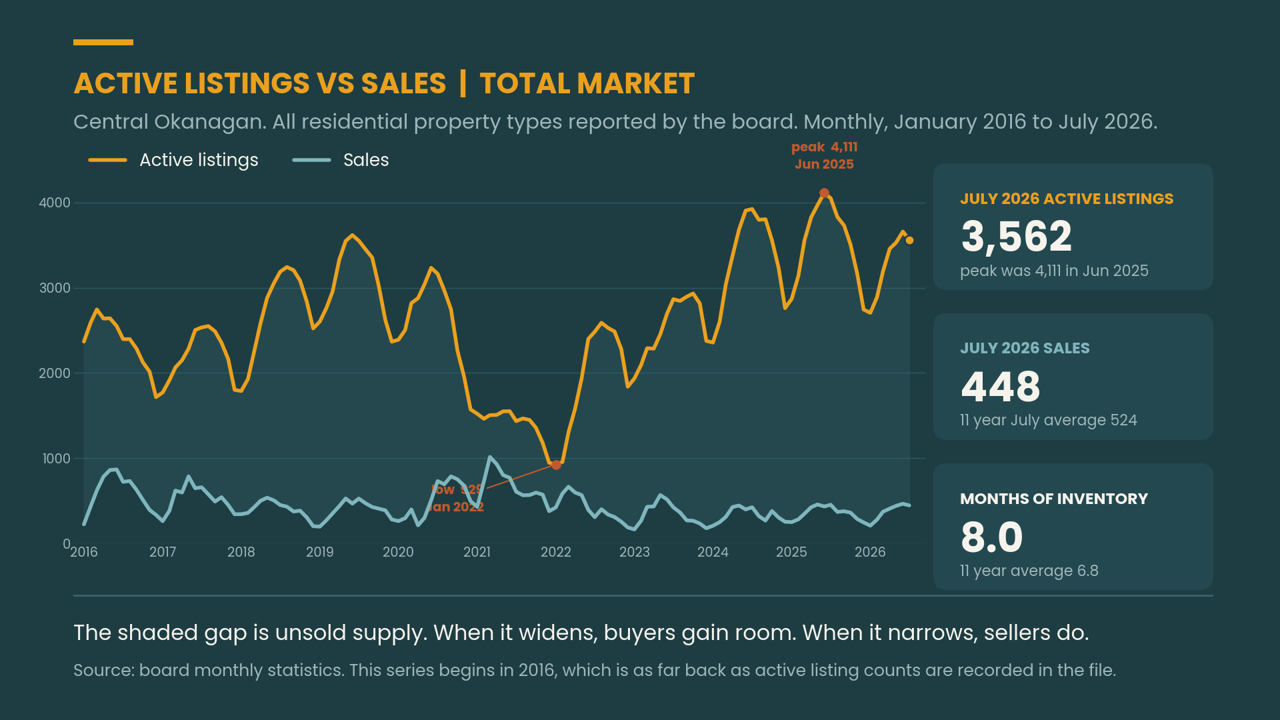
Kelowna has its own new condo supply working through the system.
We have completed units that still need buyers. We have condo projects under construction. We have presale buyers closing in a different market than the one they bought in. We have investors doing harder math. And we have appraisals becoming a bigger part of the conversation.
Kelowna is smaller than Vancouver.
But smaller does not mean immune.
If the province is willing to step into Vancouver’s unsold condo problem today, it raises a fair question.
What happens if other BC markets face similar pressure tomorrow?
Would Kelowna developers expect the same kind of help?
Would taxpayers support that?
Would buyers see it as confidence or as a warning sign?
These are fair questions.
What this could do to appraisals and comparable sales
Another issue is appraisals.
When a large block of condos gets purchased, converted, financed, or removed from the private market, it can affect how people understand value.
If the transactions happen at discounted prices, they may pull comparable values down.
If the transactions happen at prices that protect developers, they may make values look stronger than the open market really is.
Either way, appraisals can get messy.
That matters because appraisals are how many mortgages actually close.
A buyer can agree to a price.
A seller can accept the offer.
But if the lender does not support the value, the deal can run into trouble.
This is already a real issue in parts of the new condo market.
The price people hoped for is not always the price lenders will support today.
When government becomes a major buyer, the market becomes harder to read.
What this means for buyers
For buyers, the lesson is simple.
Do not just follow the headline.
If you are buying a condo in Kelowna, Vancouver, or anywhere in BC, you need to understand the supply picture.
How many similar units are for sale?
How many are still owned by the developer?
Are there assignment sales?
Are prices being reduced?
Are incentives being offered?
Are units renting for enough to support investor demand?
Are appraisals supporting current prices?
A government buyback may make the market look stronger by removing supply.
But buyers still need to ask whether the price makes sense for them.
The best deal is not always the cheapest unit.
It is the unit where the price, building, location, monthly cost, resale value, and financing all make sense.
What this means for sellers
For sellers, this announcement is a reminder that supply matters.
If you own a condo in a building with lots of similar units for sale, buyers have options.
If new developer inventory is competing against your resale unit, you need to know what incentives are being offered.
If appraisals are coming in tight, you need to price with the lender in mind, not just the buyer.
The government may step in for some markets and some buildings.
But most sellers should not count on a rescue.
The better strategy is to understand the current market and price clearly from the start.
In a cautious condo market, hope is not a pricing strategy.
What this means for developers
For developers, this should be a wake-up call.
If the only way a project works is with investor demand, rising prices, and government help at the end, that is not a strong housing model.
The next generation of housing needs to be built for real end users.
People who actually live there.
People who can afford the monthly payment.
People who need functional layouts, storage, parking, livable space, and realistic strata fees.
Developers in Kelowna should be watching this closely.
The market is not saying, “Do not build.”
The market is saying, “Build what people actually need at a price they can actually carry.”
That is a very different thing.
The honest scorecard
There is good in this plan.
It could create affordable housing faster.
It could use empty units that are already built.
It could help renters who need housing now.
It could keep some construction and housing momentum alive.
But there is also a real downside.
It may protect developers from losses the market was trying to impose.
It may create a price floor under a market that needed to correct.
It may confuse comparable sales and appraisals.
It may encourage future developers to expect government help if projects do not sell.
And it may spread the cost across taxpayers who had no upside when the original profits were being made.
That is why this is not a simple story.
It can be an affordable housing fix for some people and still be a bailout for others.
My take
My take is this:
We should want affordable housing.
We should want faster housing.
We should want empty homes used instead of wasted.
But we should also be very careful when government steps in to protect private real estate from market consequences.
The housing market needs more supply.
But it also needs honest pricing.
It needs developers to build for real demand.
It needs buyers to see real market signals.
It needs land values to adjust when the math no longer works.
And it needs affordability to mean more than moving expensive units from one balance sheet to another.
If the public is buying the problem, the public deserves to know the price.
Not just the number of units.
Not just the press release.
The actual price.
Because that is where we find out whether this is truly an affordable housing fix or a bailout dressed up as one.
Final thoughts
BC’s condo buyback plan may help some people get housing faster.
That part matters.
But it also raises a bigger question about fairness.
If a developer builds the wrong product at the wrong price, should the market correct it, or should taxpayers absorb it?
That question matters in Vancouver.
It matters in Kelowna.
And it matters for every family wondering if their kids will ever be able to afford a starter home in this country.
Housing affordability is not just about creating units.
It is about creating a market where regular people can afford to live without constantly paying for yesterday’s mistakes.
That is why this announcement deserves more than a headline.
It deserves a hard look.
If you are buying, selling, or developing real estate in Kelowna and want to understand how BC’s housing policy could affect your next move, call or text me at 778-946-6454.
Mark Coons, BBA, CE
REALTOR® | eXp Realty Kelowna
Team Lead, Selling Okanagan Group
Relocated to Kelowna in 2018
📞 778-946-6454
📩 [email protected]