Kelowna Hit Its Housing Target—but Built the Wrong Homes
Kelowna is building homes faster than the Province asked.
But that does not necessarily mean Kelowna is building the homes local buyers need most.
The City is well ahead of its provincial housing target. Rental vacancy is also rising, giving tenants more options.
Yet many young families, downsizers and move-up buyers still struggle to find practical two- and three-bedroom homes at a price they can afford.
How can all three things be true?
Because the housing target counts the number of doors built. It does not fully measure the size, price, ownership type or buyer each door is meant to serve.
Did Kelowna meet its provincial housing target?
Kelowna received a five-year target of 8,774 net new homes from the Province of British Columbia.
As of the City’s July 2026 report, Kelowna had completed 6,384 net new homes in only two reporting years.
That puts Kelowna ahead of its third-year target and only 112 homes below the fourth-year target. In simple terms, Kelowna completed almost four years of its housing target in about two years.
That looks like a clear win.
And in terms of total supply, it is.
But the mix of housing matters too.
In Kelowna’s first annual reporting period alone, the City recorded:
- 687 studio apartments
- 1,256 one-bedroom homes
- 1,207 two-bedroom homes
- 470 three-bedroom homes
Of the 3,467 net new homes delivered that year, 1,807 were rental units and 1,660 were ownership units.
Kelowna did not build nothing. It built a lot.
The better question is whether enough of that housing fits the people hoping to buy and stay in the community.
Why does Kelowna still have a shortage of family homes?
Kelowna’s housing shortage is no longer simply about the total number of units.
It is increasingly about the type of units available.
A studio apartment can help one renter. A one-bedroom rental can help a couple. Those homes matter.
But they are not direct replacements for:
- A three-bedroom townhome for a young family
- A smaller detached home for a downsizer
- An affordable home with a yard
- A duplex or fourplex unit suitable for ownership
- A practical two-bedroom condo with storage and parking
- A home that allows a family to remain in Kelowna as it grows
This is the gap between housing supply and housing fit.
Kelowna may have more doors, while still having too few doors that match the needs and budgets of local buyers.
Is Kelowna’s rental market becoming more balanced?
Yes.
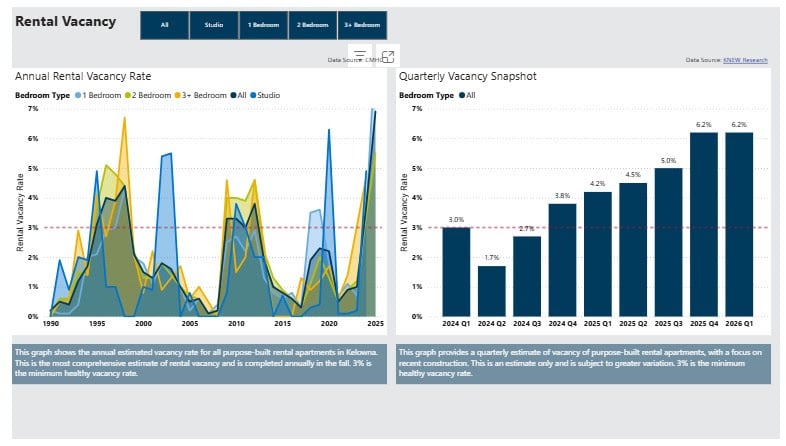
The City of Kelowna’s purpose-built rental vacancy rate reached 6.9% in 2025.
Vacancy for one-bedroom apartments reached 9.1%, while two-bedroom vacancy reached 5.5%.
That is good news for many renters.
Renters may have:
- More buildings to choose from
- More time to make a decision
- Greater negotiating power
- Access to move-in incentives
- Less pressure to accept the first available unit
For landlords and rental developers, however, rising vacancy can mean longer lease-up periods, more competition and greater pressure on rents.
But a softer rental market does not automatically solve the ownership market.
A family trying to buy a three-bedroom townhome is not helped much by a larger supply of studio and one-bedroom rental apartments.
What does price per square foot reveal about Kelowna real estate?
To understand the ownership market, I reviewed the previous 12 months of Central Okanagan residential sales by property size.
This includes resale activity across the broader Central Okanagan market, rather than only new construction inside the City of Kelowna.
The same pattern appeared in detached homes, townhomes and apartments:
The price per square foot normally falls as the home gets larger.
Why?
A home has several major costs that do not change much based on its size.
Every home needs:
- A kitchen
- Bathrooms
- Heating and cooling
- Plumbing
- Electrical service
- Permits
- Servicing
- Financing
- Professional fees
A 900-square-foot home still needs most of the same basic systems as a 2,000-square-foot home.
When those costs are spread across more space, the cost per square foot often falls.
But the line is not perfectly straight.
It is closer to a U-shaped curve.
The bottom of that curve helps show where buyers and sellers are finding the most agreement.
Detached-home prices by size in the Central Okanagan
Based on the previous 12 months of sales:
Detached-home size | Average sold price per sq. ft. | Number of sales |
|---|---|---|
Under 1,500 sq. ft. | $526 | 202 |
1,500–2,500 sq. ft. | $400 | 766 |
2,500–3,500 sq. ft. | $371 | 700 |
3,500–5,000 sq. ft. | $388 | 296 |
More than 5,000 sq. ft. | $445 | 72 |
The lowest price per square foot was found between 2,500 and 3,500 square feet.
Prices begin rising again above 3,500 square feet. That increase is not always caused by the building itself.
Many larger properties include features such as:
- Lake views
- Acreage
- Larger lots
- Pools
- Shops
- Premium neighbourhoods
- Waterfront or lake access
- Higher-end finishing
In those cases, buyers are also paying for the land, location and lifestyle.
What size detached homes sell most often?
The busiest part of the detached market was between 1,500 and 3,500 square feet.
There were 1,466 sales in this range.
This is the main engine of the Central Okanagan detached-home market.
These homes are often large enough for a family but not so large that maintenance, utilities and the total purchase price become unmanageable.
Why are builders not building more small detached homes?
Small homes can sell for more per square foot.
But builders cannot pay their bills with a percentage or a per-foot number. They need enough total revenue left after every project cost.
Consider this basic example:
- A 1,400-square-foot home selling for $526 per square foot equals about $736,000
- A 3,000-square-foot home selling for $371 per square foot equals about $1.11 million
The smaller home earns more for each square foot.
The larger home produces about $377,000 more in total revenue.
The cost of the lot, municipal fees, servicing, permits, design work and financing may not shrink by $377,000 simply because the home is smaller.
That is why a builder can struggle to make a small detached home financially viable, especially when replacing an older home on an expensive Kelowna infill lot.
The market may want a $750,000 new detached home.
The land and construction math may require the builder to create a $1.2-million or $1.5-million home instead.
This is one reason the traditional new-construction starter home has nearly disappeared.
Townhome prices by size in the Central Okanagan
Townhomes show an even cleaner pattern:
Townhome size | Average sold price per sq. ft. | Number of sales |
|---|---|---|
Under 1,200 sq. ft. | $446 | 72 |
1,200–1,600 sq. ft. | $441 | 255 |
1,600–2,000 sq. ft. | $387 | 194 |
2,000–2,800 sq. ft. | $356 | 157 |
More than 2,800 sq. ft. | $328 | 41 |
Unlike detached homes, there is no major luxury increase at the top.
That makes sense. Most townhomes do not sit on large acreage or waterfront lots.
The busiest townhome range was 1,200 to 1,600 square feet, with 255 sales.
That size often provides:
- Two bedrooms plus a den
- Three smaller bedrooms
- Two or three bathrooms
- A garage
- Some outdoor space
- Enough room for a young family
- A lower total price than a detached home
This may be one of the most important housing types in the Kelowna real estate market.
It sits between a condo and a detached house, both in size and price.
Apartment prices by size in the Central Okanagan
Apartments had the steepest price-per-square-foot curve:
Apartment size | Average sold price per sq. ft. | Number of sales |
|---|---|---|
Under 600 sq. ft. | $724 | 72 |
600–900 sq. ft. | $510 | 289 |
900–1,200 sq. ft. | $409 | 451 |
1,200–1,600 sq. ft. | $400 | 234 |
More than 1,600 sq. ft. | $506 | 41 |
A condo under 600 square feet sold for an average of $724 per square foot.
That is almost twice the rate paid for apartments between 900 and 1,200 square feet.
The smallest units still require a kitchen, bathroom, laundry equipment and mechanical systems. Those costs are spread over very little space.
The busiest apartment category was 900 to 1,200 square feet, with 451 sales.
That range often includes the practical two-bedroom condos sought by:
- First-time buyers
- Downsizers
- Small families
- Retirees
- Couples working from home
- Buyers who need a guest room or office
The price per square foot rises again above 1,600 square feet. This category often includes penthouses, luxury condos and premium view properties.
Did Kelowna build the wrong homes?
Not completely.
The rental apartments and smaller homes that were completed still add needed housing supply.
But the data suggests a mismatch remains.
Kelowna has been successful at creating a large number of units. It has been less successful at consistently creating attainable, family-sized ownership homes.
The missing part of the market is not simply “more housing.”
It is a larger supply of homes such as:
- Efficient three-bedroom townhomes
- Two-bedroom-plus-den apartments
- Duplex and fourplex ownership units
- Smaller detached homes
- Accessible homes for downsizers
- Family-sized infill housing near schools, parks and services
The strongest demand appears to sit in the practical middle.
Unfortunately, this is often the hardest part of the market for builders to produce at a price buyers can afford.
What are active sellers asking compared with recent sales?
The gap between asking prices and sold prices provides another useful signal.
In several of the busiest size categories:
Property category | Average sold price per sq. ft. | Average active asking price | Approximate gap |
|---|---|---|---|
Detached, 2,500–3,500 sq. ft. | $371 | $405 | 9% |
Townhome, 1,200–1,600 sq. ft. | $441 | $465 | 5% |
Apartment, 600–900 sq. ft. | $510 | $551 | 8% |
These categories sit on or near the busiest size ranges in each market.
There are enough sales to help buyers and sellers understand where fair value may sit.
The edges of the market are harder to price.
Detached homes under 1,500 square feet were being listed about 26% above the price per square foot achieved by recent sales.
Apartments over 1,600 square feet were being listed roughly 25% above recent sold rates.
Small homes can attract ambitious prices because there are so few of them.
Very large or unusual homes can also be difficult to price because there may not be enough similar sales.
Scarcity can create interest.
It does not remove the buyer’s budget.
What does this mean for Kelowna homebuyers?
Do not judge a property using only its total price.
A lower-priced home is not always better value. It may simply be much smaller.
Also, do not assume the lowest price per square foot is automatically the best deal. A larger home may have a lower rate per square foot but require more maintenance, heating, repairs and furnishing.
Instead, look at:
- The size range that meets your real needs
- Recent sales within that same size range
- The difference between asking and sold prices
- Strata fees and future maintenance
- Parking, storage and outdoor space
- The home’s location within Kelowna or the Central Okanagan
- Whether the layout uses its square footage efficiently
For many buyers, the market currently appears most established around:
- Detached homes: 1,500–3,500 square feet
- Townhomes: 1,200–1,600 square feet
- Apartments: 900–1,200 square feet
A smaller apartment between 600 and 900 square feet may also offer a more competitive asking-to-selling gap when that size works for the buyer.
What does this mean for Kelowna home sellers?
Owners of small, efficient homes may have something that is difficult and expensive to replace.
This can include:
- Smaller detached homes
- Well-designed two-bedroom condos
- Compact townhomes with garages
- Homes with legal suites
- Older homes on infill lots
- Entry-level homes in established neighbourhoods
New builders may not be able to reproduce these homes at the same total price.
That creates real scarcity.
But scarcity is not permission to ignore the market.
The 26% asking-to-selling gap for detached homes under 1,500 square feet shows that buyers still have a limit.
A rare home can attract attention.
The right price is what turns that attention into an offer.
What does this mean for Kelowna developers and home builders?
The highest price per square foot does not always produce the strongest project.
Developers must also consider:
- Total selling price
- Land cost
- Construction cost
- Development cost charges
- Parking requirements
- Financing
- Approval timelines
- Strata fees
- Monthly ownership costs
- Competing projects
- Absorption and sales pace
A small unit may produce an impressive price per square foot but still have a limited buyer pool at its total price.
A larger unit may produce more total revenue but become unaffordable to the families it was designed to serve.
For Kelowna infill developments, the opportunity may be found in efficient layouts rather than simply maximizing either size or unit count.
Projects that offer practical two- and three-bedroom homes may be better positioned when they combine:
- Efficient floor plans
- Limited wasted hallway space
- Useful storage
- Reasonable strata fees
- Flexible dens or office space
- Ground-level access
- Private outdoor areas
- Parking that matches the target buyer
- A total price local households can support
The market data shows where buyers are completing purchases.
The development pro forma determines whether builders can meet them there.
The real lesson from Kelowna’s housing target
Kelowna is ahead of its provincial housing target.
That deserves recognition.
More rental supply has also helped increase vacancy and provide renters with more choice.
But counting completed homes is only the first step.
We must also ask:
- How many are suitable for families?
- How many are available for ownership?
- What do they cost?
- Are the layouts useful?
- Can local incomes support the monthly payment?
- Can developers build them and still earn a reasonable return?
- Do they allow young families and downsizers to remain in Kelowna?
Kelowna counted the doors.
Now it is worth asking who those doors actually fit.
To learn where your home—or a property you are considering—sits on the Central Okanagan price and size curve, reply to this email or contact us directly.
Mark & Maddie Coons
Selling Okanagan Group | eXp Realty Kelowna
Office: 778-946-6454
Cell: 250-801-0361
Email: [email protected]