BC's 2026 Budget Housing Tax Increases: What Kelowna Buyers, Sellers, and Investors Need to Know
BC Budget 2026: A Disappointment for Housing — And What It Means Right Here in Kelowna
The BC government released its 2026 provincial budget in February, and the reaction from the real estate industry was swift and pointed. The BC Real Estate Association (BCREA) came out publicly, calling the budget a missed opportunity and raising serious concerns about measures that could make housing affordability worse — not better — across the province. For anyone buying, selling, developing, or investing in Kelowna real estate right now, this budget has real implications worth understanding.
Here's the honest breakdown: at a time when BC's housing construction pipeline is already under pressure, the provincial government chose to increase taxes on the development sector rather than reduce them. The BCREA was direct in its assessment, saying the budget "failed to address either the growing tax burden or the province's housing issues." That's a strong statement from an industry body that typically prefers careful, measured language — and it deserves attention.
What the Budget Actually Does to Housing in BC
Let's get into specifics, because the policy details matter when you're making real estate decisions.
Budget 2026 introduced three changes that have the development and real estate industry concerned. First, higher school taxation rates on development lands will increase the cost of bringing new projects to market. That cost doesn't disappear — it gets passed on, ultimately landing on buyers in the form of higher prices or on developers in the form of projects that no longer pencil out. Second, applying PST to professional housing-related services will increase what are called "soft costs" — the professional fees involved in designing, engineering, and permitting new homes. Again, these aren't abstract accounting items; they raise the total cost of building a home. Third, and perhaps most controversially, the Speculation and Vacancy Tax rate for foreign residents has been increased to four per cent. The stated goal is to discourage speculation, but the BCREA argues this will also discourage the capital needed to finance new housing supply — capital that BC badly needs right now.
Taken together, these measures don't make housing more affordable. They make it more expensive to build, which means fewer projects get started, which means less supply — and less supply is the last thing a market like Kelowna needs when demand is slowly rebuilding.
Why This Matters Specifically for Kelowna
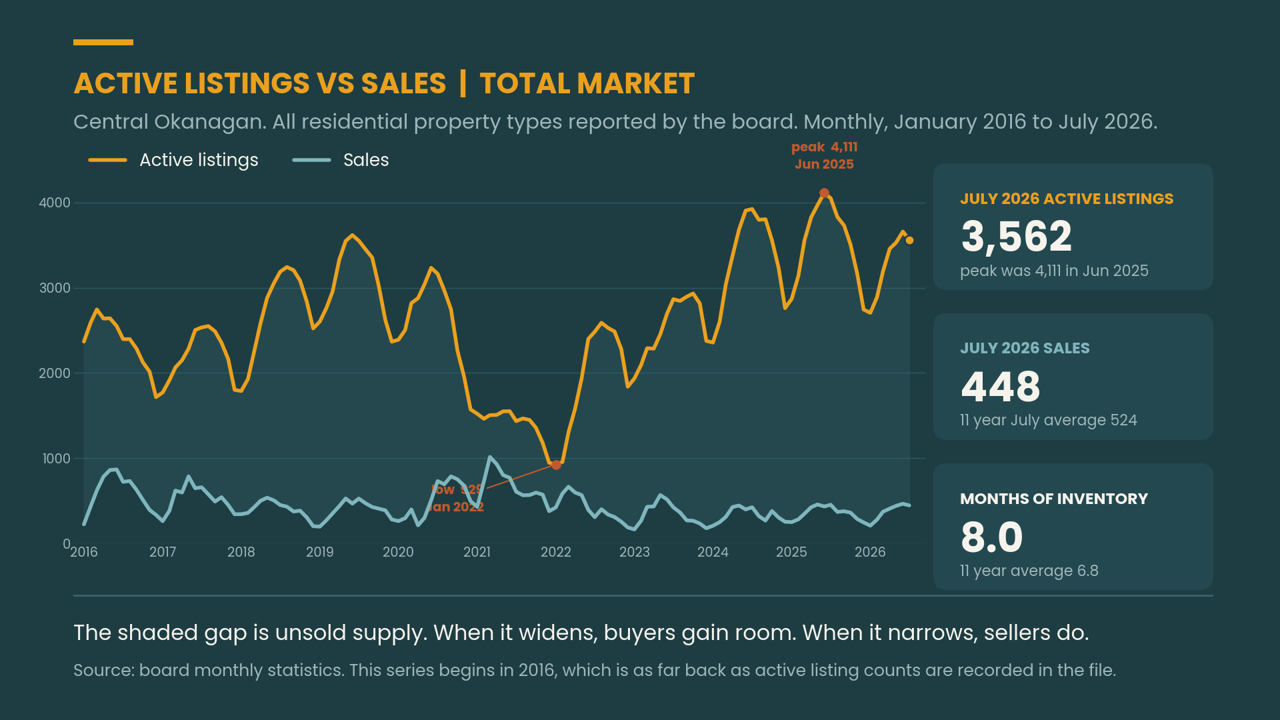
If you've been following the Kelowna housing market, you know that supply has been a consistent challenge. The Central Okanagan's population has grown significantly over the past decade, driven by lifestyle migration, remote work flexibility, and strong economic fundamentals. That growth in demand hasn't been fully matched by supply — and when supply constraints meet rising demand, prices go up.
Now layer in a provincial budget that makes new construction more expensive. Developers in Kelowna are already navigating tight margins. The Glenmore Highlands area, the Mission, McKinley, and other growing Kelowna neighbourhoods have seen construction activity, but rising costs have already caused some projects to be delayed or cancelled. Budget 2026's tax increases don't help. They tip the scale further against viability for marginal projects — which in a market like ours, are often exactly the projects that would have added the townhomes, condos, and missing middle housing that buyers most need.
The BCREA's Chief Economist put it plainly: doing so on the back of an already struggling housing sector will ultimately prove to be self-defeating. I think that's right. And as someone working with buyers and sellers in Kelowna every day, I see the effects on the ground — buyers who are already stretched, sellers navigating flat or declining benchmark prices, and developers facing a calculus that keeps getting harder.
What Should Buyers Know Right Now?
If you're a buyer in Kelowna, the immediate takeaway is nuanced. On one hand, the market is still offering negotiating room that wasn't there two years ago. Central Okanagan single-family benchmark prices came in at $1,056,600 in February 2026 — down slightly year-over-year — and townhomes are showing real value at $671,300, off 8.1% from last year. That's a window of opportunity for buyers who have been waiting.
On the other hand, policies that constrain new supply over the medium term tend to put upward pressure on prices as demand eventually recovers. The BCREA and CMHC both project that housing demand across BC and Canada will gradually strengthen through 2026 and 2027 as interest rate uncertainty stabilizes and household formation continues. If new supply isn't keeping pace because of policy-driven cost increases, that demand recovery could translate into price pressure — particularly in high-demand markets like Kelowna.
The practical implication: buyers who act thoughtfully now, at current pricing, may find they've positioned themselves well ahead of a tighter supply environment over the next two to three years.
What Should Sellers and Investors Know?
For sellers, the budget reinforces that pricing your home realistically in today's market is more important than ever. Buyers are informed, and they're not going to overpay in an environment where there's still meaningful choice. But well-priced, well-presented Kelowna properties are moving — the market has not stopped.
For investors, the Speculation and Vacancy Tax increase deserves close attention if you hold property through a foreign structure or have clients who do. The increase to four per cent for foreign residents is significant, and the threshold for what qualifies under the tax rules is worth reviewing with a real estate lawyer or tax advisor before making any moves.
More broadly, the budget is a reminder that policy risk is real in the BC housing market. Understanding the regulatory environment is part of making smart investment decisions — and that's exactly the kind of context I bring to conversations with clients navigating the Kelowna market.
Staying Informed as Policy Changes Unfold
The situation isn't static. The BCREA is actively advocating for changes, and there may be provincial or federal counterweights in the months ahead — including the federal government's recently proposed $1.7 billion fund to help provinces lower the cost of homebuilding, which could potentially provide some offset to these provincial headwinds. Staying on top of these policy developments is part of how I help my clients make decisions that aren't just right for today, but positioned well for what comes next.
Have questions about what this means for your home or investment? We are here to help.
Mark Coons, BBA, CE
REALTOR® | eXp Realty Kelowna
Team Lead, Selling Okanagan Group
Relocated to Kelowna in 2018
📞 778-946-6454
📩 [email protected]