The Investor Has Left the Building in Kelowna Real Estate. Now What?
If you have been watching the Kelowna real estate market and thinking something feels off, you are not wrong.
There are more listings. Some homes are sitting. Yet some properties still sell fast.
That can feel confusing until you understand one big change in the market:
A major buyer group has pulled back hard.
The revenue investor — the person buying a home to rent out, build equity, and sell later for a gain — is no longer driving the market the way they once did. In the market commentary you shared, that buyer group fell from 15% of all buyers in 2021 to 5% by the end of 2025. That is a major shift, and it helps explain why parts of the market feel slow while other properties still move well.
For home sellers in Kelowna, buyers trying to find value, and especially developers and home builders looking at infill multifamily opportunities, this matters a lot.
Because when one type of buyer leaves the market, another type of opportunity starts to show up.
What Changed in the Kelowna Real Estate Market?
The short answer is this: the math changed.
For years, many investors bought properties in Kelowna because they believed the numbers would work through a mix of:
- rental income
- long-term appreciation
- short-term rental income
- future redevelopment upside
But over time, the pressure built.
The market commentary you shared points to a stack of forces all hitting at once: higher rates, tighter landlord rules, short-term rental legislation, rising costs, and weaker cash flow. Together, they changed the investment case for many small landlords and individual investors.
That does not mean all real estate in Kelowna is a bad investment.
It means the old, simple playbook is not working like it used to.
And that changes how sellers should market, how buyers should search, and how builders should think about land.
What the Listings Data Shows
Your market commentary highlights decade-long MLS data filtered for tenant-occupied listings across the Central Okanagan, covering roughly 12,000 listings. The pattern is clear.
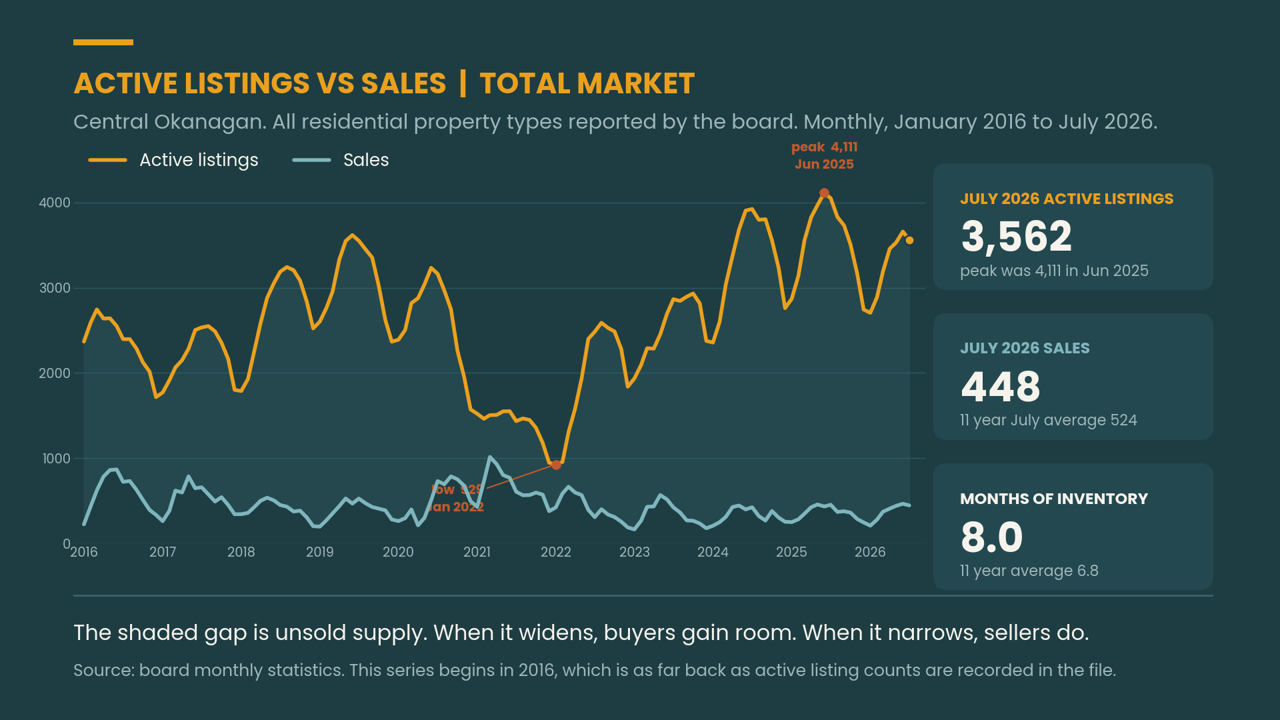
From 2016 to 2019, the market looked relatively balanced, with around 280 to 320 active investor listings at a time and monthly sales running between 40 and 90. Then the frenzy years hit, and in 2021 tenant-occupied sales surged. After that, the market turned sharply. By mid-2024, active tenant-occupied listings had climbed to nearly 480, while monthly sales had fallen to around 12 to 25.
That tells us something important:
There are more investor-style listings on the market, but far fewer buyers for them.
That is why many of these properties are sticking around.
The Sales-to-Active Ratio Tells the Story
One of the clearest signals in your write-up is the sales-to-active ratio.
This ratio measures how many listed properties are actually selling in a given month. In the analysis you shared, tenant-occupied properties reached a sales-to-active ratio of 79.7% at the 2022 peak. Today, the ratio sits around 5%, meaning roughly one in twenty listed investor properties is selling in a given month.
That is not just a slower market.
That is a market segment that has almost frozen.
And when that happens, the people who win are usually the ones who understand that the buyer pool has changed.
Why Investors Pulled Back
The decline in investor demand was not random.
It was logical.
Your commentary lays out the reasons clearly:
1. Higher borrowing costs
Once rates moved up, many deals no longer worked. Carrying costs rose, and monthly payments stopped matching realistic rent.
2. Rent controls and rising expenses
The analysis notes that rent increase limits stayed very low in 2021 and 2022 while costs like property taxes, insurance, and maintenance rose much faster. That widened the gap each year.
3. Harder vacant possession and tighter landlord rules
Buyer demand for tenant-occupied homes often drops when possession is uncertain or delayed. That creates more discounting and longer selling times.
4. Short-term rental restrictions
The commentary specifically points to Bill 35 in 2024 removing the Airbnb-style income model that had supported an entire group of condo investors in Kelowna.
5. Weak rental math
The market commentary estimates that average rents for a three-bedroom home in Kelowna were sitting around $2,400 to $2,600 per month while a typical detached home price was far higher. That gap made the numbers tough before even adding taxes, insurance, or repairs.
That last point matters most.
The investor did not just leave because of fear.
In many cases, the spreadsheet told them to leave.
What This Means for Home Sellers in Kelowna
If you are selling a home in Kelowna, especially one with a tenant in place, you need to understand this:
You are probably not marketing to the same buyer you would have marketed to in 2021.
Back then, many sellers could rely on investor demand.
Today, that is a much smaller group.
According to the market commentary you shared, the more likely buyer today may be:
- a first-time buyer
- a local move-up buyer
- a strategic investor with a very specific thesis
- an owner-occupier looking for a discounted entry point
That means your pricing, your presentation, and your messaging matter more than ever.
A seller who prices a property based on old investor excitement may sit.
A seller who understands who is actually buying today can position the property far better.
Sellers need to ask:
- Is this home best marketed to a family, a first-time buyer, a value-add buyer, or a builder?
- Does the property have suite potential?
- Does the lot have future land use or infill value?
- Is the current tenant helping or hurting marketability?
- Am I speaking to the real buyer in today’s market?
That last question is one of the most important in Kelowna real estate right now.
What This Means for Buyers in Kelowna
For buyers in Kelowna, this shift may create one of the better windows we have seen in a while.
When investor demand falls, buyers often get:
- more selection
- less pressure
- better negotiating room
- more chances to buy properties with upside
- better access to homes that may once have been snapped up by investors
That does not mean every listing is a deal.
But it does mean buyers who are patient, educated, and willing to act when the right property shows up can have an advantage.
Buyers should look for:
- homes with legal or easy suite potential
- properties that need cosmetic improvement
- tenant-occupied homes with pricing pressure
- larger lots with future value
- homes in strong family areas where long-term demand is likely to hold up
This is not the same kind of market as 2021.
This is a market where careful buyers may get rewarded.
What This Means for Developers and Home Builders in Kelowna
This is where the story gets even more interesting.
If you are a developer, small builder, or home builder in Kelowna looking at infill multifamily projects, this market shift matters in a big way.
Why?
Because as the small investor pulls back, more of the opportunity moves toward:
- land assemblies
- underused lots
- older homes on valuable land
- redevelopment sites
- infill townhouse opportunities
- missing middle housing
- small multifamily projects
- purpose-built rental development
Your commentary makes a key point here: while many traditional single-family rental purchases no longer work well, some larger-scale development and purpose-built rental projects still do, especially when financing programs support them. It specifically highlights CMHC’s MLI Select program as one reason many projects being built in Kelowna now are purpose-built rental.
That is a major clue.
The opportunity may no longer be:
“Can I buy this one house and rent it out?”
The better question may now be:
“Can I use this lot better than it is being used today?”
For builders and developers in Kelowna, that is where some of the strongest upside may sit.
Why Infill Multifamily Builds Matter More Now
Kelowna still has long-term housing demand.
But the type of housing that makes sense is changing.
As detached homes become harder to cash flow and affordability stays tight, there is growing pressure to create more efficient housing forms. That is why infill multifamily development in Kelowna matters so much.
This includes opportunities such as:
- duplexes
- fourplexes
- townhomes
- small apartment sites
- land assemblies in established neighborhoods
- purpose-built rental on well-located sites
For home builders and developers, infill is not just a planning trend.
It is becoming part of the real financial answer.
Better land efficiency. More doors per lot. More flexibility. Better ability to spread costs over multiple units.
That does not mean every infill site works.
It means the sites that do work may become more valuable over time as the market keeps adjusting.
Who Is Buying in the Okanagan Right Now?
Your commentary also highlights buyer survey data from the Association of Interior Realtors that helps explain who is active in the market today.
A few shifts stand out:
- first-time buyers have recovered strongly and now make up a larger share of the market
- out-of-region buyers have pulled back from peak levels
- revenue investors are a much smaller group than they once were
That matters because it changes how homes should be marketed.
A property with development upside should not be marketed the same way as a turnkey family home.
A property with a basement suite should not be marketed the same way as a corner lot with future density potential.
A seller who understands the buyer mix has an edge.
A buyer who understands the buyer mix has an edge too.
And builders who understand the buyer mix can make better land decisions.
The Real Opportunity in Kelowna Real Estate Right Now
The market is not dead.
It is not broken.
It is changing.
That is a big difference.
The old easy-money investor model is much weaker now. But that does not mean opportunity has disappeared.
It means opportunity is now more selective.
Based on the market commentary you shared, the strongest opportunities today may be in:
- discounted tenant-occupied homes
- value-add properties
- below-market acquisitions for patient buyers
- land assemblies where expectations are softening
- sites with redevelopment potential
- purpose-built rental partnerships
- infill multifamily opportunities in strong neighborhoods
That matters for almost everyone in the market.
If you are a seller:
You need to know who your buyer is now.
If you are a buyer:
You need to know where the negotiating room is.
If you are a developer or builder:
You need to know which lots and properties still make sense when the old model no longer does.
Final Thoughts
The investor has not disappeared completely from the Kelowna real estate market.
But the casual investor has.
The easy investor has.
The investor who could buy almost anything and count on the market doing the hard work for them has.
What is left now are people who need to be more thoughtful.
That includes:
- sellers who need to position properties properly
- buyers who need to spot real value
- developers who need to think in terms of land use and density
- home builders who need to understand where infill multifamily can create better long-term returns
That is where the real opportunity in Kelowna may be today.
Not in pretending it is still 2021.
But in understanding what kind of market this actually is now.
FAQ: Kelowna Real Estate, Buyers, Sellers, and Developers
Is now a good time to sell a home in Kelowna?
It can be, but sellers need to price and market to today’s buyer. Homes that are positioned properly still sell. Homes marketed with an outdated strategy may sit longer.
Is now a good time to buy in Kelowna?
For many buyers, yes. Less investor competition may create better selection and more negotiating room, especially on properties with upside.
Why are investors leaving the Kelowna market?
Higher rates, tighter landlord rules, short-term rental restrictions, and weaker cash flow have made many traditional rental deals harder to justify.
What does this mean for developers in Kelowna?
It may create more opportunity in land assemblies, purpose-built rental, and infill multifamily projects where better land use can improve the numbers.
What should home builders in Kelowna be watching?
Builders should be watching underused lots, zoning changes, infill opportunities, redevelopment potential, and neighborhoods where multiple-unit housing may be more viable than traditional single-home investing.
If you are thinking about selling, buying, investing, or building in Kelowna, the biggest mistake right now is using an old playbook in a new market.
If you want help understanding where the value is, how to position your property, or whether a site has redevelopment or infill potential, let’s talk.
Mark Coons PREC*
BBA, CE
Team Lead, Selling Okanagan Group
eXp Realty Kelowna
Relocated to Kelowna in 2018.
📞 778-946-6454
📩 [email protected]