What should Kelowna homeowners do when their mortgage comes up for renewal?
Start the process four to six months before your maturity date, compare your lender's renewal offer against the full market, and use the renewal as an opportunity to reassess your entire mortgage structure, not just the rate.
A significant number of BC homeowners are heading into mortgage renewals in 2026 and 2027. If you're among them and you're sitting on a term that locked in at historically low rates several years ago, this renewal is a different conversation than your last one. The rate environment has changed, the product landscape has evolved, and how you approach the next term matters more than most homeowners realize.
I'm not a mortgage broker, but I work closely with homeowners across Kelowna, West Kelowna, Lake Country, and Peachland through real estate decisions that often intersect directly with mortgage structure. The renewal moment is one of the most important financial touch points a homeowner has, and treating it as a formality is one of the most common and costly mistakes I see.
Start Earlier Than You Think
The single most consistent piece of advice that applies to virtually every homeowner approaching renewal is this: start the process well before your maturity date arrives. Most lenders will allow you to begin renewal discussions 90 to 120 days out, and many mortgage professionals recommend starting your review four to six months in advance.
Why does the timing matter? Because once your maturity date is close, you're operating under your lender's timeline. You're more likely to accept whatever is offered because the pressure to have something in place feels urgent. Starting early puts you in a position to explore, compare, and negotiate from a position of choice rather than necessity.
Don't Sign the First Offer That Arrives
When your lender's renewal offer lands in your inbox or mailbox, it probably won't be their most competitive rate. Lenders rely on the fact that many borrowers will simply sign and return the offer because it's the path of least resistance. Mortgage loyalty is not always rewarded.
The renewal moment is exactly when it's worth taking the time to see what the full market looks like. A difference of even 0.25% on a $500,000 mortgage over a five-year term is meaningful money. That math is worth doing before you default to convenience.
Fixed, Variable, or Somewhere in Between
Rate type decisions at renewal deserve more thought than most homeowners give them. The fixed versus variable question isn't about trying to predict what the Bank of Canada will do. It's about understanding your own financial situation and risk tolerance.
Fixed-rate terms provide payment certainty. If your budget runs relatively tight or if predictability matters to you, that certainty has real value that doesn't show up in a rate comparison. Variable rates carry more exposure to rate movement but have historically rewarded borrowers who can tolerate short-term fluctuation over a long hold period.
Shorter terms (one to three years) can work as a bridge strategy if you believe the rate environment will shift in your favour over the next few years, but they need to be evaluated against the actual current pricing of shorter terms versus longer ones. Sometimes the spread makes it worthwhile. Sometimes it doesn't.
The most important question isn't "what will rates do?" It's "what does my financial life actually need from my mortgage right now?"
Use the Renewal to Restructure, Not Just Renew
Your mortgage renewal is an opportunity to reassess the full picture, not just swap a rate. This is worth slowing down to actually think through.
Amortization: If you've been in your home for several years, have you considered adjusting your remaining amortization? Shortening it increases your monthly payment but significantly reduces total interest paid and builds equity faster. Extending it reduces monthly obligations but costs more over time. Both can be the right move depending on your cash flow needs.
Debt consolidation: If you're carrying high-interest consumer debt alongside your mortgage, renewal time is often the lowest-friction moment to explore consolidating that into your mortgage at a significantly lower rate. The penalty structure of the previous term no longer applies, and you're already going through the full documentation and qualification process.
Prepayment privileges: Not all mortgages are structured identically. At renewal, it's worth explicitly negotiating for the prepayment privileges that actually match how you plan to use the mortgage. Annual lump-sum privileges, increased payment options, and portability provisions can all have value depending on your situation.
Build a Buffer Into Your Budget
If your previous term was at a rate below 3% and you're now renewing into a rate in the 4.5% to 5.5% range, your monthly payment is going up. That's a mathematical reality for a large number of Okanagan homeowners right now.
Building a deliberate buffer into your monthly budget before your renewal takes effect gives you options. It lets you test what the higher payment feels like before you're committed to it. It creates room for rates to move higher without destabilizing your finances. And it gives you the ability to deploy any payment surplus toward lump-sum principal payments, accelerating your payoff and reducing total interest.
What This Means If You're Also Thinking About Moving
For some Okanagan homeowners, the mortgage renewal conversation happens at the same time as a question about whether this is the right time to sell or upsize. Those two conversations are connected.
If you're in a property that no longer fits your life, renewing into another five-year term locks you into a potential penalty window if you sell partway through. A shorter term, or a portable mortgage, might give you the flexibility to make a move when the timing is right without paying a significant breakage penalty.
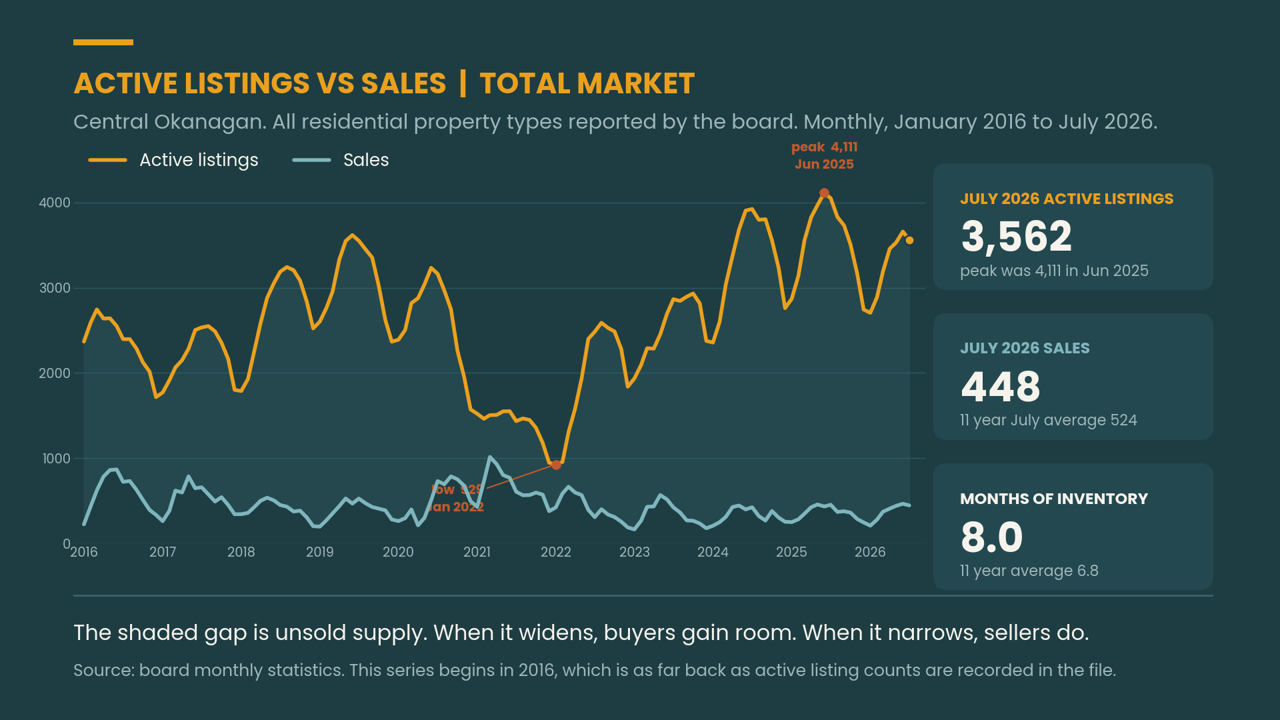
The Central Okanagan real estate market has shifted considerably over the past 18 to 24 months. Based on the 27-year MLS dataset I work from, certain segments of the market, particularly single-family homes in Glenmore, Upper Mission, and Lake Country, have seen price corrections from 2022 peaks, while others have shown more resilience. Understanding where your property sits in that picture is relevant to a renewal decision if a move is on your horizon.
Frequently Asked Questions
When should I start the mortgage renewal process in BC?
Ideally four to six months before your maturity date. Many lenders will allow you to start discussions and even lock in a rate hold 90 to 120 days out. Starting early gives you time to compare offers, explore switching lenders if warranted, and make a decision without urgency pressure.
Can I switch lenders at renewal without a penalty in Kelowna?
Yes. At the maturity date of your mortgage term, there is no prepayment penalty for switching lenders. This is the one moment in your mortgage cycle when you have the most freedom to move. The process involves re-qualifying with the new lender, which requires updated income verification and a credit check.
What is a mortgage rate hold and how long does it last?
A rate hold is a lender's commitment to honour a specific interest rate for a defined period, typically 90 to 120 days. If rates rise before your renewal date, your held rate is protected. If rates fall, most lenders will allow you to take the lower rate at closing. Securing a rate hold early is a low-risk strategy for borrowers approaching renewal.
Should I take a shorter or longer mortgage term at renewal in 2026?
This depends on your view of where rates are headed, your financial flexibility, and your plans for the property. A shorter term preserves flexibility if you think rates will improve or if you may sell. A longer term provides payment certainty if your budget benefits from predictability. Neither is universally better, and the current spread between one-year and five-year rates should factor into the decision.
How does my home's current value affect my mortgage renewal options?
Your home's appraised value determines your loan-to-value ratio, which can affect whether you qualify for certain products and rates. Homeowners with significant equity (generally below 65% LTV) often have access to the most competitive pricing. If your property has appreciated meaningfully since your last renewal, your equity position may open up options that weren't available before.
One Last Thing Before You Sign
Mortgage renewal is one of the few financial decisions where most homeowners have meaningful leverage and don't use it. The lender wants to keep your business. You have the right to negotiate. You have the right to shop. You have the right to restructure.
If you're also weighing whether your current home still fits where your life is headed, that's a conversation I'm well-positioned to have with you. Understanding your property's current market value is part of making a smart renewal decision, and I can help you get a clear picture of where things stand.
Book a home value review at calendly.com/sellingkelownarealestate or call/text 778-946-6454.
Mark Coons, BBA, CE
REALTOR® | eXp Realty Kelowna
Team Lead, Selling Okanagan Group
Relocated to Kelowna in 2018
📞 778-946-6454
📩 [email protected]