How Is the Kelowna Real Estate Market Right Now?
Happy Wednesday!
I get asked this more than any other question.
At the coffee shop. At my kid’s hockey game. At dinner parties. In the grocery store line.
How’s the market?
Simple question. Tough answer.
Because the better question is this:
How is my market?
That is the question that actually matters.
The Kelowna real estate market is not one market. It is a mix of different markets moving in different directions at the same time.
A downtown Kelowna condo is not moving the same way as a single family home in Lower Mission.
A townhouse in Glenmore is not the same market as a luxury home in Lake Country.
A development lot with MF1 zoning is not the same market as a finished resale home.
And an infill multifamily opportunity in Kelowna is not being judged the same way as a regular family home.
So when someone asks, “How’s the market?” the real answer depends on a few things:
Are you buying?
Are you selling?
Are you doing both?
Are you a builder, developer, investor, or homeowner sitting on land with future redevelopment upside?
What are you buying?
What are you selling?
What is your timeline?
What is your backup plan?
Because regardless of the market, there are always opportunities.
Always.
But certain windows are wide open.
Others are closing fast.
A few have already closed.
And some are slowly opening.
The worst answer to “how’s the market?” is a generic one, because the generic answer almost never applies to your exact situation.
So today, I’m breaking down what is actually happening in the Kelowna and Okanagan real estate market by segment.
This will not be a perfect plan for your exact situation, but it should help you see the market more clearly.
And if you want a focused plan for your home, your move, your investment, or your development property, call, text, or email me. Even if it is just something you are thinking about.
The Short Answer: The Market Depends on Your Segment
There is not one Kelowna real estate market.
There are about a dozen.
All doing different things at the same time.
Sales jumped 70% over the winter.
Days on market dropped from 54 to 38.
Buyers showed up.
That part is real.
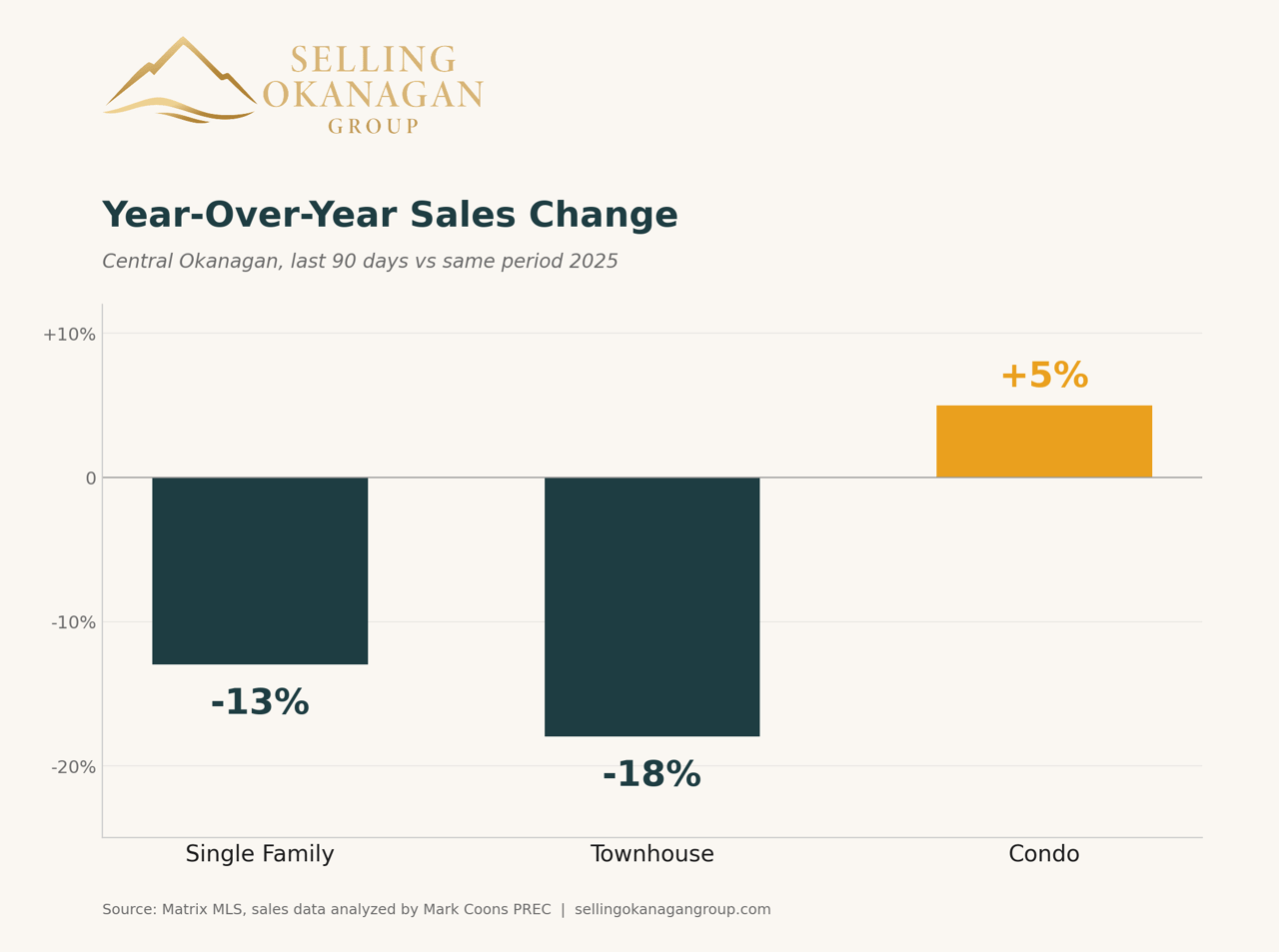
But compared to last spring?
Single family home sales are down 13%.
Townhouse sales are down 18%.
Condo sales are up 5%.
So depending on what you own or what you want to buy, the story changes.
Some buyers have more time.
Some sellers need sharper pricing.
Some condo owners may be seeing signs of life.
Some builders and developers are watching land values, zoning, construction costs, carrying costs, and resale demand very carefully.
That is why your personal situation matters more than the headline.
What Changed in the Kelowna Housing Market?
A few things are happening at once.
Some new buildings are now completed, although many units are still vacant.
Some short-term rental inventory has shifted.
Population movement has changed.
Buyer confidence has changed.
And affordability is still a major issue.
BC lost 41,000 people last year, which was the first population decline since Statistics Canada started tracking the data.
The big driver was non-permanent residents leaving the province. International students, work permit holders, and temporary residents made up a big part of that shift.
Those people were often renters.
Some would have become future first-time buyers.
That bottom-of-the-market pipeline has shrunk in a measurable way.
But it is not all negative news for BC.
Canadians are also moving back into British Columbia.
BC gained over 3,000 people last year from other provinces, with many coming from Ontario.
The number of British Columbians leaving for Alberta also dropped.
After years of people leaving for Calgary and Alberta, that flow has started to shift.
So the buyer mix has changed.
Today’s buyer is different.
Different age.
Different price point.
Different product.
Different confidence level.
The person moving to Kelowna from Toronto may not be 25 years old with a student visa.
They may be 55, selling a property in Ontario, and coming here with equity.
Or they may be a remote worker who wants the Okanagan lifestyle but does not want to put every dollar into real estate.
Buyers are still active.
But many are less bullish than they were a few years ago.
They want value.
They want flexibility.
They want the right property.
And they are not always willing to overpay just because the listing exists.
What This Means for Kelowna Sellers
For sellers in Kelowna, pricing matters more than it has in years.
Here is one of the clearest examples:
The median single family list price today is $1,299,000.
The median single family sold price today is $957,000.
That is a $342,000 gap between what sellers are asking and what buyers are actually paying.
That is the biggest spread I have tracked in four years.
That gap tells us something important.
Buyers are not gone.
But they are selective.
Homes priced inside the real sold range are still moving.
Properties priced properly are selling in about 35 days.
Homes priced too high are helping sell the competition.
So if you are selling a home in Kelowna, West Kelowna, Lake Country, or anywhere in the Central Okanagan, the strategy cannot be, “Let’s just try a high number and see what happens.”
That can work in a rising market.
It is much harder in a selective market.
The better question is:
Where does my home sit compared to what buyers are actually buying right now?
Not what is listed.
Not what your neighbour wants.
Not what someone told you in 2021.
What is actually selling today?
That is the number that matters.
What This Means for Kelowna Buyers
For buyers, this market has opportunity.
But it is not the same opportunity in every segment.
If you are buying a single family home in Kelowna, you may have more room to negotiate than you did during the peak years.
If you are buying a condo, you need to look closely at building quality, strata fees, insurance, rental rules, short-term rental history, and future supply.
If you are buying a townhouse, the right unit in the right location can still move quickly, but the wrong one can sit.
If you are relocating to Kelowna from Vancouver, Calgary, Toronto, Edmonton, or another province, you need to compare lifestyle, commute, school catchments, property type, and long-term resale.
This is where the market can reward patient buyers.
But patience does not mean waiting forever.
It means knowing your numbers before the right property shows up.
The best buyers in this market are not guessing.
They know:
What areas they want.
What property type fits their life.
What monthly payment they are comfortable with.
What homes are actually selling for.
What problems they are willing to accept.
And what issues are deal breakers.
The buyers who win in this market are not always the ones who offer the most.
They are the ones who understand value first.
What This Means for Developers, Builders, and Infill Buyers in Kelowna
This is where the market gets even more interesting.
Kelowna infill development is not the same as regular resale real estate.
If you are a builder, developer, or investor looking at MF1, MF2, core neighbourhood lots, carriage house potential, fourplex sites, townhome assemblies, or small-scale multifamily, the question is not just, “Is this a good house?”
The better questions are:
What can the land become?
What does zoning allow?
What is the buildable square footage?
What are the city costs?
What are the servicing issues?
What are the parking requirements?
What is the resale value of the finished units?
What is the rental value if held long term?
What is the timeline from purchase to permit to completion?
Infill multifamily in Kelowna has opportunity, but the numbers need to be tight.
A property can look cheap as a house and still be expensive as a development site.
Or it can look overpriced as a house but make sense because of zoning, lot size, lane access, location, and future density.
For homeowners sitting on larger lots in Kelowna, especially in areas with MF1 zoning or strong redevelopment potential, the market may see your property differently than a normal buyer does.
A regular buyer may look at the kitchen, roof, flooring, and layout.
A builder may look at the lot width, depth, zoning, setbacks, services, lane access, tree issues, and future unit count.
Same property.
Different buyer.
Different value.
That is why sellers with redevelopment potential need to be very careful before pricing their property like a standard single family home.
And builders need to be careful not to chase every “development opportunity” unless the math actually works.
The Okanagan Is Not One Market Either
If you zoom out beyond Kelowna, the picture changes again.
Across the Okanagan, every area is moving differently.
Penticton has one of the tightest single family markets in the valley, sitting around 5.6 months of inventory.
That is tighter than Kelowna.
Tighter than Vernon.
Homes there are moving in about 37 days.
Vernon is close behind at 6.5 months of inventory.
The North Okanagan single family market is actually outperforming Central Okanagan in some areas right now.
Penticton condos are also strong, sitting around 4.5 months of inventory.
Meanwhile, Osoyoos is sitting around 15 months of inventory, making it one of the slower markets in the valley.
Same valley.
Very different markets.
Now look at price.
Lake Country is around $1.07M.
Oliver is around $635K.
That is a $435K spread for a similar product only about 90 minutes apart.
So if you live in Vernon and you are watching Kelowna numbers to decide if you should list, you may be watching the wrong market.
If you are looking at Penticton because you assume the South Okanagan is cheaper, you need to look closer.
If you own in Osoyoos, your timeline may be very different than someone selling in Oliver, Penticton, Kelowna, or Vernon.
That is why local market data matters.
The Headlines Do Not Tell the Whole Story
Canada’s headline GDP shrank two quarters in a row.
That sounds like a recession.
But when you look deeper, the story changes.
RBC recently pointed out that per-capita GDP is actually recovering.
The country is not simply shrinking in the way the headline makes it sound.
The population numbers are changing.
Less population growth can mean less pressure on housing demand.
That gives some buyers more time.
But it does not mean every market is weak.
It means we need to look below the headline.
Different industries.
Different buyers.
Different locations.
Different housing types.
Different levels of demand.
The headline will tell you one thing.
The sub-data tells you the truth.
Most people stop reading at the headline.
That is why I keep writing these.
So, How Is the Kelowna Real Estate Market?
The honest answer is this:
It depends what lens you are looking through.
For some Kelowna buyers, there is more room to negotiate.
For some Kelowna sellers, the market is still active, but pricing needs to be sharp.
For condo owners, the story is different building by building.
For townhouse buyers, value depends on location, layout, strata, and supply.
For developers and builders, Kelowna infill multifamily still has opportunity, but only when the land, zoning, servicing, build costs, and resale numbers work.
For homeowners with redevelopment potential, your property may have a different buyer pool than you think.
For relocation buyers, the Okanagan still has lifestyle pull, but people are being more careful with their money.
So I challenge you to change the question.
Do not ask:
How’s the market?
Ask:
How’s my market?
That is where the real answer starts.
If you are thinking about buying, selling, investing, building, downsizing, relocating, or exploring the development potential of your Kelowna property, reply to this email or call/text me.
Even one line is enough to start.
Tell me where you are at, what you are thinking, and what your dream move would look like.
Then we can look at your market, not just the headline.
Go ahead. Give it a try.
Ask me:
How’s my market?
Mark & Maddie Coons
Selling Okanagan Group | eXp Realty Kelowna
📞 (O) 778-946-6454 | (C) 250-801-0361
📩 [email protected]