Do Kelowna Homes Really Sell for Less in Fall and Winter?
By Mark Coons | Selling Okanagan Group
Everyone talks about spring being the best time to buy or sell real estate.
More listings. More buyers. More activity.
But what if the quieter months of the year actually offer buyers better value?
I've always been interested in this question because the advice buyers receive often focuses on how much a seller will negotiate off their asking price.
That's useful information, but I've never thought it tells the whole story.
A seller can list a $900,000 home for $1 million, accept $950,000 and give the buyer a $50,000 discount.
Did the buyer get a deal?
Not necessarily. They may have still paid $50,000 more than the property was worth.
So I wanted to look at seasonal pricing from a different angle.
Instead of comparing the sale price with what the seller was asking, I compared what buyers paid with the typical price per square foot in the surrounding neighbourhood.
The results were interesting.
Fall and winter buyers paid approximately 1.2% below their neighbourhood's median price per square foot. Spring buyers paid approximately 0.6% above it.
That's a difference of 1.8 percentage points.
And it's a more useful finding than simply saying sellers negotiate more in winter.
Do homes really sell for less in Kelowna during fall and winter?
Historically, buyers in the Central Okanagan have purchased homes at lower prices relative to their neighbourhood's median price per square foot during fall and winter than during spring.
My research found:
- Fall and winter: Buyers paid approximately 1.2% below the neighbourhood median price per square foot.
- Spring: Buyers paid approximately 0.6% above the neighbourhood median.
- Difference: A 1.8-percentage-point seasonal gap in relative pricing.
- Consistency: The fall and winter comparison was more favourable in 10 of the 11 years examined.
That doesn't mean every home costs 1.8% less in winter.
It doesn't even mean that overall Kelowna home prices necessarily fall by that amount.
What it suggests is that buyers have historically done better relative to the local market during the quieter months.
Here's why that distinction matters.
A discount from asking price isn't the same as good value
Imagine two homes in the same neighbourhood.
One sells in November after the owner reduces the asking price twice.
The other sells in April at almost full asking price.
Which buyer got the better deal?
Most people would point to November.
But without knowing what the homes were worth relative to comparable sales, there's no way to answer that question.
The November home could have been overpriced from the beginning.
The April home might have been priced below market value and sold quickly.
This is why I don't like using the discount from asking price as the only measure of negotiating success.
Asking prices are decisions made by sellers.
Sale prices relative to comparable properties tell us more about what buyers are actually paying.
And that's what I wanted to examine with the seasonal data.
What does the 1.8-percentage-point gap actually measure?
To understand the result, think of the neighbourhood's median price per square foot as a reference point.
If a particular neighbourhood has a median selling price of $500 per square foot, that becomes the benchmark for this example.
A buyer purchasing at 1.2% below that benchmark would pay approximately $494 per square foot.
A buyer purchasing at 0.6% above it would pay approximately $503 per square foot.
Here's how those seasonal results compare.
Measure | Fall and winter | Spring |
|---|---|---|
Neighbourhood benchmark | $500/sq. ft. | $500/sq. ft. |
Difference from benchmark | −1.2% | +0.6% |
Illustrative purchase price | $494/sq. ft. | $503/sq. ft. |
The difference is $9 per square foot, or 1.8% of the $500 benchmark.
On an 1,800-square-foot home, that would represent approximately $16,200.
That's meaningful money.
But there's an important limitation.
This is an illustration of the historical pricing gap, not evidence that waiting until November will save $16,200 on a particular $900,000 home.
The houses sold in different seasons aren't necessarily identical. Their age, condition, views, renovations, lot sizes and other characteristics can vary.
And a median price-per-square-foot comparison doesn't account for all those differences.
What the data tells us is that the relative prices buyers paid tended to be more favourable in fall and winter.
It doesn't guarantee the same outcome on any individual property.
Why might buyers get better relative value in winter?
There are a few plausible explanations.
1. Fewer buyers competing for the same property
Spring typically brings more people into the market.
That can mean more showings, more interest and, for desirable properties, more competition.
By late fall, some buyers have already purchased. Others decide to pause their search until the new year.
With fewer people actively looking, a buyer may have more room to negotiate.
That doesn't apply equally to every home, but it can change the dynamics of a negotiation.
2. Sellers who remain on the market may have different timelines
Some homeowners list in the spring because that's traditionally when they expect the most activity.
By November, a property that's still available may have been exposed to the market for months.
Other sellers may need to coordinate a relocation, possession date or purchase of another home.
That doesn't mean they're desperate or willing to accept any offer.
But understanding their situation may give a buyer an opportunity to negotiate on price, dates or conditions.
3. Spring can create competition for the most desirable homes
I've noticed that one of the challenges buyers face isn't simply finding a home.
It's finding a home they want without competing against several other people who want the same thing.
When more buyers are active, well-priced properties that check the right boxes can attract attention quickly.
A quieter season may improve a buyer's position, even when the overall market isn't changing much.
These are possible explanations for the pattern, not causes proven by the seasonal price study.
Does this mean you should wait until fall to buy?
Not automatically.
This is where historical averages can become misleading if we try to turn them into rules.
Let's say you find a home in April that works for your lifestyle, is priced reasonably and fits your long-term plans.
Should you pass on it because the historical numbers favour November?
I wouldn't make that decision based on the calendar alone.
You have to consider what waiting could cost.
Maybe the right property doesn't come available again.
Maybe mortgage rates change.
Maybe prices in your particular neighbourhood rise.
Or maybe fall brings better negotiating conditions and you find something comparable for less.
We don't know in advance.
The historical seasonal advantage is one factor to consider. It shouldn't replace an evaluation of the home you're actually buying.
A lower price doesn't necessarily mean a better home
There's another issue with comparing homes by price per square foot.
Not all square footage is worth the same amount.
A renovated home with a great layout may reasonably sell for more per square foot than an older home with significant deferred maintenance.
A lake view, usable yard, garage, suite potential or more desirable location can change the comparison.
Even the style of home matters.
A rancher and a two-storey home might offer the same finished square footage but appeal to different buyers.
So while neighbourhood price per square foot helps establish context, it's only the beginning of a valuation.
When I assess whether a buyer is getting good value, I want to look at the recent comparable sales and make adjustments for the differences between the properties.
The seasonal research tells us when buyers have historically had an advantage across the market.
The property-level research tells us whether that advantage exists on the home in front of us.
What about buying in January instead of November?
I wouldn't assume every fall or winter month delivers the same result.
October, November, December and January can have different inventory levels and buyer activity.
And a seasonal average can hide differences between neighbourhoods and property types.
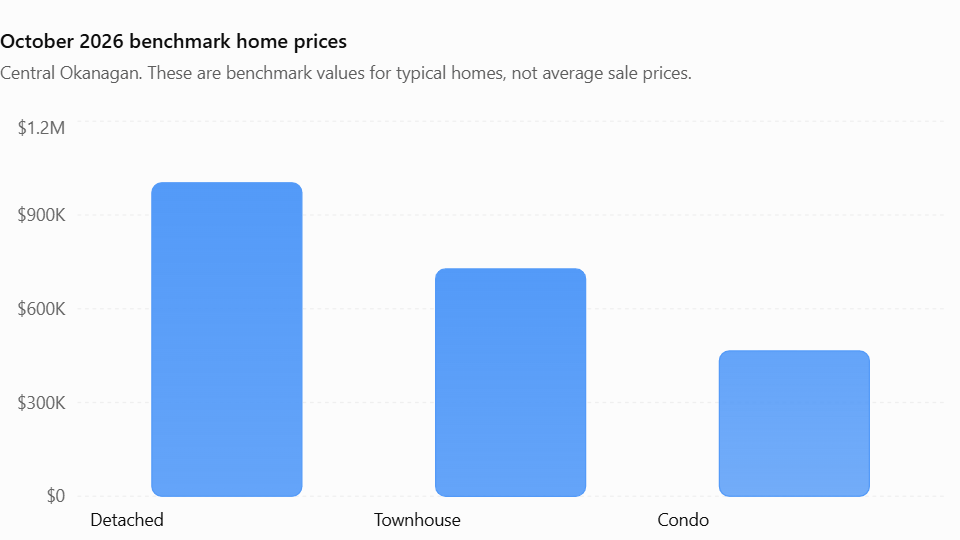
For example, the conditions affecting a downtown Kelowna condo may be very different from those affecting a detached home in Lower Mission or a walkout rancher in Lakeview Heights.
Price range matters too.
A buyer shopping below $700,000 may face a completely different level of competition than someone shopping above $1.5 million.
The 1.8-percentage-point gap is useful evidence about the broader historical pattern.
The next question is whether that pattern is showing up in your price range and preferred neighbourhood today.
That's where current market data becomes more valuable than the seasonal average.
How I'd use this research if I were buying in Kelowna
I would start by identifying the neighbourhoods and types of homes I actually want.
Then I'd compare current listings against the properties that have recently sold.
I'd want to know:
- What have similar homes actually sold for? Not just what they're listed for.
- How long have competing properties been on the market? A home that's been available for 120 days may present a different negotiation than one listed yesterday.
- Have sellers adjusted their prices? Multiple reductions can indicate that the initial asking price wasn't aligned with buyer expectations.
- How much comparable inventory is available? More alternatives can strengthen your negotiating position.
- How does the asking price compare with the neighbourhood benchmark? Is the property genuinely good value once its features and condition are considered?
I'd also look at the original asking price, not just the most recent list price.
But I would never use that number on its own to judge whether you got a good deal.
If the evidence shows a home is priced well today, buying now may make sense.
If the data shows a wide gap between seller expectations and actual sales, waiting or negotiating more firmly may be the better decision.
So, is fall and winter the best time to buy a home in Kelowna?
The historical results give us a reason to take the quieter months seriously.
In 10 of the 11 years studied, fall and winter buyers did better relative to neighbourhood median price per square foot than spring buyers.
That's a consistent pattern worth understanding.
But it doesn't prove every individual buyer would have saved money by waiting, and it doesn't tell us what will happen in the coming year.
The biggest thing I take from this research is that the best buying conditions aren't always found when the most homes are available.
Spring may offer greater selection.
Fall and winter may offer less competition and more favourable relative pricing.
Neither is automatically better.
The right answer depends on whether your priority is selection, negotiating leverage, finding a specific kind of property or securing the right home before your circumstances change.
I'd rather make that decision using the actual market than a rule about which month is best.
Want to know whether today's listings offer good value?
Historical averages are interesting. What's more useful is knowing how the homes you're considering compare with actual sales.
If you're looking in Kelowna, West Kelowna or Lake Country, I can compare current listings with recent comparable sales and the historical seasonal patterns in your preferred neighbourhood.
That way, you're not just looking for a discount off the asking price.
You're evaluating what the property is actually worth.
Email [email protected] with the neighbourhood and price range you're considering, and I'll help you look at the numbers.
Mark Coons
Personal Real Estate Corporation | REALTOR®
Selling Okanagan Group | eXp Realty Kelowna
778-946-6454