BCREA Report: BC Home Sales Still Well Below Historical Averages in February 2026
BCREA's February Numbers Tell a Clear Story
The BC Real Estate Association has released its February 2026 statistics, and the headline from BCREA Chief Economist Brendon Ogmundson is blunt: housing market activity "continues to struggle, with sales declining from every region in the province compared to the same time last year."
Here are the key numbers. In February 2026, 4,516 residential units sold across BC's MLS systems — a drop of 9.7% year-over-year. The average MLS residential price in BC fell 2.9% to $932,243, compared to $960,572 in February 2025. Total sales dollar volume was $4.21 billion, down 12.3% from the same period last year. And perhaps most striking: BC unit sales in February were 32.87% below the ten-year average for the month. That last figure puts the current market in sobering context — we're not just in a slowdown from a hot pandemic market, we're running nearly a third below what this province has historically done in February.
Year-to-date through February, the picture is even more pronounced: residential sales dollar volume is down 17.8% to $7.3 billion, unit sales are off 15.8%, and the average price is down 2.4% to $929,323.
What's Driving the Weakness — and Why It Matters for Kelowna
To understand why BC's market is running so far below historical norms, you have to look at the combination of forces that have been at work since 2022. Interest rates rose dramatically from historic lows, making monthly mortgage payments on BC's expensive housing stock significantly less affordable. Buyer confidence eroded. Many would-be purchasers shifted to a wait-and-see posture, anticipating either lower prices or lower rates before acting.
Meanwhile, new home construction slowed — particularly in markets like Kelowna where development costs have made new projects increasingly unviable — which restrained supply. The result has been a market that's both expensive and illiquid: prices haven't come down dramatically because supply is tight, but transaction volumes have collapsed because buyers can't or won't pay today's prices at today's rates.
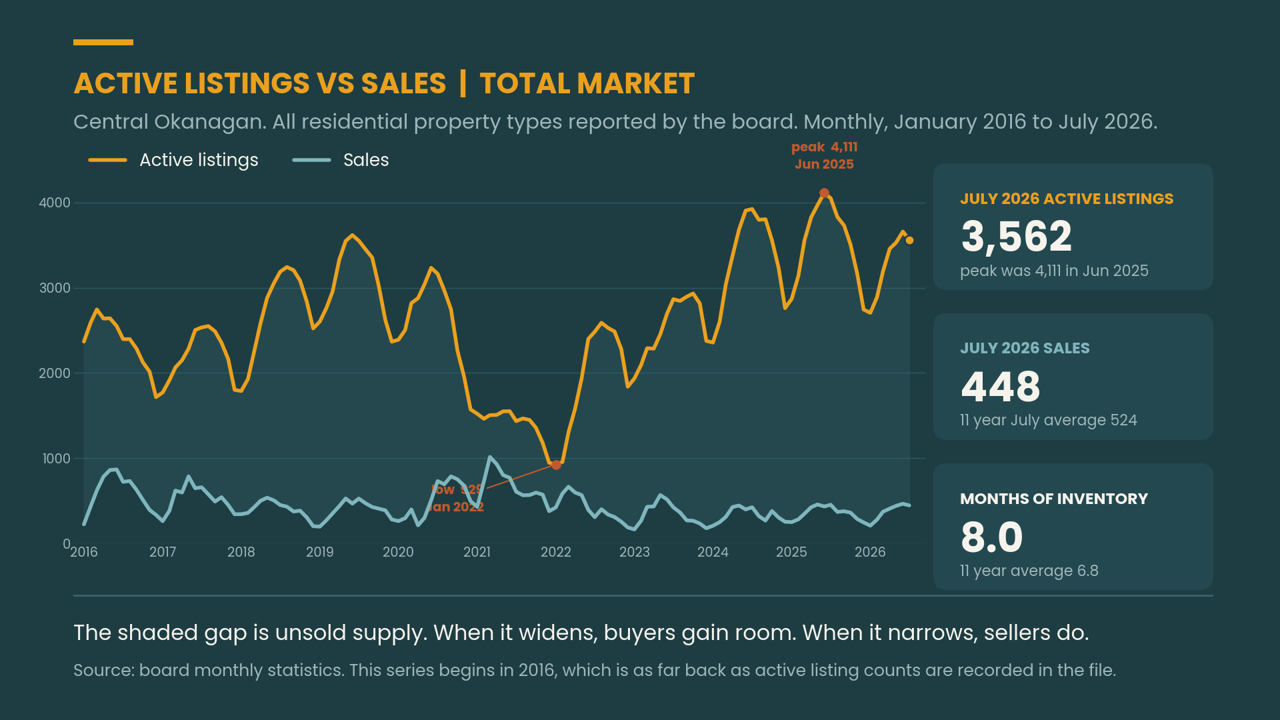
For Kelowna and the Central Okanagan, this provincial backdrop matters because it shapes the financing environment, buyer psychology, and investment appetite that flows into our market. But our region has shown more resilience than many parts of BC — the Association of Interior Realtors data for February showed Central Okanagan sales actually up 1.1% year-over-year, which stands in sharp contrast to the province-wide decline.
The BCREA's Cautious Optimism — and Whether It's Warranted
Despite the weak numbers, BCREA's Ogmundson expressed hope that improved affordability conditions and stable rates will motivate prospective demand to enter the market over the rest of 2026. That's a reasonable, if cautious, outlook — and it's contingent on a few things going right.
First, the Bank of Canada needs to continue providing rate relief. The recent jobs data — including 84,000 positions lost nationally in February — gives the Bank room to cut, and potentially reason to. Each rate cut improves affordability for rate-sensitive buyers and can shift the calculus for people who've been sitting on the sidelines.
Second, seller expectations need to continue adjusting to where the market actually is, not where it was in 2022. BCREA's data showing a 2.9% year-over-year price decline suggests this adjustment is slowly happening, but it's uneven. Markets with realistic sellers are transacting. Markets with aspirational pricing are stagnating.
Third, the construction pipeline needs policy support to prevent a severe supply shortage from emerging in the medium term. BCREA noted that "dampening sentiments concerning new home construction in BC leave the housing market vulnerable to long-term demand growth" — which is precisely the concern that Kelowna's home builders' association has been raising loudly at the local level.
Your Practical Takeaway for the Okanagan Market
The provincial numbers give you the backdrop. What matters most for your real estate decisions is the local picture — and in the Central Okanagan, the story is somewhat more encouraging than the BC-wide data suggests. We have structural demand, a resilient local employment base relative to the national average, and a lifestyle appeal that continues to attract buyers from higher-cost markets. That foundation doesn't disappear because of a tough provincial stat sheet.
If you're trying to time the market perfectly, waiting for the exact bottom, you'll likely miss the window. The buyers who do well in transitions like this one are the ones who are prepared, informed, and ready to move when the right property or the right opportunity presents itself. That preparation starts with a conversation. I work with buyers and sellers across Kelowna, West Kelowna, Lake Country, and Peachland, and I'm happy to walk you through exactly what the current data means for your specific situation.
Have questions about what this means for your home or investment? Contact us:
Mark Coons, BBA, CE
REALTOR® | eXp Realty Kelowna
Team Lead, Selling Okanagan Group
Relocated to Kelowna in 2018
📞 778-946-6454
📩 [email protected]