Why the Average Sale Price Is $128K Higher Than the Median
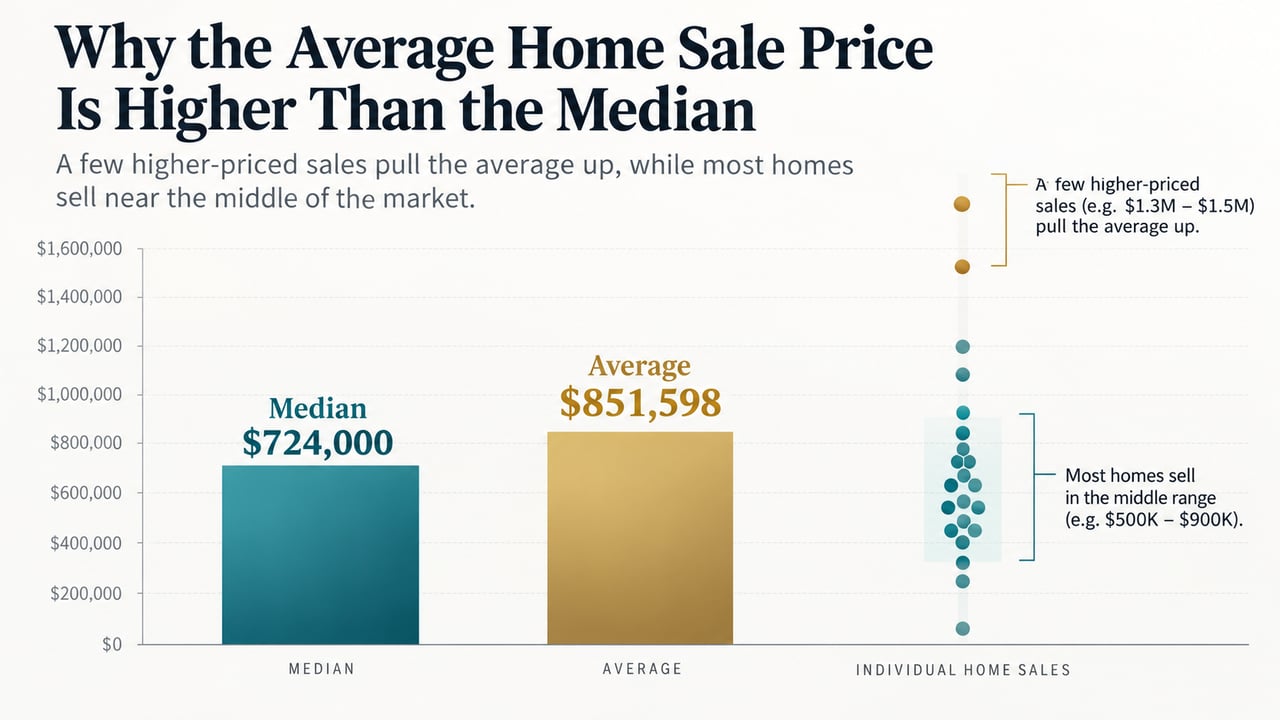
In September 2026, the average residential sale price in the Central Okanagan was $851,598 while the median was $724,000. The average was $127,598 higher, or about 17.6%. That does not mean one number is wrong. Higher-priced sales can pull the average upward while having much less effect on the median.
This is one of the easiest real estate statistics to misunderstand.
September gave us a great example.
Central Okanagan | September 2026 |
|---|---|
Median sale price | $724,000 |
Average sale price | $851,598 |
Difference | $127,598 |
Average above median | 17.6% |
Same month. Same market.
Two prices separated by almost $128,000.
So which one tells you what homes are actually worth?
Neither, by itself.
That is the part I think gets missed when market statistics get reduced to one headline number.
What is the median sale price?
The median is the middle sale.
If every sale in September were lined up from lowest price to highest price, the median would be the price in the middle.
Half of the sales would be below it and half would be above it.
That makes the median less sensitive to a few very expensive transactions.
In September, that middle point was $724,000.
It does not mean most homes sold for exactly $724,000.
It tells us where the middle of the sales distribution landed.
What is the average sale price?
The average is calculated by adding together the prices of every property sold and dividing that total by the number of sales.
That means every transaction influences the number.
And expensive properties can influence it a lot.
Here is a simple example. These are made-up numbers, not September sales:
$500,000
$600,000
$724,000
$800,000
$2,000,000
The median is still $724,000.
But the average is $924,800.
One $2-million transaction did not change the middle sale at all.
It changed the average by a lot.
That is why an average sale price can rise even when the middle of the market is not rising at the same pace.
So why was September's average $127,598 higher?
The gap tells us something important about the sales distribution.
There were enough higher-priced transactions to pull the mathematical average substantially above the middle sale.
But there is an important limit to that conclusion.
The average-versus-median gap alone does not prove that luxury sales increased, that detached homes became more valuable, or that the overall market went up.
To answer that, I would want to break the sales down further.
How many were detached homes?
How many were condos and townhomes?
How many sold above $1 million?
How many were above $1.5 million or $2 million?
Did those shares change from the month or year before?
That is where the real story starts.
The property mix can move the average without home values moving
This is one of the biggest problems with broad real estate averages.
Imagine September has more lake-view homes, acreages or higher-end detached homes selling.
The average price could rise.
Now imagine the next month has more condos and entry-level townhomes selling.
The average could fall.
That does not automatically mean the first group of homes appreciated and then lost value a month later.
The mix of what sold changed.
Central Okanagan real estate includes condos, townhomes, detached homes and properties at very different price points.
Blending them into one average creates a useful market statistic.
It does not create a valuation tool.
Is the median better than the average?
For understanding the middle of a market, I generally prefer the median.
It is harder for a handful of expensive sales to distort it.
But I would not stop there either.
Suppose the Central Okanagan median is $724,000 and you own a detached home in Kelowna worth somewhere around $1.2 million.
The $724,000 median tells you very little about your home.
The same applies if you are shopping for a $450,000 condo.
Your real market is much narrower.
Property type matters.
Price range matters.
Location matters.
Size, age, condition, lot, view, renovations and competition matter.
The overall median is context.
It is not your comparable sale.
This matters when headlines say prices are rising or falling
This is where I think people can get into trouble.
Imagine the average price increases 8%.
It is tempting to say:
Kelowna home prices went up 8%.
Maybe.
But the average alone does not prove that.
There may simply have been more expensive properties included in that month's sales.
The opposite can happen too.
If fewer expensive homes sell one month, the average can drop sharply even though comparable homes have barely changed in value.
Before deciding the market moved, I would want to compare like with like.
Same property type.
Similar price range.
Similar location.
Ideally, look at median prices, price per square foot, repeat sales and actual comparable properties too.
One number should rarely make the decision for you.
What does September's $724,000 median actually tell us?
It gives us a useful centre point.
Half of September's residential sales were below the median and half were above it.
The $851,598 average tells us that the upper end of the sales distribution carried enough dollar value to pull the overall average considerably higher.
Put together, those numbers tell us more than either one separately.
They tell us the market is not evenly distributed around one simple "Kelowna home price."
And that is useful.
Because there really isn't one price that represents every Central Okanagan home.
What should buyers look at?
If you are buying, I would use the broad average and median for context only.
Then narrow the data quickly.
If you are looking for an $850,000 detached home, look at recent sales of comparable detached homes around that price.
Look at competing inventory.
Look at how long those homes take to sell.
Look at price reductions and what sellers ultimately accept.
That information is much more useful than knowing the entire Central Okanagan average is $851,598.
What should sellers look at?
The same principle applies.
Your home is not worth more because the average went up.
It is also not automatically worth less because the average fell.
The more useful question is:
What are buyers paying for homes like yours?
If comparable homes are selling quickly and close to asking price, that matters.
If similar homes are sitting for 100 days and reducing their prices, that matters too.
A market average cannot replace that analysis.
The number I would use
If someone forced me to choose between only the average and median to describe the broad Central Okanagan market, I would usually start with the median.
But the better answer is to stop looking for one magic number.
September's $851,598 average and $724,000 median are both correct.
The $127,598 gap is not a mistake.
It is information.
It is telling us to look deeper at what actually sold before deciding what happened to home values.
That is the useful part.
Natural Questions
What is the difference between average and median home price?
Average price adds up every sale and divides the total by the number of sales. Median price identifies the middle sale when all transactions are ranked from lowest to highest.
Why is the average usually higher than the median in real estate?
Higher-priced properties can pull the average upward substantially. They have much less influence on the median because the median only measures the middle point of the sales distribution.
Is median price the same as my home's market value?
No. Median price describes a group of sales. Your home's market value depends on comparable properties, location, size, condition, features, current competition and buyer demand.
Does a rising average price mean home values are rising?
Not necessarily. The average can increase because more expensive properties sold during that period. Comparable or repeat-sale analysis is needed before concluding property values actually increased.
The September 2026 figures used in this article are Central Okanagan residential market statistics supplied by Mark Coons: an average sale price of $851,598 and median sale price of $724,000.
The difference is $127,598, meaning the average was approximately 17.6% higher than the median.
This article does not attempt to identify exactly which September transactions created that difference because the full transaction-level September dataset was not supplied for this analysis. The gap is evidence that the distribution of sale prices is skewed upward, but further segmentation by property type and price range would be required to establish exactly why.
If you want to see the current numbers instead of relying on one headline price, I keep the Okanagan Market Dashboard updated here: https://okanaganmarket.netlify.app/
Mark Coons Personal Real Estate Corporation
Mark Coons, BBA, CE
REALTOR® | eXp Realty Kelowna
Team Lead, Selling Okanagan Group
Relocated to Kelowna in 2018
778-946-6454
[email protected]
Links to other related articles::